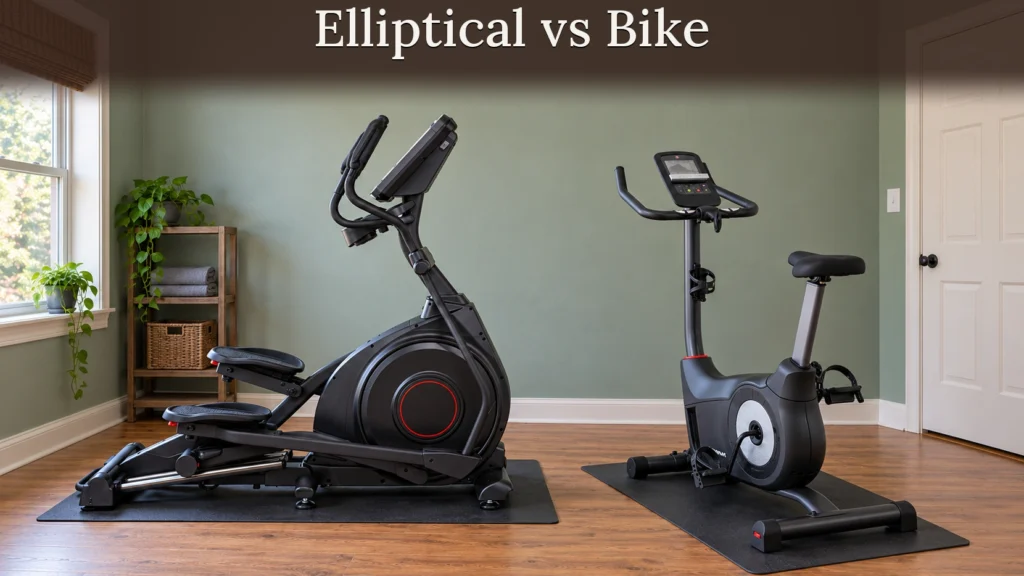
Elliptical vs Exercise Bike: Movement, Effort, and Home Fit

Founder
I founded HomieGym to help you make informed decisions about training at home. My background includes university-level sports science education, practical coaching, gym training and combat sports.
The elliptical vs exercise bike choice starts with how you want to move: a standing, guided stride or seated pedaling. I favor the bike when sitting support makes the intended session more manageable, and the elliptical when you prefer standing cardio and can coordinate its pedals and handles comfortably.
Neither category wins for every body or goal. Compare the movement, support, effort, and home setup you would use regularly. A harder-looking machine or a larger calorie display is a weak reason to choose an activity you struggle to repeat.
Table of Contents
Elliptical vs Exercise Bike: Compare the Movement First
A standing elliptical guides your feet through a continuous pedal path. A conventional exercise bike lets you pedal in circles from a seat. That difference changes your position, support, and the coordination the session requires.
This comparison concerns full-size standing ellipticals and stationary bikes. An outdoor elliptical bicycle, a seated under-desk device, and a hybrid machine that converts between modes are different designs. On a bike with moving arm handles, upper-body involvement also differs from the conventional fixed-handlebar cycling discussed here.
| Your decision | Standing elliptical | Conventional exercise bike |
|---|---|---|
| Body support | Stand on guided pedals | Sit on a saddle or seat |
| Foot movement | Machine-specific elliptical path | Circular pedal stroke |
| Arm task | Push/pull linked handles if fitted | Usually support on fixed bars |
| Fit checks | Stride, pedal spacing, handle reach | Seat position, pedal reach, handle reach |
| Home checks | Pedal/handle travel and headroom | Access, adjustments, intended riding position |
A laboratory comparison of elliptical exercise, stationary cycling, and walking found distinct joint-motion patterns. Elliptical motion was closer to walking than cycling was, while still differing from walking. A familiar-looking leg movement does not make these activities interchangeable practice (1).
If cycling itself is the goal, choose a bike that supports your intended riding position. If you want an indoor break from running landings without sitting for the session, an elliptical may suit that preference. For walking or running practice, the elliptical and treadmill comparison addresses the more direct alternative.
Choose the Support and Fit You Need
Seated support can change whether a session feels manageable. It does not guarantee that every bike will suit you. Saddle pressure, pedal reach, the height you must step over, and how far you lean toward the bars still need checking.

An upright bike generally places the saddle above the pedals. A recumbent bike adds a supported seat with pedals farther forward, although the exact layout varies. I would compare getting into position and completing comfortable pedal revolutions before judging either by its screen or programs.
The recumbent and upright comparison explains that choice in more detail. Here, the useful distinction is whether a seated position helps you sustain the cardio you want.
On an elliptical, check whether the guided stride suits your legs at an easy effort. You should be able to use the intended handholds without reaching excessively, folding over the console, or being pulled into an awkward rhythm. A guided pedal path offers less freedom to change your step than ordinary walking.
Handholds and pedals can move together. Learn the machine's mounting and stopping procedure before a trial, and follow its manual. If getting on or off is difficult, assess that problem before deciding that a comfortable middle portion of the session makes the machine suitable.
Low Impact Still Involves Joint Load
Both activities avoid the repeated foot landings of running, but your knees and hips still move against load. The low-impact label alone cannot tell you which movement will feel better or suit an existing condition.
In a 2024 laboratory study, 12 healthy men used a stationary bike and elliptical at two cadences. The tested elliptical produced higher knee torque, and faster pedaling increased peak torque on both devices. These were acute mechanical measurements, not a study of pain, injury rates, or arthritis treatment (2).
I would use that finding to question a blanket claim that an elliptical is automatically gentler on the knees. It does not establish that bikes are universally safe or ellipticals harmful. The exact machine, adjustments, effort, and your response remain part of the decision.
If an easy trial causes pain that persists, worsens, or changes your movement, stop and seek appropriate guidance. Do not keep raising the seat, shortening the stride, or changing resistance indefinitely to force an activity that remains uncomfortable. Someone managing an injury or medical condition needs an individual answer.
Compare Where You Feel the Effort
An elliptical with moving handles lets you add active pushing and pulling while the legs pedal. On a conventional bike, the legs drive the movement while the hands usually provide support. The handles have to be used actively for the arms to contribute that work.
Mier and Feito found higher oxygen consumption and perceived effort during combined arm-and-leg elliptical exercise than leg-only exercise at the tested settings. Resistance and stride rate also changed the demand. That acute result supports paying attention to how you use the machine; it does not establish a complete upper-body strength program (3).
Notice what limits a manageable trial. If your legs tire quickly on a bike, try an appropriate adjustment or a less demanding setting before deciding that cycling cannot provide enough cardio. If the elliptical's arm rhythm takes your attention away from controlling the pedals, start with the permitted fixed handholds while learning.
Calories and Weight Loss Need a Fair Comparison
Neither machine burns more calories in every possible session. A short easy ride and a hard elliptical effort are different tasks. Duration and actual effort need to be part of the comparison.
A 2024 study compared seven cardio machines in 30 experienced, recreationally active men. During 12-minute bouts at very hard and maximal effort, the reported mean energy estimates were higher for the tested elliptical than for the tested bikes. The paper did not clearly establish a difference from the spin bike at the very hard effort. These results describe those demanding laboratory conditions, not a prediction for a beginner's steady ride or long-term weight change (4).
I would not choose between a bike and elliptical by multiplying a short laboratory rate into a workout you cannot complete. Compare your expected session, including any breaks. Keeping a moderate ride in the week can be more useful than repeatedly postponing a demanding elliptical session.
Console totals also rely on estimation. Mier and Feito's elliptical study found overestimation on the tested machine, with substantial variation between participants. That does not provide a correction percentage for your equipment or make a bike display automatically accurate.
For a weight goal, consider what the session adds alongside eating habits and other activity. The elliptical weight-loss guide explains calorie estimates and realistic expectations. There is no need to abandon an enjoyable cycling habit solely because another machine involves your arms.
Check the Session and the Space at Home
Measure the area the machine uses while you exercise, including getting on, getting off, and moving parts. The dimensions of the base alone do not settle whether the equipment fits.
- Elliptical: allow for the full pedal and handle travel, access, and your head height on the raised pedals.
- Bike: check the mounting route, seat and handlebar adjustment range, and space for the posture you intend to use.
- Either machine: confirm the manual's clearance requirements and the delivery route before relying on a floor outline.
A compact bike may be easier to position than a long elliptical, but compare actual models. A folding frame still needs operating space, and moving a heavy machine after every session can become an obstacle. Noise also depends on the resistance system, maintenance, pace, and building; neither category is universally quiet.
Then consider how the exercise fits your day. Seated cycling can suit someone who wants a supported indoor session. Standing elliptical work can suit someone who wants to spend less of the workout sitting. Both still need enough effort to provide the intended training. A moving pedal is not automatically moderate activity.
WHO guidance treats aerobic activity as a weekly total across suitable activities: 150 to 300 moderate minutes, or 75 to 150 vigorous minutes or an equivalent mix, plus strength work on at least two days. These are general health recommendations; they do not require you to use one machine exclusively (5).
Use a Normal Trial to Make the Choice
Try the movement at an easy, controlled effort before testing a demanding program. I would then compare a manageable steady block on each machine, long enough to notice support, reach, and the effort you can maintain. A few fast pedal strokes tell you little about the session you intend to repeat.
- Learn the controls, stopping procedure, and model-specific adjustments.
- Notice whether breathing, local leg fatigue, grip, or discomfort ends the trial first.
- Check whether the machine fits your home and leaves you willing to return for the next planned session.
Choose the bike when seated pedaling fits that session better. Choose the elliptical when standing gliding feels comfortable and its coordination adds something you enjoy. If neither trial works, keep looking at other activities rather than buying a machine on the assumption that you will learn to tolerate it.
FAQs
Is a bike or an elliptical better for beginners?
A bike can be a useful starting choice when seated support makes exercise easier to manage, while an elliptical can suit a beginner comfortable with standing and the guided stride. Start with the movement you can control at an easy effort.
Can elliptical exercise replace cycling training?
Elliptical exercise can add cardio, but it does not reproduce seated cycling position or pedal mechanics. Keep appropriate cycling practice when cycling performance is the goal.
Does the elliptical replace strength training?
No, moving elliptical handles do not make the machine a complete strength program. Include separate resistance exercises that you can progress for your strength goals.
Can you use both during the week?
Yes, cycling and elliptical exercise can both contribute to your weekly aerobic activity. Account for the combined effort and recovery rather than making every session demanding.
This content is for informational and educational purposes only. It is not a substitute for professional medical advice, diagnosis, or treatment. Consult your healthcare provider before starting a new fitness program if you have a health condition, symptoms, or concerns about exercise or balance.
References
- Damiano DL, Norman T, Stanley CJ, Park HS. Comparison of elliptical training, stationary cycling, treadmill walking and overground walking. Gait Posture. 2011;34(2):260-264. doi:10.1016/j.gaitpost.2011.05.010
- He MY, Lo HP, Chen WH. Effects of stationary bikes and elliptical machines on knee joint kinematics during exercise. Medicina (Kaunas). 2024;60(3):498. doi:10.3390/medicina60030498
- Mier CM, Feito Y. Metabolic cost of stride rate, resistance, and combined use of arms and legs on the elliptical trainer. Res Q Exerc Sport. 2006;77(4):507-513. doi:10.1080/02701367.2006.10599385
- Prieto-Gonzalez P, Yagin FH. Energy expenditure, oxygen consumption, and heart rate while exercising on seven different indoor cardio machines at maximum and self-selected submaximal intensity. Front Sports Act Living. 2024;6:1313886. doi:10.3389/fspor.2024.1313886
- Bull FC, Al-Ansari SS, Biddle S, et al. World Health Organization 2020 guidelines on physical activity and sedentary behaviour. Br J Sports Med. 2020;54(24):1451-1462. doi:10.1136/bjsports-2020-102955