
How to Use a Stepper Machine: Setup, Posture, and Common Mistakes

Founder
I founded HomieGym to help you make informed decisions about training at home. My background includes university-level sports science education, practical coaching, gym training and combat sports.
Equipment editor on our team: Milutin Tucakov
Learn how to set up a mini stepper, use its height adjustment, position your feet, step with support, and finish comfortably. Rotating stair machines need their own controls.
Knowing how to use a stepper machine helps you settle into smooth, controlled steps without fighting the pedals or your balance. Set the machine on a stable surface, adjust it before getting on, and begin slowly with a built-in handle or a stable support allowed by the manual.
I want a beginner to feel comfortable starting and stopping before adding faster steps or resistance-band exercises. A steady movement you can control gives you a better starting point than trying to copy a difficult class on your first attempt.
Table of Contents
How to Use a Stepper Machine Step by Step
For a mini stepper with linked pedals, prepare the machine, step onto the lowered pedal first, and alternate gentle downward pressure, provided its manual gives this entry method. Here, pressing one pedal raises the other. Rotating stair machines use a different start and stop procedure.
- Check the equipment. Finish assembly, check the user-weight limit, and clear the surrounding floor.
- Set the stepping height. Make permitted adjustments while off the pedals.
- Arrange your support. Keep the handle or other approved stable support within reach.
- Get on one foot at a time. Lower one pedal, place your weight on it, then place the other foot on the raised pedal.
- Alternate the pressure. Press the higher pedal down while easing pressure on the other.
- Find an easy rhythm. Control the stroke without bouncing or leaning excessively.
- Finish deliberately. Slow down, stop, and use support while stepping onto the clear floor.
Sunny Health & Fitness's getting-started guide describes the lowered-pedal mounting sequence and alternating pressure. Check your own instructions if the pedals move independently or the machine has a different entry method.
Set Up the Stepper and Understand Its Adjustment
The base should stay level and secure as you shift your weight. Put it on the surface specified by the manual, with room to get on, step off, and use any attached bands without catching nearby furniture.
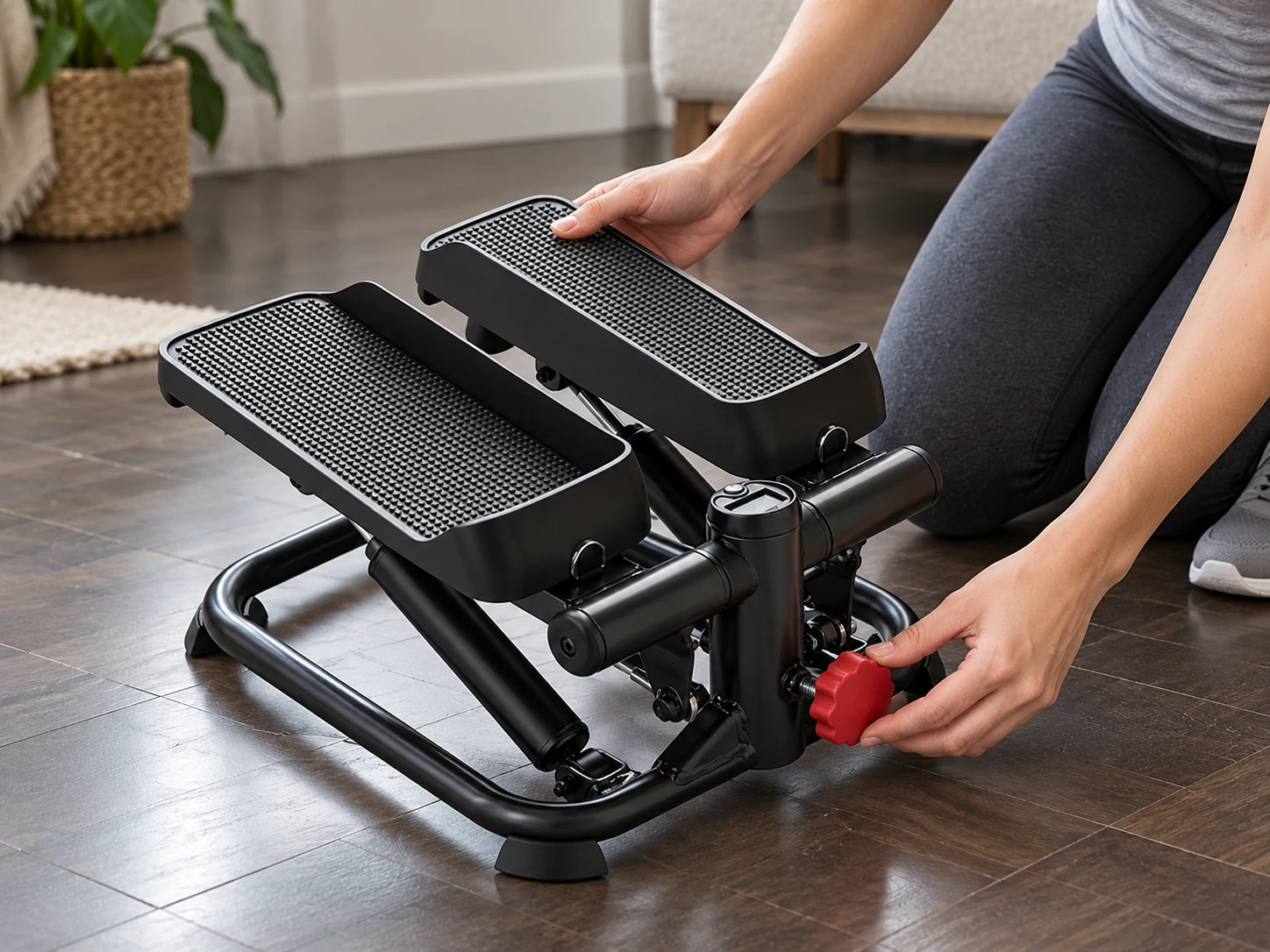
The Sunny SF-S0978 manual, for example, calls for a solid, flat, level surface, a protective floor covering, and at least 2 feet (60 cm) of clear space around the machine. That is a model-specific requirement, so use the clearance supplied with your own stepper.
Before mounting, check that the pedals, fasteners, cable, and any bands are correctly fitted and undamaged. If the base rocks, correct the setup before using it.
On the SF-S0978, the front knob changes pedal stepping height. The instructions say to lift one pedal by hand before turning the knob, clockwise for more height and counterclockwise for less. Make that adjustment while off the machine, keeping your fingers clear of moving parts.
A height knob changes the available pedal travel. It should not be described as a numbered resistance selector unless the model's documentation says it provides that function. Sunny's separate cable-installation guide also identifies this control as a step-height adjustment.
I would begin with a permitted setting that lets you move smoothly. If each stroke requires an awkward body shift, get off and reconsider the setting.
Place Your Feet Securely on the Pedals
Start with your shoes securely supported within each pedal's usable surface, following the model's foot-placement instructions. You do not need to begin by balancing on your toes or deliberately hanging part of your foot off a pedal.
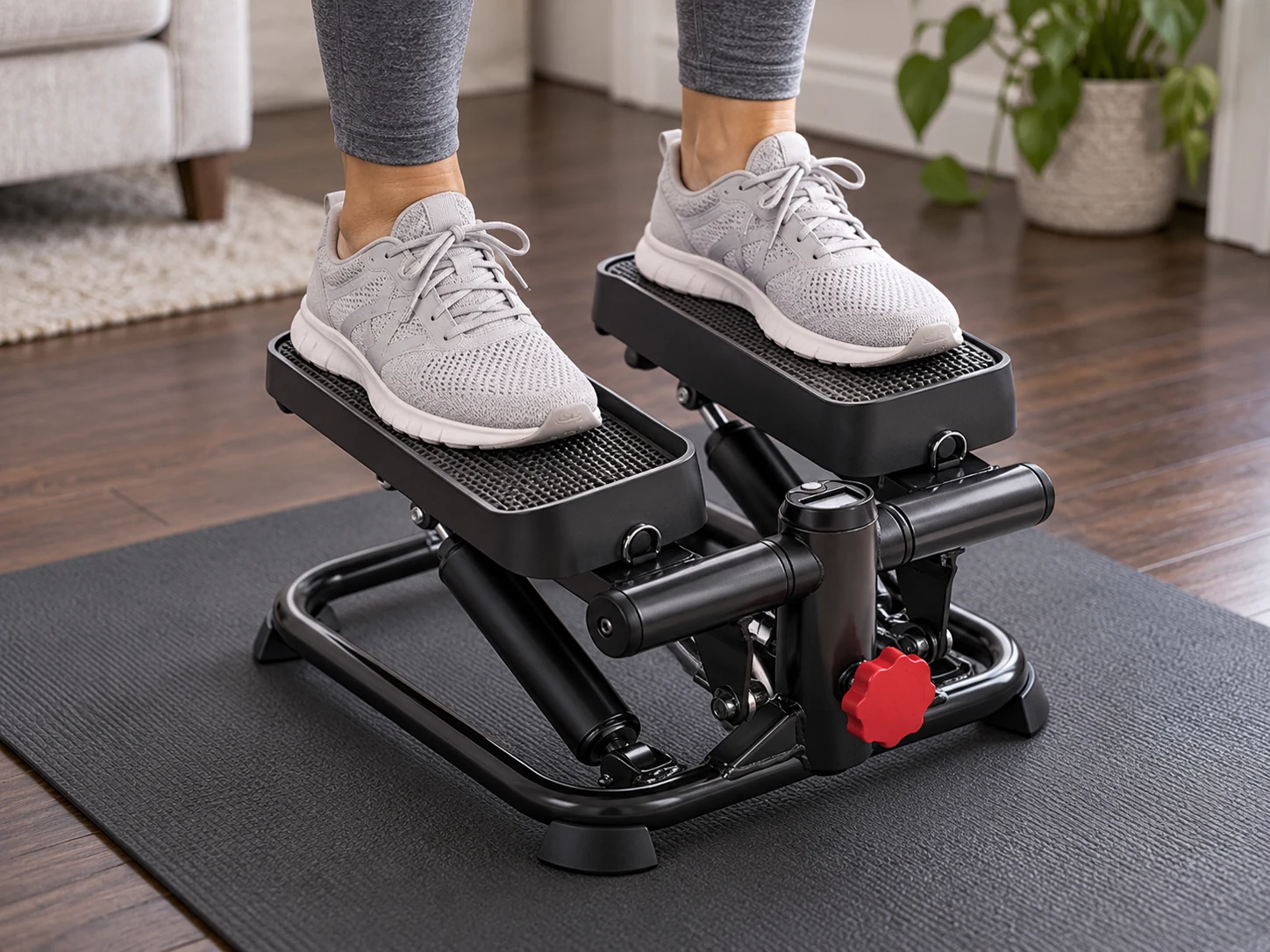
Wear suitable athletic shoes and secure the laces. The Domyos MS100 user guide specifies sports shoes and clothing that cannot catch in the moving parts. Bare feet and loose slippers are poor choices for learning the movement.
Keep your feet in their intended positions as the pedals alternate. If one shoe starts sliding or turning on the surface, stop and reposition instead of trying to shuffle it back while continuing to step.
The cue to keep your feet flat needs some care. Flat against a pedal and flat against the floor are different positions when the pedal tilts. Let the ankle follow the machine's intended movement without forcing your heel into an uncomfortable angle. A little heel movement does not automatically mean your technique is wrong.
I favor secure footing over exaggerating heel or forefoot pressure to target a muscle. Use specialized foot positions only when your model's guidance permits them and you can maintain control.
Keep Your Posture Comfortable and Use Support
Keep your trunk comfortably controlled above the pedals, with relaxed shoulders, your head comfortably upright, and support within reach. Avoid hunching over the display or forcing a rigid, exaggerated pose.
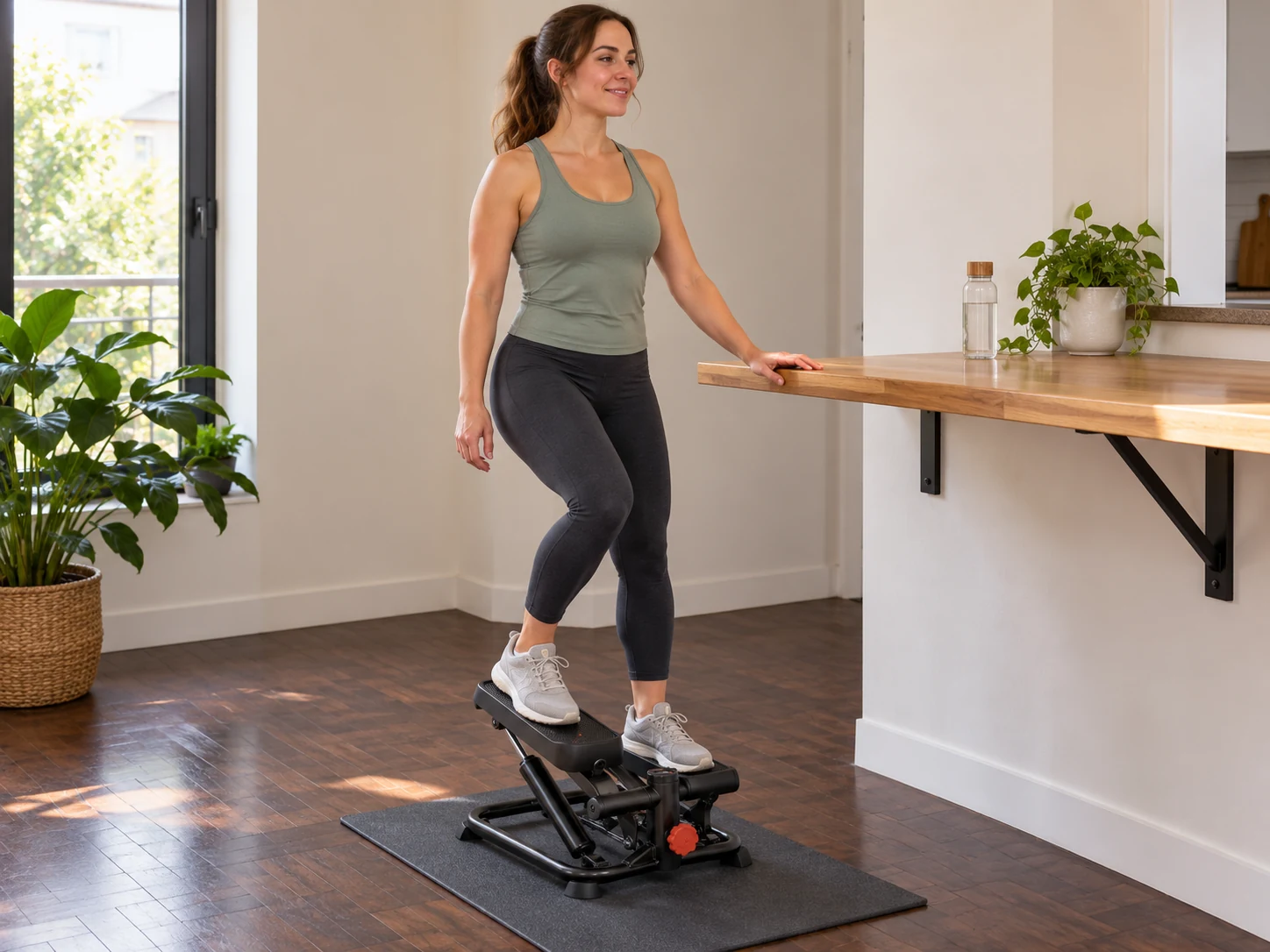
Sunny's form guide recommends lengthening the spine and keeping the shoulders down. A slight shift through the hips can be part of the movement, but that does not justify a deep crouch or a large forward lean on every stepper. Your model's instructions take priority over a pose copied from a different machine.
Keep using permitted support when you need it. The SF-S0978 manual advises holding something for support if balancing is difficult. Choose something stable that will not roll, tip, or slide when you hold it, and arrange it without obstructing your way off.
Keep breathing normally. If maintaining your position starts taking more attention than controlling the pedals, slow down or finish the attempt.
Correct Common Stepper Mistakes
The most useful correction is usually to reduce the demand and recover control. Use the table to identify what changed before adding speed or more complicated movements.
| What happens | What to change |
|---|---|
| Pedals crash into the base | Slow down and switch pressure to the other foot sooner, without forcing the pedal into the base |
| You sway to finish each step | Stop, then check support and the height setting |
| Shoes slide or twist | Stop and check footing and the pedal surfaces |
| You stare down and hunch | Slow down and restore a comfortable head and trunk position |
| Bands make balance difficult | Leave them aside and return to supported stepping |
| You reach for the knob while stepping | Get off before making the adjustment |
Domyos tells MS100 users to reverse the movement before the pedals hit the base. Its support guidance also explains that pedal resistance depends on speed and can change as the piston oil warms. A change in feel is a reason to check the model's guidance, rather than automatically tightening the knob or forcing a harder stroke.
If the machine develops an unusual noise, visible damage, or a suspected leak, stop and use the manufacturer's troubleshooting advice. Do not keep exercising to see whether the problem disappears.
Stop, Step Off, and Check Your First Practice
Finish with enough control to step off deliberately. On a hydraulic mini stepper, ease the pace, stop alternating the pedals, hold your permitted support, and follow the model's exit instructions one foot at a time.
For your first practice, get on, try a few comfortable cycles, and get off again. I would repeat that sequence if the transitions feel uncertain. There is no required minute target for learning those actions.
Follow any use and cooling limits in your manual. The SF-S0978 warns that its hydraulic cylinders can become excessively hot after prolonged use and says to let them cool between uses. Keep hands away from hot cylinders when moving or adjusting the machine afterward.
Stop for pain, dizziness, or other unusual symptoms, and get appropriate medical advice before continuing when needed. If you cannot keep the movement comfortable or mount and dismount securely, seek help with the setup or choose another way to exercise.
Using a Rotating Stair Machine at the Gym
A rotating stair machine needs a console-controlled start and stop, plus its own mounting method. Ask staff to show you the stop controls and permitted entry and exit sequence before your first use.
The Life Fitness PowerMill instructions, for example, direct users to grasp the handlebars and use the step assists to mount. To dismount, users stop the unit, hold the handlebars, and use those assists to back off. Do not transfer the mini stepper's lowered-pedal sequence to moving stairs.
Likewise, a twist or side-to-side stepper follows its designed pedal path. Follow its instructions without adding an extra twisting action through your body. A brand or model name alone does not establish that its controls match the machine you already know.
FAQs
How should a beginner start using a stepper?
Begin with a stable setup, permitted support, and a slow stepping rhythm you can control. Practice getting on and off before adding faster steps, bands, or a longer session.
Should you step on your toes on a mini stepper?
Use the model's normal supported foot position first, rather than deliberately balancing on your toes. Follow the pedal's movement comfortably, and reserve any special calf-focused variation for guidance that applies to your exact machine.
Does the knob increase resistance?
The knob on many hydraulic mini steppers changes step height, while a true selectable-resistance control must be identified in the model's instructions. On the Sunny SF-S0978, the documented knob adjustment changes pedal stepping height.
Can you hold on while using a stepper?
Yes, use the built-in handles or stable support permitted by your machine's instructions when you need help balancing. Keep your way on and off clear, and avoid adding bands if they occupy a hand you need for support.
Can you use a regular stepper sideways?
Use a regular stepper in its intended orientation unless its instructions explicitly allow another position. A machine designed for a twisting or side-to-side pedal path is different from turning your body sideways on an ordinary mini stepper.
This content is for informational and educational purposes only. It is not a substitute for professional medical advice, diagnosis, or treatment. Consult your healthcare provider before starting a new fitness program if you have a condition or symptoms that affect exercise.