Mini Exercise Bike: Uses, Limits and What to Check

Founder
I founded HomieGym to help you make informed decisions about training at home. My background includes university-level sports science education, practical coaching, gym training and combat sports.
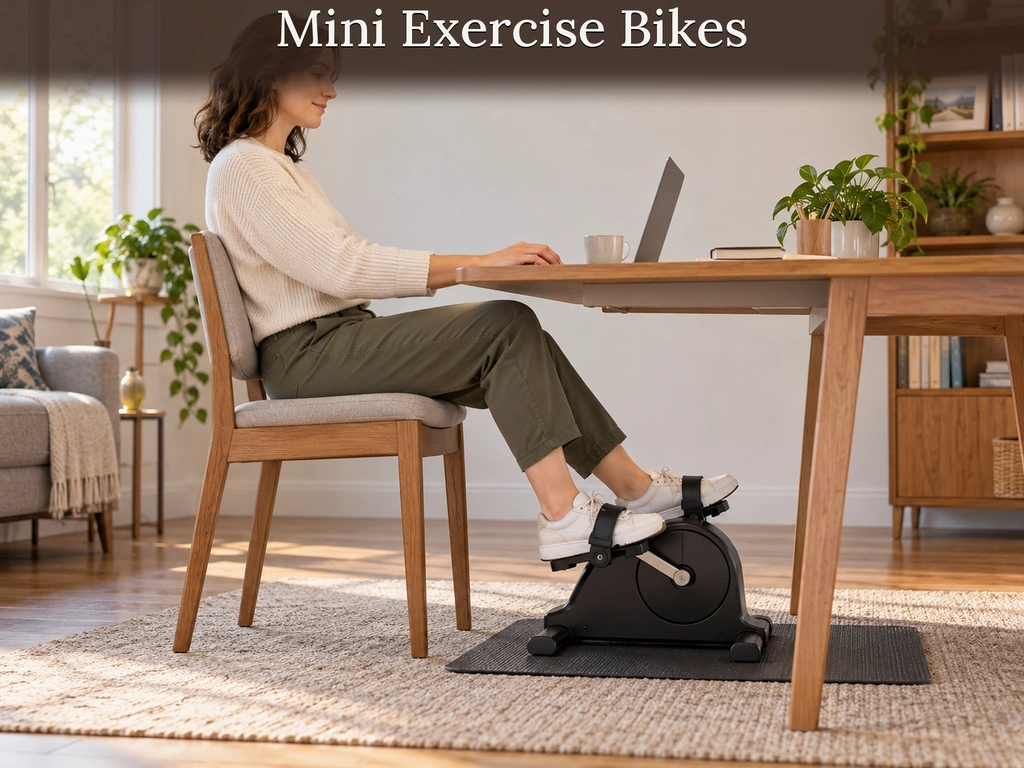
A mini exercise bike can give your legs something to do while you read, watch television or work at a desk. You pedal from your own chair, so there is no full bike frame or saddle to find space for. Its appeal is adding movement to seated time, provided the chair and pedal position work together comfortably.
I would choose an active model for that everyday role before comparing displays or programs. This guide explains how active pedaling differs from motor-driven movement, what to check under your desk, and when a full exercise bike is a better match for the riding you want. Under-desk ellipticals follow the same split: the Sunny Health & Fitness under-desk elliptical uses manual magnetic pedals, while the YOSUDA YSD-ME adds a motor-driven mode.
Table of Contents
What a Mini Exercise Bike Can Do
A mini exercise bike gives you a way to pedal without installing a full bike frame and saddle. Your existing chair supplies the seat and support. That makes the chair part of the setup, rather than an unrelated piece of furniture.
An active stationary bike pedal exerciser can add movement while you read, watch television, or do a suitable desk task. You supply the effort and choose a manageable resistance. Its useful role depends on whether you can keep a comfortable position and still do the other task. More demanding pedaling may be easier to separate from work.
I would choose this format for someone whose main problem is finding a practical way to move the legs during seated time. If the goal is dedicated cycling sessions with a fitted saddle, substantial resistance changes, or standing work, compare a full bike designed for those sessions. Small size alone does not establish that the two formats provide the same training.
For dedicated rides, the stationary-bike design guide compares complete upright, recumbent, indoor-cycling, and air-bike formats.
Some mini devices also allow hand pedaling on a stable tabletop. For example, the Sunny SF-B0891 is documented for feet or hands. Use that option only when your exact model permits it, with the support and positioning its instructions require. A device suitable on the floor is not automatically suitable on a narrow desk edge. The Pooboo folding exercise bike avoids that setup altogether, with a hand crank built into its own frame.
Active Pedaling and Motorized Movement
Active pedaling means you turn the pedals; motorized movement means a motor can drive them. A powered display or Bluetooth connection does not tell you which function the device uses. Look for the actual resistance and drive description.
| Function | User-Driven Device | Motorized Device |
|---|---|---|
| Pedal movement | User supplies the turn | Motor can drive the turn |
| Main control | Resistance and your pace | Motor speed/program, depending on model |
| Useful question | Can I pedal comfortably against this load? | Can I control and tolerate the assisted motion? |
| Evidence needed | Active-pedaling outcomes | Evidence for the actual assisted use |
The SF-B0891 is manually powered and has a resistance dial. In contrast, the Sunny SF-B024041 motorized manual describes 18 selected speed levels, direction controls, and programs. Speed levels and resistance levels are different measures. Eighteen motor speeds do not establish a harder workout than eight resistance settings.
Read manual mode carefully. On that motorized example, it means selecting the motor's speed and direction yourself rather than using a preset program. The label does not establish that the machine becomes an unpowered resistance bike. If active use is important, ask the manufacturer exactly which unpowered or resisted modes are permitted.
A motor turning the pedals can create movement without the same voluntary workload as active pedaling. Do not apply active-cycling calorie, fitness, or weight-loss results to that situation. If the purchase is for rehabilitation, impaired movement, or assistance after an injury, get the appropriate clinical advice and exact-device instructions. Both of these Sunny manuals explicitly state that the equipment is not suitable for therapeutic use.
What Desk-Pedaling Research Supports
Light active pedaling can fit around some short desk tasks. The studies below examined voluntary pedaling at controlled workloads and durations.
In a laboratory experiment with 96 physically inactive adults, participants completed typing, reading, reasoning, and phone tasks while pedaling at 17 or 25 watts and while seated without pedaling. Performance was statistically equivalent across those conditions, and the lower pedaling workload was more comfortable(1). This supports the possibility of combining light pedaling with certain desk tasks.
Those tasks lasted five minutes each in a controlled laboratory. The study also stabilized the equipment and chair, and the sample had limited racial and educational diversity. It does not establish better productivity throughout a workday or tell you what resistance number to select on your device. I would use it as a reason to try a short, comfortable task, then judge whether the actual setup works.
A separate 12-week trial compared active DeskCycle use with ordinary desk work in healthy, sedentary administrative workers. Forty women entered and 32 completed it; eligibility required a body mass index (BMI) of 25 or less and no cardiovascular or metabolic disorders. The pedaling group used the lowest resistance for about an hour per weekday, and participants were asked to maintain their usual diet and activity(2).
Some LDL-related blood measurements changed differently between groups, while several other lipid measures did not show consistent effects. This small trial does not establish heart-disease prevention or results from occasional pedaling on any mini device. Some findings weakened after further adjustment.
For your routine, distinguish light movement from moderate aerobic exercise. CDC guidance recommends at least 150 moderate minutes or 75 vigorous minutes per week, or an equivalent mix, plus muscle-strengthening activity on two days. Easy desk pedaling does not automatically meet moderate intensity or replace strength work.
| Study | What Was Examined | Limit for This Purchase |
|---|---|---|
| 96-adult laboratory experiment | Short desk tasks at 17 or 25 W versus seated work | No all-day productivity or passive-device claim |
| 12-week REMOVE trial | DeskCycle, about 1 hr/weekday; 32 women completed | Healthy-worker sample; no heart-disease prevention result |
Fit the Device to Your Desk and Chair
Check the whole moving leg and shoe path, together with the chair's stability. A housing that slides under your desk can still leave too little space for your knees at the top of the pedal turn.

The SF-B0891 product page lists a 10-inch peak pedal height, a 10.5-inch overall device height, and a 20.5-by-16.5-inch floor footprint. None of those measurements is your knee-clearance requirement. Your shoe, leg length, seat height, distance from the device, and the underside of the desk all change the usable space.
Measure to the lowest obstruction, including a drawer, keyboard tray, or crossbar. Then try the complete pedal circle while seated. Keep room for the shoe and knee throughout the rotation, without tucking your legs into a position you cannot maintain. Raising the chair can create another problem if it leaves the keyboard too low or the back support unusable.
Check whether pushing the pedals moves the chair backward or slides the device forward. Use a stable seating and floor arrangement allowed by the manufacturer. A rolling chair needs particular attention. If a model supplies a chair strap or other restraint, follow its instructions rather than improvising a tether around moving parts or using an unsuitable chair.
The SF-B0891 manual calls for a solid, level surface and at least two feet of clear space around the equipment. Check your intended desk arrangement against the actual clearance instructions. An under-desk product name does not remove that requirement. Ask the manufacturer when a desk leg or other obstruction makes the arrangement unclear.
Start With Controlled, Comfortable Pedaling
Begin with easy active pedaling and a short trial that lets you check comfort and control. A few manageable minutes can expose a sliding chair, knee contact, or awkward reach before you commit to a longer session. This is a setup trial, not a prescribed treatment dose.
| Stage | What to Check |
|---|---|
| Before movement | Assembly, chair stability, foot retention, and model-specific controls |
| Easy trial | Full knee and shoe path, comfortable posture, and no sliding |
| Before removing feet | Stop the movement using the exact device instructions |
Complete assembly and inspect the pedals, straps, fasteners, and floor contact first. Sit down, position the device, secure your feet as instructed, and start slowly. Keep the motion seated. The active Sunny manual warns against standing on the unit. Do not use a small pedal exerciser as a step or a support for getting out of the chair.
If you want to work while pedaling, begin with a task that tolerates a brief interruption. Try reading or a routine call before assuming detailed typing will feel comfortable. If the other task deteriorates, reduce the demand or separate the pedaling from that work. The laboratory results do not require you to keep doing two things at once.
On an active model, compare effort with your breathing rather than another machine's resistance number. The CDC's moderate-intensity talk test allows talking but makes singing difficult. Keep an easy trial easier than that if needed. More effort is optional, and the device still needs to remain stable and comfortable.
For a motorized device, learn the start, pause, speed, and direction controls before use. Position your feet and start the device in the order specified by its manual, with the stop control within reach. Stop the pedals before removing your feet. Do not treat an automatic program as a starting prescription.
Stop for pain, numbness, dizziness, chest symptoms, or unusual breathlessness, and obtain appropriate medical assessment. Do not keep pedaling through symptoms to finish a display target. For ordinary tracking, record time, the device setting, comfort, and whether the chair stayed in place. I would use those observations before treating the console's calorie estimate as a measured result.
What to Check Before Buying
Check the device against its specific job: desk movement, seated activity elsewhere, permitted hand use, or clinically advised assisted movement. Those uses lead to different questions. A compact design can still be inconvenient to lift, store, or operate.
| Check | Why It Changes the Choice |
|---|---|
| Drive and modes | Active resistance versus motor-driven movement |
| Moving pedal height | Legroom throughout the rotation |
| Base and chair setup | Sliding, rolling, and usable posture |
| Weight and handle | Repeated lifting and moving |
| Controls and display | Reach, stopping, and readable information |
| Manual and return terms | Permitted use and cost of a failed fit |
I prioritize the lowest usable load and easy controls when the aim is light seated activity. For a powered model, check the initial speed, how it starts, whether direction changes automatically, and whether the remote and device controls both do what you need. A long program list is less useful than a start and stop sequence you can manage.
Compare the machine's actual weight with the move you expect to make. Pulling a device from beside a chair differs from lifting it onto a desk. Check the permitted gripping points, stable storage position, cord management on powered models, and whether someone else will need to position it.
Before paying, ask whether an assembled and tried device can be returned, who pays shipping, and whether the packaging must be kept. Confirm the exact model and manual rather than choosing from a generic product name. Ask for clarification when a seller's health or rehabilitation claim extends beyond the manufacturer's instructions.
Give the Device a Specific Job
I recommend an active mini device when comfortable seated movement fills a practical gap in your day. Check a short trial in the actual chair and room, then decide whether it remains comfortable during the task you want to combine with it.
If your priority is a dedicated workout, compare the training options and fit of a full stationary bike. If back support is the main reason for the purchase, the recumbent bike benefits guide explains the supported-seat format and its limits. A chair-and-pedals setup should earn its place through useful movement you can control, rather than a promise to replace the rest of your activity.
For assisted movement related to a health condition, settle the exact device and supervision requirements with your treating professional before ordering. Bring the manual, including its stated use limits.
This guide provides general equipment and activity information, not a rehabilitation prescription. Follow the exact model's instructions. For an injury, impaired movement, ongoing symptoms, or a medical condition affecting exercise, seek individual advice about device choice, positioning, and appropriate effort.
FAQs
Are mini exercise bikes useful?
Yes, an active mini exercise bike can be useful for adding comfortable movement during seated time. Its value depends on the setup and effort, and it does not automatically replace a dedicated cardio or strength routine.
Will a mini exercise bike fit under any desk?
No, a mini exercise bike needs enough clearance for your knees and shoes through the full pedal turn. Check the chair, desk obstructions, device movement, and required safety space together.
Is an electric mini bike the same as an active pedal exerciser?
No, an electric mini bike may drive the pedals with a motor while an active exerciser relies on your effort. Check the actual modes because a powered display or a manual program label alone does not explain the drive.
Can I stand on a mini pedal exerciser?
No, do not stand on a seated mini pedal exerciser. Follow its instructions and use separate appropriate support when getting up from the chair.
Can I choose a mini bike for rehabilitation on my own?
Get individual clinical advice before choosing a mini device for rehabilitation. The appropriate active or assisted function, movement range, and supervision depend on your needs and the exact model's permitted use.
References
- Rovniak LS, Cho J, Freivalds A, et al. Effects of desk pedaling work rate on concurrent work performance among physically inactive adults: a randomized experiment. Med Sci Sports Exerc. 2023;55(1):20-31. doi:10.1249/MSS.0000000000003026. Read source
- Nasir H, Dutheil F, Ramos I, et al. Effects of portable pedal machines at work on lipoprotein subfraction profile in sedentary workers: the REMOVE study. Lipids Health Dis. 2024;23:105. doi:10.1186/s12944-024-02098-w. Read source