Weight Bench Exercises: A Practical Routine for Home

Founder
I founded HomieGym to help you make informed decisions about training at home. My background includes university-level sports science education, practical coaching, gym training and combat sports.
Useful weight bench exercises include dumbbell chest presses, supported rows, and, on a suitable adjustable model, seated overhead presses. I recommend choosing one chest-press angle and one row first, then adding other movements when they fill a gap in your routine.
The starting workout below pairs bench exercises with lower-body work on the floor. It includes setup checks, movement instructions, and a progression plan for repeating the routine.
Table of Contents
Weight Bench Exercises: Choose What Your Bench Supports
Start with a flat chest press and one-arm row on a suitable flat bench. An adjustable backrest also gives you incline pressing and supported seated pressing. These are choices for different movement positions, rather than four exercises everyone must perform together.
Compare flat and adjustable benches to decide which pressing positions your bench needs to provide.
| Exercise | Bench's job | Main equipment check |
|---|---|---|
| Flat dumbbell chest press | Supports head and torso horizontally | Stable flat position and supported feet |
| Incline dumbbell chest press | Supports torso at an incline | Locked backrest and suitable seat |
| One-arm dumbbell row | Supports free hand and knee | Pad contact and clearance for dumbbell |
| Seated dumbbell overhead press | Supports upright torso | High backrest and overhead clearance |
| Incline reverse fly, optional | Supports chest during a lighter pull | Chest support and room for arms |
Check your exact bench's assembly, load definition, adjustment locks, and permitted uses before training. Keep the whole user-and-equipment arrangement within its instructions. The BowFlex 5.1S guide, for example, specifies secure back and seat supports, centered body weight, and a hard level surface. A high lifting capacity alone does not approve every direction of loading.
The bench adjustment guide explains how to check the support mechanism before choosing a position.
This routine keeps standing work on the floor. I leave bench dips, jumps, and step-ups out of a general bench plan because their support and loading requirements need separate approval. Use a purpose-built step or dip station when that is the exercise you want. Do not add those movements simply because a bench is nearby.
Flat and Incline Dumbbell Chest Presses
Choose the flat press if you have a flat bench or want the simplest starting arrangement. Choose the incline press when your adjustable bench and body position suit it. Use one in the starter routine; adding both at once increases pressing work without solving a missing pulling or lower-body movement.

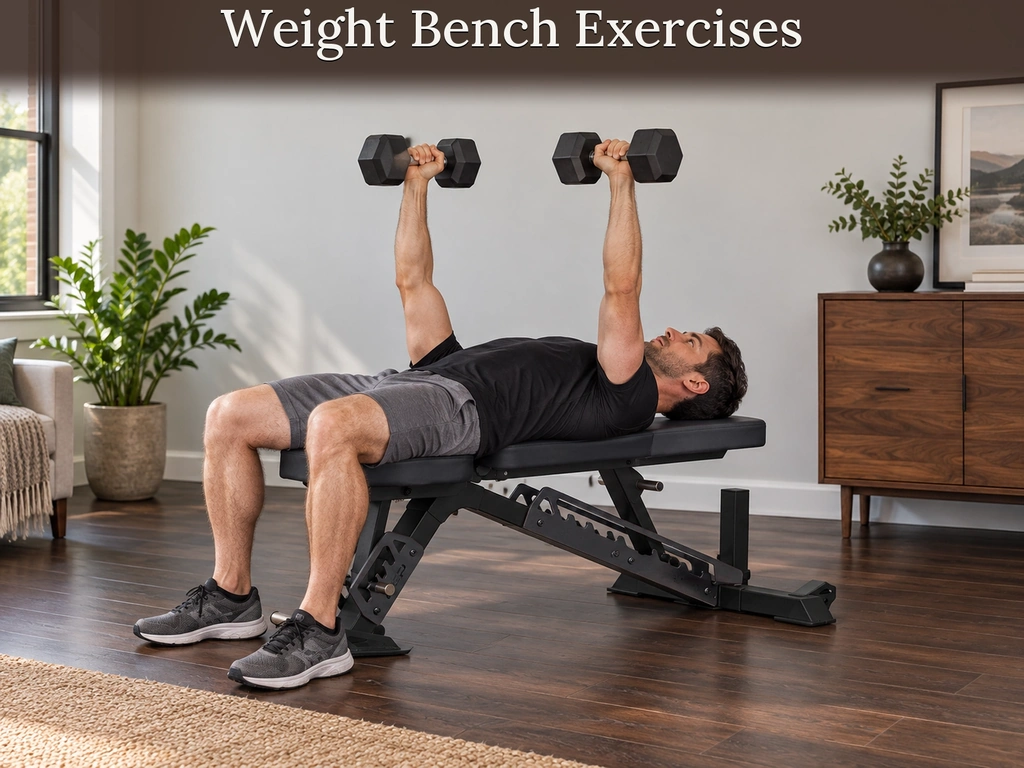
Flat Dumbbell Chest Press
Lie lengthwise on the flat pad with your head, upper back, and butt supported, and feet planted. Hold the dumbbells with thumbs wrapped around the handles and wrists steady above your forearms. Start with the weights controlled above your chest and shoulders. Lower them together toward the sides of your chest, then press smoothly back up. Keep a comfortable elbow path and avoid bouncing, dropping into the bottom, or lifting your body off the pad to finish. ACE's chest-press guide describes these support points, a closed grip, neutral wrists, and a controlled lowering and press.
I choose the starting load by whether you can get into position, complete the set, and return the weights deliberately. An impressive first press is of little use if you cannot manage the finish. Practice with a light pair and arrange competent assistance for unfamiliar or demanding pressing. Avoid making a deep reach toward the floor while lying back with the other dumbbell still above you.
Incline Dumbbell Chest Press
Lock the backrest and seat into a supported incline, then use the same firm foot contact and closed grip. Lower the dumbbells toward the upper-chest area while keeping your head, shoulders, and butt supported; press them back above you. ACE's incline chest-press instructions use a 45 to 60-degree bench, with elbows beneath the wrists and a controlled return. That is a published technique example, rather than proof that everyone needs the same angle. Use an available position you can perform comfortably, and record it so the next session is comparable.
Start lighter when changing from flat to incline. Changing the angle changes the exercise you are measuring, so yesterday's flat-press load is not a target to force onto the incline. If a higher backrest makes you slide, lose support, or reach awkwardly with the weights, reassess the position before adding repetitions.
Barbell pressing needs additional equipment. A bench alone does not provide a rack or catch system. Our rack bench press setup explains that station's cup and safety checks. Do not transfer dumbbell setup instructions to an unsupported barbell press.
Use the Bench for a Supported Dumbbell Row
A one-arm row uses the bench to support your free hand and knee while the other arm pulls. Keep the torso steady and give the dumbbell room to travel beside the pad. This makes the bench useful for pulling as well as pressing.
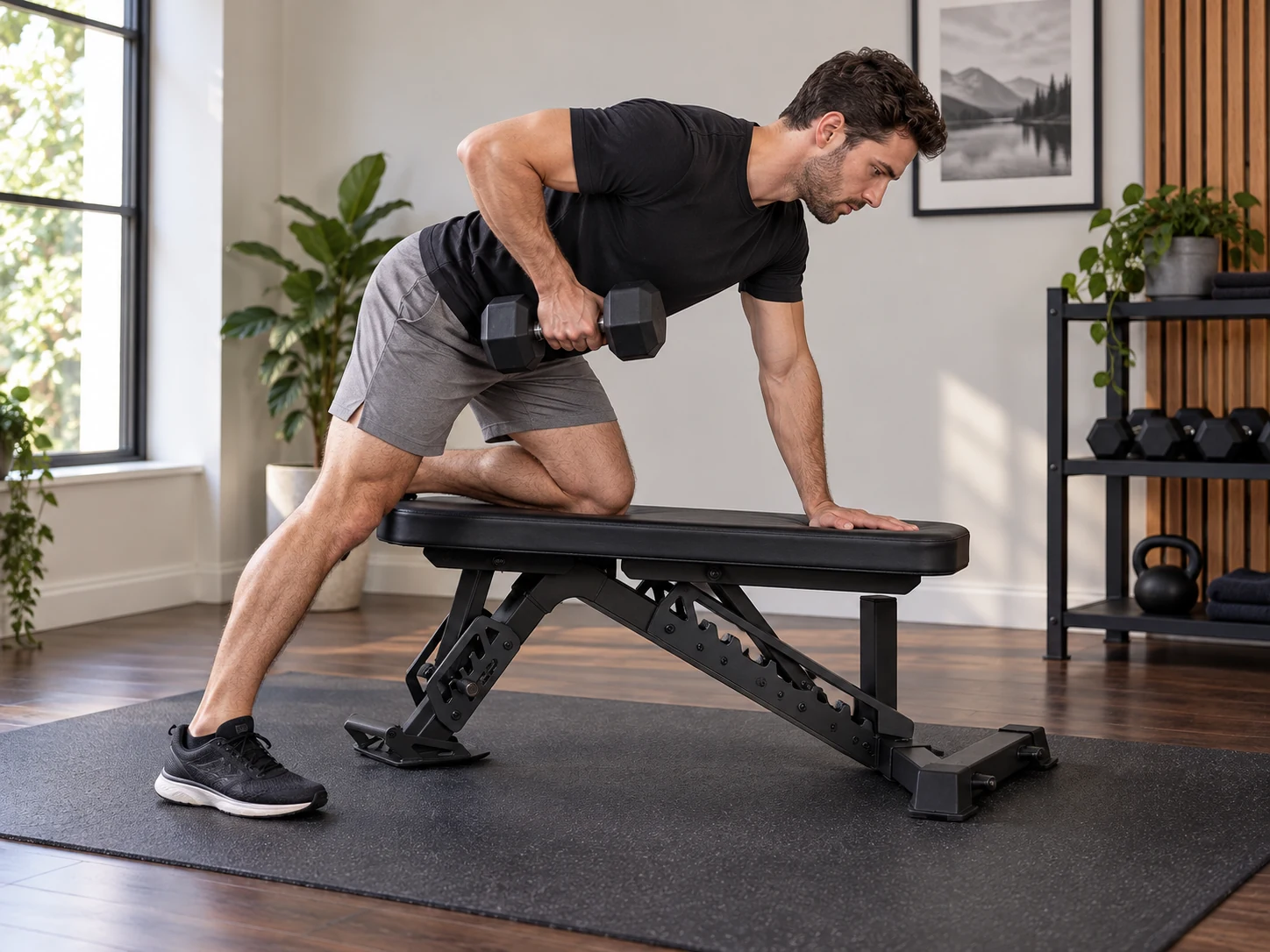
For the knee-supported version, place the free hand below the shoulder and the same-side knee below the hip, with the other foot firmly on the floor. Brace your trunk and let the working arm hang below the shoulder. Pull the elbow back close to your side, then lower the dumbbell with control. Stop the pull before you need to turn your torso to lift it higher. These are the main position and movement checks in ACE's single-arm row guide.
I keep one row in the starting session. A chest-supported row or a hand-supported version with both feet on the floor may fit a different bench or preference; our dumbbell back exercise guide compares those choices and their technique. Use the alternative in the same pulling slot, rather than adding every variation to the workout.
An incline reverse fly is an optional lighter accessory once the main routine is established. With chest supported on a suitably inclined pad and feet planted, raise light dumbbells out to the sides toward shoulder height, then lower under control. Keep your torso against the pad. ACE's guide describes a 45 to 60-degree backrest for this version. A row weight can be far too heavy for this longer-arm movement; begin with a separate light load.
Seated Dumbbell Overhead Press
The seated overhead press uses a high backrest to support your torso while you press above your head. Choose it only when you can reach overhead comfortably and the room allows the full movement. Check ceiling lights and low beams as well as the bench setting.
Allow room for the bench and its adjustments as well as clearance above the dumbbells.
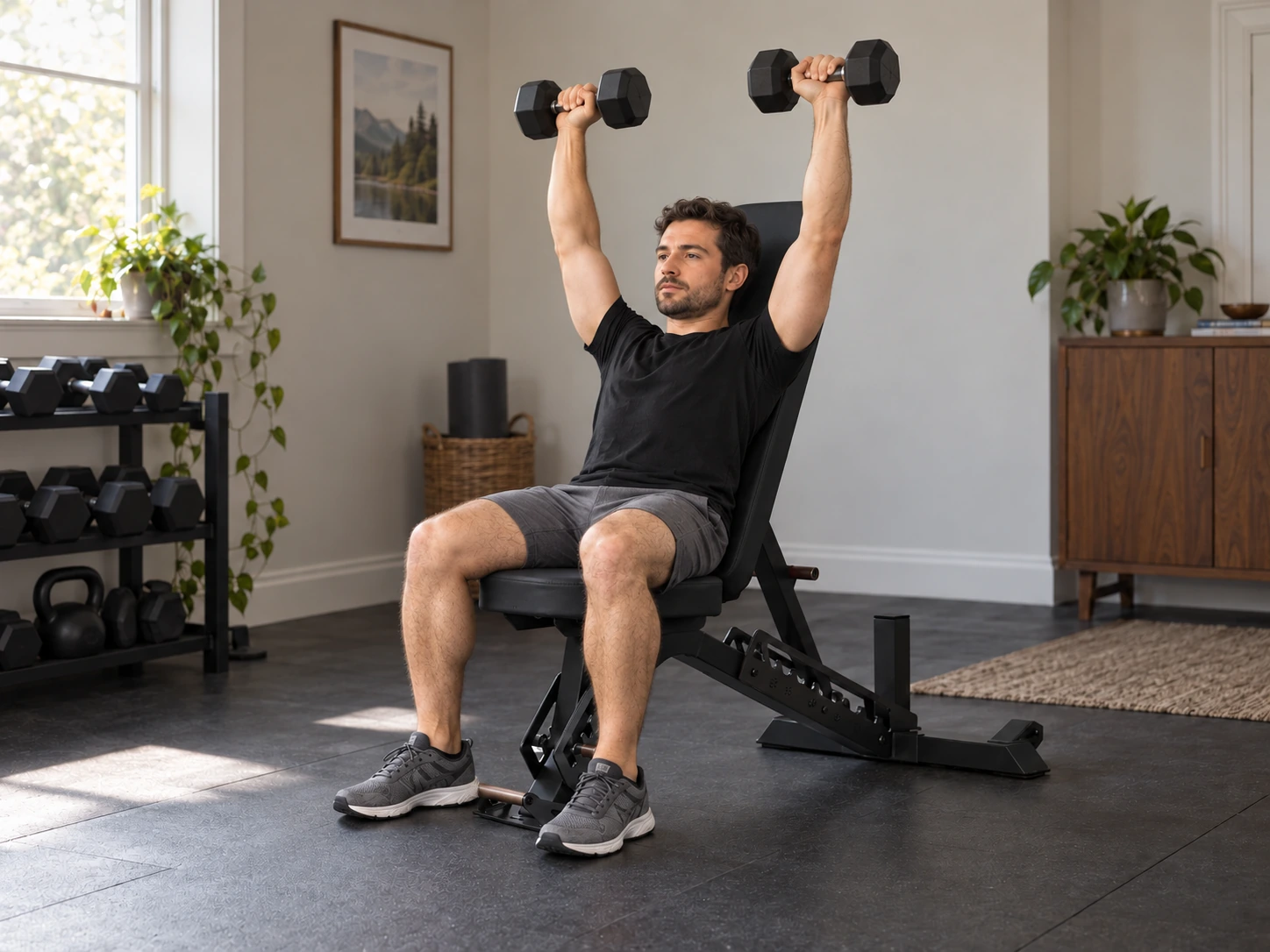
Sit against the backrest with your head, shoulders, and butt supported and both feet on the floor. Bring light dumbbells to shoulder level with a closed grip and neutral wrists. Brace your trunk, press overhead, then lower smoothly to the start. Keep contact with the backrest without arching your lower back to complete the repetition. ACE describes the supported setup and suggests keeping the elbows slightly forward for comfort through the movement.
I treat this as the optional second press in a beginner session. If you already press overhead elsewhere in the week, count that work before adding another slot here. Skip a painful or poorly controlled overhead movement while getting appropriate guidance. A chest press follows a different direction, so it is not an identical substitute.
A Complete Starting Workout With a Bench and Dumbbells
For a generally healthy beginner who can perform the chosen movements comfortably, I recommend two nonconsecutive sessions each week. Use the same session initially so you can learn the setup and compare your repetitions. ACSM's 2026 guidance supports training the major muscle groups at least twice weekly; the exact exercise selection and numbers below are my example, rather than an ACSM bench program.
| Order | Exercise | Sets and reps | Starting rest |
|---|---|---|---|
| 1 | Goblet squat, feet on floor | 2 x 8 to 12 | About 2 minutes |
| 2 | Flat OR incline dumbbell chest press | 2 x 8 to 12 | About 2 minutes |
| 3 | One-arm supported dumbbell row | 2 x 8 to 12 per side | About 2 minutes after both sides |
| 4 | Dumbbell Romanian deadlift, feet on floor | 2 x 8 to 12 | About 2 minutes |
| 5, optional | Seated dumbbell overhead press | 1 to 2 x 8 to 12 | About 2 minutes |
Complete the listed sets of one exercise before moving on. For the row, do both sides before the longer rest, pausing between sides when needed to reset. A rep is one complete movement; a set is a group of repetitions before resting. Take longer than the suggested rest if you need it to repeat the next set with control.
The two floor exercises cover lower-body work that these bench-supported movements leave out. In a goblet squat, hold a suitable dumbbell close to your chest as you bend the knees and hips, then stand. In a Romanian deadlift, use a slight knee bend and move your hips back as the dumbbells lower close to your legs, returning to standing while maintaining your back position. Learn both movements before making the load challenging. The full technique and no-bench alternatives are in our full-body dumbbell workout; use that guide as your main plan if you prefer training without a bench.
Warm up with comfortable general movement, then easier practice sets of the exercises you will use. Choose a working load that leaves about two or three controlled repetitions available at the end. This is an estimate, especially for beginners. End a set when you need to swing, shorten the movement, or change your body position to continue.
This is a starting whole-body session, with room to develop as your goals change. It does not train every muscle equally or include every pulling direction. Keep suitable aerobic activity alongside resistance training, and add more specialized work for a defined need rather than extending the bench list indefinitely.
Make Progress With the Same Bench Settings
Build repetitions within the range before increasing the load. When all working sets reach the top with the same support, range, and control, try the smallest manageable weight increase and return toward the lower end. Keep your chest-press angle and row variation unchanged while you assess that progress.
For example, a press that moves from 10 and 9 reps to 12 and 12 at the same weight may be ready for an increase if you still have a little capacity left. If the next available dumbbell makes eight controlled repetitions impossible, keep the current load. There is no requirement to add weight each week.
Record the exercise, backrest and seat positions, weight per dumbbell, and reps in each set. For rows, note each side if they differ. I value that short record because it distinguishes a stronger press from a different press: moving the backrest or shortening the lowering range can change the numbers without establishing progress in the original exercise.
Put the First Week on Your Calendar
Choose two separated days, check the bench, and practice the flat or incline press and supported row with light weights. Use the workout table for your working sets once the movements are comfortable. Leave the optional press out if the first four exercises already use the attention and energy you have.
At the next session, reproduce the settings and use your notes to decide whether to repeat the load, add a controlled repetition, or go lighter. Start by making one routine easy to set up and track. Add another bench exercise only when you can name the gap it will fill.
FAQs
What exercises can you do with a flat weight bench?
A suitable flat weight bench supports dumbbell chest presses and one-arm supported rows. It can also support other permitted exercises, but it does not provide the inclined back support needed for this guide's incline and seated pressing versions.
Can a weight bench alone give you a full-body workout?
A weight bench alone does not provide a complete progressively loaded strength routine. Add suitable resistance and lower-body movements, and judge the whole program by what it trains rather than whether every exercise touches the bench.
Do you need bench exercises for abs and legs?
No, leg and abdominal training do not require a weight bench. Squats, hinges, and suitable floor-based trunk work can fill those roles without standing on upholstery or improvising an attachment.
Are these bench exercises suitable for women and beginners?
These exercises can suit women and beginners when the equipment fits and the movements and loads match the individual. Choose the starting load from controlled practice rather than a fixed weight based on sex, and adapt the routine to your ability and recovery.
Should you do this bench workout every day?
No, the starting plan is two nonconsecutive weekly sessions rather than repeating it hard every day. Account for presses and rows in your other training before adding more bench workouts.
This is general exercise information for adults, not an injury-treatment program. Follow your equipment's instructions, learn unfamiliar lifts with a qualified coach, and seek individualized advice for pain or a relevant medical condition.