Dumbbell Workouts: A Full Body Plan for Home

Founder
I founded HomieGym to help you make informed decisions about training at home. My background includes university-level sports science education, practical coaching, gym training and combat sports.
Equipment editor on our team: Milutin Tucakov
Dumbbell workouts can train your legs, chest, back, shoulders, and arms with a pair of weights and enough room to move. Below is a full body dumbbell workout you can follow at home, with a weekly schedule and a clear way to make it harder.
I recommend starting with a small group of exercises you can repeat and track. Learning the movements and choosing a suitable weight will help you more than changing the routine every session.
Table of Contents
Dumbbell Workouts: Your Starting Routine
Start with two sets of the exercises below, twice a week, leaving at least a day between sessions. This beginner dumbbell workout covers a squat, a hip hinge, two presses, a row, and a carry. You can do the whole routine without a weight bench.
Use this table as your workout card. A rep is one complete repetition; a set is a group of repetitions before you rest. The numbers are my suggested starting plan for a generally healthy adult, rather than a prescription everyone must follow.
| Exercise | Sets | Reps or time | Rest after each set |
|---|---|---|---|
| Goblet squat | 2 | 8-12 | 90-120 seconds |
| Dumbbell Romanian deadlift | 2 | 8-12 | 90-120 seconds |
| Dumbbell floor press | 2 | 8-12 | 90-120 seconds |
| One-arm dumbbell row | 2 per side | 8-12 per side | 90-120 seconds after both sides |
| Standing dumbbell shoulder press | 2 | 8-12 | 90-120 seconds |
| Suitcase carry | 2 per side | 20-30 seconds per side | 60-90 seconds after both sides |
Complete both sets of one exercise before moving to the next. For rows and carries, do the left and right sides, then take the listed rest. Use a lighter weight for the shoulder press when needed; you do not have to use the same load throughout the workout.
During your first sessions, finish each set while you could still do a few controlled reps. For the carry, stop before your grip loosens or you begin leaning. This leaves room to learn the movements while you build confidence with the load.
Here, full body means the routine includes work for the major regions of your body. The exercises do not train every muscle equally. This is a practical starting dumbbell workout plan, with room to add more specific work as your goals develop.
How to Do the Dumbbell Exercises
The best dumbbell exercises for this plan are the ones you can perform comfortably, control, and make more challenging over time. The following instructions explain the six movements on your workout card, including what to change if a movement is too difficult.
Most are compound dumbbell exercises, meaning they involve movement at more than one joint. That lets one exercise train several muscles together. The carry adds a different task: keeping your body steady while you hold a load and walk.
Goblet Squat
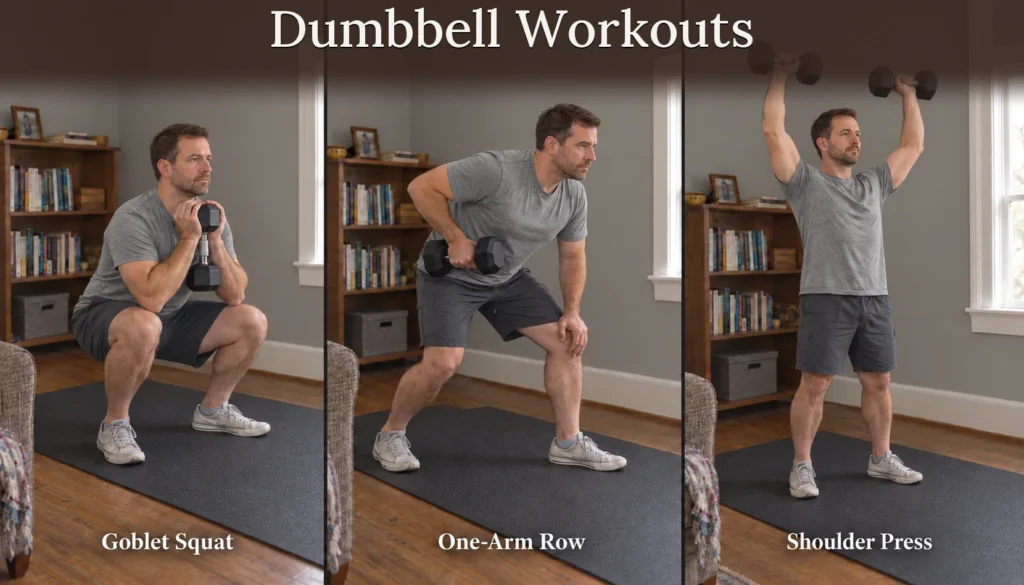
The goblet squat trains your thighs and glutes while you hold one dumbbell close to your chest. Start with your feet about shoulder-width apart, then adjust your stance slightly so the movement feels natural. Keep your feet firmly on the floor as you bend your knees and hips to lower yourself.
Hold the weight securely with both hands and keep it close throughout the rep. Let your knees travel in the same general direction as your toes. Stand back up without bouncing out of the bottom. NASM describes this front-held position as a useful squat variation.
I prefer a comfortable, repeatable depth to a deeper squat that makes you lose balance. If you are still learning, practice bodyweight squats first and add the dumbbell once you can control the movement.

Dumbbell Romanian Deadlift
The Romanian deadlift trains the back of your thighs and your glutes through a hip hinge: your hips move backward while your torso tips forward. Stand with a dumbbell in each hand, arms down, and a small bend in your knees. Push your hips back and keep the weights close to your legs.
Lower until you feel tension through your hamstrings and can still hold your back steady, then return to standing. The weights do not need to reach the floor. ACE's technique guidance emphasizes learning an unloaded hinge before adding resistance.
If your back keeps rounding, put the weights down and practice the hinge. I would keep an unloaded version in the workout until the movement is clear, rather than add weight to a position you cannot yet control.

Dumbbell Floor Press
The floor press gives you a chest and triceps exercise without a bench. Sit on the floor with light dumbbells, then lower yourself carefully onto your back, keeping the weights close and controlled. Bend your knees and plant your feet. Set up only with weights you can safely bring into position and put down.
Start with your upper arms resting on the floor and your forearms approximately upright. Press the dumbbells above your chest, then lower until your upper arms gently touch the floor. Keep your elbows a comfortable distance from your torso and avoid bouncing them off the ground.
The floor limits how far your upper arms can move behind your body, so this has a shorter pressing range than a bench press. It is a useful home option when the movement feels comfortable. Choose another pressing variation if it causes pain.
The bench exercise routine includes a flat dumbbell press if you later have a suitable bench.

One-Arm Dumbbell Row
The one-arm dumbbell row trains your back and arms by pulling a weight toward your body. Take a staggered stance and hinge forward. For this no-bench version, rest your free forearm lightly on your front thigh while keeping your torso steady. Let the dumbbell hang beneath the working shoulder.
Pull your elbow toward your hip without twisting your torso, then lower the weight under control. Think about moving your arm while the rest of your body stays quiet.
Do the same number of reps on each side. If maintaining the position is harder than rowing the weight, reduce the load or use a purpose-built, stable bench for support when one is available. Do not lean on furniture that can move or tip.
Standing Dumbbell Shoulder Press
The shoulder press works your shoulders and triceps as you lift the dumbbells overhead. Stand with your feet planted and bring light weights to shoulder height. Your palms can face forward or slightly inward. Press upward without leaning backward to finish the rep, then lower the weights smoothly.
Keep your wrists above your forearms and your torso steady. If you need to arch your back or shrug hard to complete each repetition, try a lighter load. The motion should feel controlled all the way up and down.
I keep this exercise optional for someone who cannot comfortably reach overhead. Do not force a painful range to complete the table. You can omit this press while you get appropriate guidance and continue the other comfortable movements. A floor press trains a different pressing direction, so it is not an identical replacement.
Suitcase Carry
The suitcase carry trains your grip and asks your trunk muscles to resist leaning to one side. Hold one dumbbell beside you, stand tall, and walk slowly through a clear space. Keep your shoulders roughly level and avoid letting the weight pull you sideways.
Turn carefully, without swinging the dumbbell, and switch hands after the planned time. The 20-30 seconds in the table is a starting suggestion. Shorten the carry if your posture changes or your grip starts opening; a longer timer is not useful when you can no longer hold the weight securely.
If you lack room to walk, stand in place and hold the weight with the same posture. That keeps the grip and trunk challenge while removing the walking component. Keep a clear area around your feet before picking up or setting down the dumbbell.
How to Choose Dumbbell Weight
Choose a weight that lets you complete the planned reps with control while the last few feel challenging. Test the weight on each exercise, because a suitable squat load can be far too heavy for a shoulder press.
For your first session, err on the lighter side. Do a practice set, then ask whether you could have completed a few more repetitions without changing the movement. If every rep feels easy and you could keep going for many more, increase the load slightly next time. If you cannot reach the lower end of the range cleanly, reduce it.
There is no single starting weight that fits every beginner. Your existing strength, exercise choice, and available dumbbell increments all matter. I would avoid choosing a pair solely from a chart based on age or sex. The movement itself is the better check.

If you are buying equipment, look at both the lightest setting and the size of each weight increase. When coaching an online client with a small, partly furnished room, I considered one adjustable pair to reduce the space needed for multiple fixed pairs. That space advantage is useful only when the available weight range also fits the exercises.
| Type | Changing the load | What to check |
|---|---|---|
| Fixed | Pick up a different pair | Have suitable weights for different lifts |
| Plate-loaded | Add or remove plates | Secure collars and follow handle capacity limits |
| Selector adjustable | Select a setting in the cradle | Check increments, locking, and permitted use |
You can start dumbbell workouts at home with fixed weights you already own. If one pair becomes too light for your legs but remains challenging for your arms, change the lower-body variation or plan a suitable equipment upgrade. Our home gym essentials guide covers the equipment and space decisions in more detail.
Warm Up for the Movements You Will Use
Before your first working set, rehearse the movements with light or no weights. Use the dumbbell warm-up below to practice the exercises without tiring yourself out.
- Walk or march comfortably for a few minutes.
- Practice several bodyweight squats and unloaded hip hinges.
- Practice the row and floor press with light dumbbells. If you are including the shoulder press, rehearse it through a comfortable range.
- Before the working sets of each exercise, do an easier practice set.
Check the floor space at the same time. Move loose objects out of the carry path and leave room around you for floor presses. For plate-loaded dumbbells, check that the collars are secure. For selector models, confirm the chosen setting is engaged before lifting them from the cradle. Follow the locking and use instructions for your particular set.
I recommend using the practice reps to check whether today's weight and range feel suitable. If a movement causes pain, stop and reassess it; warming up longer is not a reason to keep forcing the same motion.
How Many Sets and Reps Should You Do?
For this beginner dumbbell workout plan, use two sets of 8-12 reps for the five repetition-based exercises, plus the carries in the workout card. This gives you a manageable amount of work while you learn. It is a starting choice, not a claim that this range is ideal for every training goal.
As the routine becomes familiar, you can add a third set to selected exercises if you are recovering well and want more work. Count the challenging sets you do for each muscle each week before adding more.
For muscle growth, the load has to remain meaningfully challenging as you improve. For maximum strength, heavier loading becomes more important. ACSM's 2026 guidance distinguishes these goals and notes that the amount of work should suit the person. You do not need to test your maximum lift to begin this routine.
Rest about 90-120 seconds between the main sets as a starting point, then take longer if needed to repeat the movement well. If breathlessness is making you stop a squat set before your legs are meaningfully challenged, rushing the next set is unlikely to help.
Complete rows and carries on both sides before the longer break, taking a short pause when switching sides if necessary. For this plan, I prefer steady sets to a fast circuit: they make it easier to notice which weight and rep count actually suit each exercise.
Your Weekly Dumbbell Workout Plan
Two nonconsecutive sessions are a sensible starting schedule for this routine. Repeat the same exercises so you can learn them and compare your performance. The CDC recommends muscle-strengthening activity that works all major muscle groups on at least two days each week.
| Day | Plan |
|---|---|
| Monday | Full body dumbbell workout |
| Tuesday-Thursday | Walking, other suitable activity, or rest |
| Friday | Repeat the dumbbell workout routine |
| Weekend | Activity or rest according to recovery |
Once two sessions fit your week and you are recovering well, you can try Monday, Wednesday, and Friday instead. Move to three days by changing the schedule first; you do not need to add sets and heavier weights at the same time.
I would keep the two-day plan if a third session makes your performance worse or becomes difficult to maintain. Choose a schedule that lets you return for a productive workout.
If you use a split routine instead, our dumbbell leg workout, shoulder exercise guide, and triceps exercise guide explain those sessions separately. Count their work within your week rather than adding every routine on top of this one.
Dumbbell strength training covers the resistance-training part of your week. Keep walking, cycling, rowing, or other suitable aerobic activity alongside it. A rising heart rate during a lifting session does not automatically mean this program meets your weekly cardio needs.
How to Progress Your Dumbbell Workout
Start by adding controlled reps within the planned range, then increase the weight when you can complete the top end on all sets. This is one simple way to apply progressive overload: making the training demand greater as you adapt.
Change one thing at a time. If you add weight, keep the exercises and number of sets the same so you can judge that change. There is no need to increase the dumbbell weight on a fixed weekly deadline.
| Session | Weight per dumbbell | Reps in each set | Next decision |
|---|---|---|---|
| 1 | 15 lb | 9, 8 | Keep the weight |
| 2 | 15 lb | 10, 10 | Add reps if control stays good |
| 3 | 15 lb | 12, 12 | Consider the smallest suitable increase |
| 4 | 17.5 lb, if available | 9, 8 | Build reps again |
Those loads illustrate the decision process. Choose your own starting weight, and expect progress to take a different number of sessions. If the next available pair is too heavy to reach eight good reps, keep the current load.
With fixed dumbbells, you can use more repetitions or a harder suitable variation when the current exercise becomes easy. A split squat, for example, can make your existing load more demanding for each leg. These changes have limits: eventually you may need heavier weights to keep progressing toward your particular strength goal.
A dumbbell workout for muscle gain can also need more weekly work over time. Add sets gradually and check recovery. Increase the work on selected exercises before adding sets across the whole routine. Keep a short log of exercise, weight, sets, and reps; that is enough to see whether your routine is moving forward.
Are Dumbbell Workouts Effective?
Yes. Dumbbells are a valid way to perform resistance training and develop strength and muscle when your training remains challenging and you repeat it consistently. The main benefits of dumbbell training at home are practical: you can cover several movements with compact equipment and adjust the load as your ability changes.
ACSM's 2026 guidance supports home-based resistance training and reports that equipment type did not consistently determine outcomes across the evidence reviewed. That supports using dumbbells as a training tool; it does not establish that any pair or any routine will be enough for every goal.
The weight range is the main equipment limit to watch. A pair that stays challenging for raises or presses can become easy for squats and deadlifts. You may also want a bench or other equipment for additional exercise options later. A dumbbell-only workout is a useful choice while its exercises and loads still meet your needs.
Compare a barbell and dumbbell setup before replacing a pair that no longer covers your lower-body loads.
I would judge the routine by the work you can repeat and improve. Completing more controlled reps with the same weight, or handling a suitable heavier load, is more informative than how sore you feel the following morning.
FAQs
Can I Do a Dumbbell Workout Every Day?
Repeating this full-body dumbbell routine hard every day is not the starting plan; use the nonconsecutive schedule above. Easy movement can fit between lifting sessions, while more advanced plans need exercises, effort and weekly work arranged around recovery.
How Long Should a Dumbbell Workout Be?
Allow roughly 35 to 50 minutes for this dumbbell routine, including practice sets, rest and weight changes, with your actual pace changing the estimate. If time is short, prioritize the squat, hinge, floor press and row rather than rush all six movements.
Can You Do a Dumbbell Workout Without a Bench?
Yes, this entire dumbbell workout works without a bench, using floor presses, a row supported by your stance, squats, hinges, standing presses and carries. A bench adds supported rows and different pressing angles when those options serve your training and fit your space.
Is One Pair of Dumbbells Enough?
One pair of dumbbells can be enough when its weight suits your exercises, but it may be too heavy for one movement and too light for another. Start with suitable lighter or unloaded options where needed, and let a real load mismatch guide the next equipment purchase.
Start With a Routine You Can Repeat
For your first week, choose two training days, keep the weights manageable, and use the workout card. Write down what you actually complete, including any exercise you adapt or omit. That gives the next session a useful starting point.
Once the movements feel familiar, build the repetitions and increase the load when you are ready. If the plan is already challenging, keep it steady. If time is the problem, use the shorter version from the duration section.
My priority is a routine that fits your current equipment and leaves you able to train again. Start there, then let your progress show which exercises, weights, or extra equipment deserve a place next.
This content is for informational and educational purposes only. It is not a substitute for professional medical advice, diagnosis, or treatment. Always consult with your healthcare provider before starting any new fitness program or using fitness technology for health monitoring.