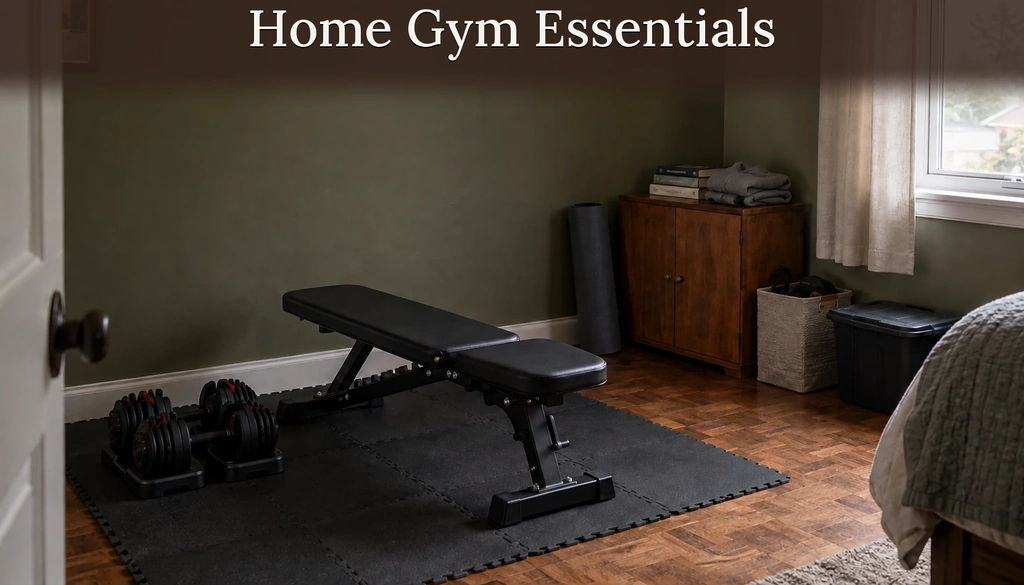
Home Gym Essentials: Equipment, Space, and Budget Guide for Beginners

Founder
I founded HomieGym to help you make informed decisions about training at home. My background includes university-level sports science education, practical coaching, gym training and combat sports.
Equipment editor on our team: Milutin Tucakov
You do not need a fully equipped gym to start training effectively at home. For most beginners, a pair of dumbbells, a stable bench, an exercise mat, and suitable flooring can cover a large part of basic strength training without taking up much space or requiring a huge budget.
When I help someone plan a home gym, I do not start with a shopping list. I start with the exercises they want to do, the space they actually have, and how much they are willing to spend. That usually makes it much easier to see which pieces of equipment are essential now and which ones can wait.
Table of Contents
Home Gym Essentials and What to Buy First
If I were building a beginner home gym from scratch, I would try to cover as much of the body as possible with as little equipment as possible. That is why I would start with adjustable dumbbells, a stable bench, and an exercise mat.
Adjustable dumbbells are the most useful first purchase for most beginners. One compact pair can cover lighter upper-body work, pressing and pulling, and heavier lower-body exercises as your strength improves. Some heavier systems can reach around 50 kg (110 lb) per dumbbell, so they can stay useful far beyond curls and shoulder exercises.
A bench makes those dumbbells much more versatile by adding stable positions for pressing and pulling, while a mat gives you a comfortable surface for core work, mobility, stretching, and other floor exercises.
See how the bench exercise routine combines dumbbell presses and rows with lower-body work.
| Equipment | Why I would buy it early | Where it starts to fall short |
|---|---|---|
| Adjustable dumbbells | Train muscles across almost the entire body with one compact pair and a wide range of loads | Each side works independently, so beginners need more coordination and stability to keep heavier movements controlled |
| A weight bench | Adds more pressing and pulling positions | Adds no resistance on its own |
| An exercise mat | Makes floor work more comfortable | Does not replace equipment flooring or resistance equipment |
| Later additions | Fill gaps such as vertical pulling, heavy barbell work, or cardio | Add them when you know what your current setup is missing |
This setup can take a beginner surprisingly far, but dumbbells also ask more from your coordination. You may be strong enough to move the weight before you are skilled enough to control both sides evenly through the full movement.
That is one reason barbell, cable, pull-up, or machine-based training may become useful later. It is not because the starter setup suddenly stops working, but because different equipment can make certain movements easier to control, load, or progress.
Start with equipment that can do a lot, then add something only when you can clearly explain what your current setup cannot do.
Adjustable Dumbbells for Home Gym
For most beginner home gyms, I would still start with adjustable dumbbells because one pair can cover a wide range of exercises without filling the room with separate weights. But I would not choose them only because they save space.
The better question is how you actually train. If you usually perform one exercise at a time and change the weight between sets, an adjustable pair makes a lot of sense. If you move quickly between several stations, train with another person, or regularly need several different weights ready at once, fixed dumbbells can be much more convenient. A rubber hex pair like the FitVids 20 lb dumbbells is ready the moment you pick it up, with no collars or selector to set.
Fixed, Plate-Loaded, and Quick-Adjust Dumbbells

| Type | Best fit for | Main tradeoff |
|---|---|---|
| Fixed dumbbells | Fast transitions, circuit training, shared workouts, and having several weights ready at once | Take the most space and usually cost more as you add more pairs |
| Plate-loaded dumbbells | Low-cost flexibility and people who already own compatible plates | Slower weight changes, longer handles, and more setup between exercises |
| Quick-adjust dumbbells | Most home gyms where one compact pair needs to cover many different weights | More expensive upfront, and weight steps, handle shape, durability, and maximum load vary by model |
In circuit sessions, I have used fixed dumbbells at separate stations so clients could move straight into the next exercise without stopping to change the load. If three out of five stations use different dumbbell weights, fixed pairs are clearly more practical. You simply walk to the next station and pick them up.
That convenience comes with a cost. Every additional fixed weight needs more storage space and usually more money. In a home gym, where one person is often training alone, a quick-adjust pair can make much more sense because one compact set replaces several fixed pairs.
One detail I would always check before ordering is whether the listed weight refers to one dumbbell or the pair. A “100 lb set” may simply mean two 50 lb dumbbells. With plate-loaded handles, also check whether the advertised total includes the handles and whether both sides can be loaded equally. The TELK 105 lb adjustable dumbbell set is a good one to read this way: the 105 lb is the whole kit, split across two plate-loaded handles.
How Much Weight Do You Need?
The right adjustable dumbbell should be light enough for your smaller exercises and heavy enough for the strongest movements you expect to train. That range matters much more than simply buying the set with the highest number on the box.
For example, the weight you use for a lateral raise may be far below what you can handle for a row, squat, or Romanian deadlift. This is also why small increments matter. A 5 lb jump can be easy to manage on a heavy lower-body exercise but feel huge on a smaller shoulder or arm movement.
When I compare adjustable dumbbells, I would check three things first:
- Starting weight: can you go light enough for smaller upper-body exercises?
- Weight increments: are the jumps small enough to progress without being forced into a much heavier load?
- Top weight: is there enough room for your stronger exercises as you improve?
Expansion and handling come after that. Some systems let you add more weight later, while others have a fixed ceiling. Also check how the mechanism is meant to be adjusted, locked, stored, and set down.
For context, adjustable systems vary widely. Compact models may stop around 50 lb (22.7 kg) per dumbbell, while heavier or expandable systems can reach roughly 100 to 110 lb (45 to 50 kg) per dumbbell. The best range is not automatically the largest one. It is the one that covers both ends of the training you actually plan to do.
Adjustable Bench for Home Gym
An adjustable bench gives you more ways to use the dumbbells you already have. It adds stable positions for presses, supported rows, seated exercises, and different pressing angles, which makes a basic dumbbell setup much more versatile.

A flat bench covers the basics, but an adjustable bench gives you more exercise options by changing the backrest angle. That lets you move from flat pressing to incline work and seated positions without adding another piece of equipment.
I would pay for stability before I paid for extra attachments. A bench that wobbles, sits at an awkward height, or makes it hard to plant your feet securely will affect almost every exercise you do on it. An attachment you rarely use adds much less value.
When comparing benches, I would check:
- Backrest positions: make sure it reaches the angles you actually plan to use, then use the bench adjustment guide to check how those positions lock.
- Stability: the frame should stay solid while you press, row, or get into position.
- Fit: check pad height, width, length, and whether you can place your feet comfortably.
- Load rating: confirm how the manufacturer defines its capacity.
- Storage: check the bench weight and whether it can actually be folded, rolled, or stored upright; compare folding bench designs if it must fit a specific storage opening.
A bench can look compact in a product photo and still be awkward to move. The REP AB-3100, for example, weighs about 70 lb (31.8 kg), so I would plan where it will stay between sessions instead of assuming I will move it after every workout.
A bench is useful, but it is not mandatory on day one. If your budget is tight, you can still train with standing exercises and floor presses, then add a bench when you want more pressing angles and supported movements.
Home Gym Mats and Home Gym Flooring

A workout mat and gym flooring are not the same thing. One is mainly for your body, the other is mainly for your equipment and the floor underneath it.
Use an exercise mat for floor work, stretching, mobility, core exercises, or anything where you are kneeling or lying down. For that, I would care more about usable size, grip, and comfort than simply buying the thickest mat available.
Use gym flooring when you need a more stable and durable surface under benches, dumbbells, racks, or heavier equipment. A soft exercise mat is usually a poor choice under a bench or for standing lifts because it can compress and make the setup less stable.
The Manduka PRO, for example, is about 71 x 26 in (180 x 66 cm) and 6 mm thick. That gives you a useful reference for personal floor space, but it is not designed to protect a room from heavy dropped weights.
If your gym is upstairs or you are adding much heavier equipment, remember that rubber flooring does not increase the building’s load capacity and does not guarantee that noise will stay out of the room below. In that situation, flooring helps protect surfaces, but it does not solve every structural or noise problem.
Compact Home Gym Equipment for a Small Room
When you are planning a small home gym, the goal is not to fit the most equipment into the room. The goal is to leave enough space to actually train.
Product dimensions only tell you whether something physically fits. You also need room for your body, the movement itself, access around the equipment, and storage when the session is over.
| Before you buy | What to check |
|---|---|
| 1. Measure the equipment | Check the full dimensions of the bench, dumbbells, rack, or machine |
| 2. Measure the movement | Make sure you have room for your arms, legs, weights, and any moving parts during the exercise |
| 3. Leave access space | You still need room to walk around, pick up weights, load plates, and get into position |
| 4. Plan where it goes after training | If the room has another use, check whether the equipment can actually be moved or stored easily |
| 5. Keep one open training area | Instead of giving every item its own permanent space, let the same area work for bench, mat, and standing exercises |
If you cannot perform the exercise comfortably once the equipment is in place, it does not really fit.
How Much Space Do You Need for a Home Gym?
For a basic one-person setup, a 3 x 3 m room can be enough for adjustable dumbbells, a bench, compact weight storage, and mat work. The key is not to give every piece of equipment its own permanent station.
In a smaller room, I would make the central area do more than one job. Use it for bench and dumbbell work, then move the bench when you want to use the mat. That way, the same floor space supports several types of training instead of being permanently occupied.
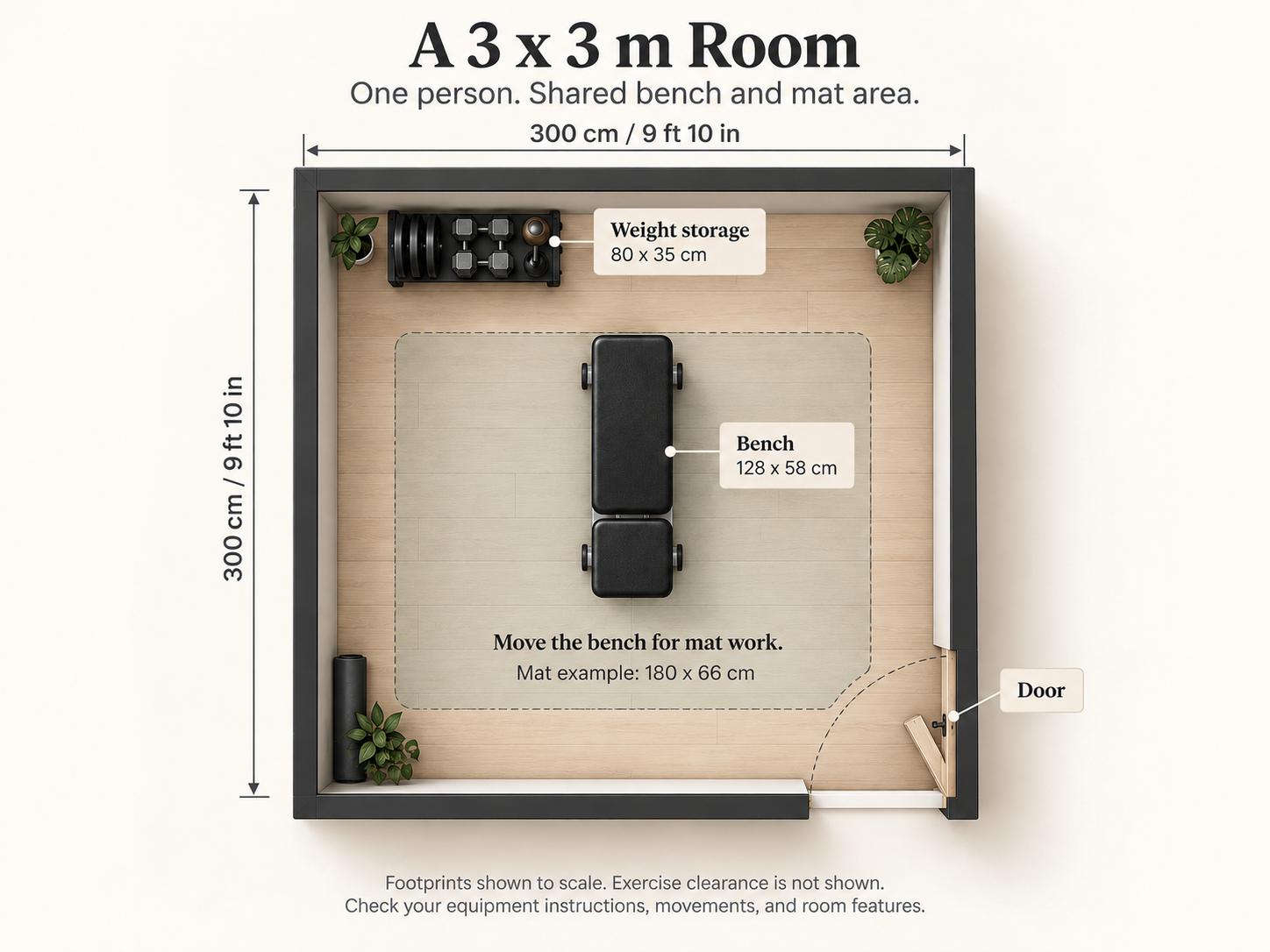
A room this size can work well for a basic setup, but larger equipment changes the calculation quickly. I would plan barbells, racks, and cardio machines separately around their full in-use space rather than their stored dimensions.
Check barbell dimensions when measuring the full width of a rack-based station.
The room is big enough only when you can use the equipment comfortably, not just fit it inside.
Budget Home Gym Equipment and Buying Order
Building a home gym on a budget does not mean buying the cheapest version of everything. The goal is to spend first on equipment you will actually use and avoid paying twice because the first purchase was too limited.
I would build the budget in this order:
- Start with the dumbbells: choose the weight range you actually need and compare quick-adjust, plate-loaded, and fixed options.
- Add the bench: an adjustable bench gives you more exercise options, but a simpler flat bench can save money if those extra positions are not important yet.
- Add the basics: include a mat, shipping, taxes, and any storage you genuinely need.
- Look one step ahead: check what happens when you need more weight. Some systems expand, while others eventually need to be replaced.
For a beginner bench, I would compare stability, backrest positions, pad size and fit for the planned exercises before deciding how much to spend. Include delivery and any needed accessories in the comparison. A low listing price does not tell you whether the bench will stay stable or let you plant your feet comfortably.
If your budget is tight, I would also compare used fixed dumbbells and benches locally. Just count the real cost of completing the setup, not only the number in the listing. Missing collars, plates, attachments, or replacement parts can turn a cheap purchase into an expensive one.
And always check what the price actually includes. A dumbbell listing may show the weight of the pair rather than each dumbbell, and plate-loaded sets may include handles without enough plates for the loads you expected.
Illustrative prices, not current quotes: take a $650 budget for goblet squats, dumbbell hinges, bent-over rows and floor presses. A suitable adjustable pair at $350 delivered, a $25 body mat and $100 equipment flooring total $475. Assume tax is included and permitted storage is already available. A $200 delivered bench brings the total to $675, which is $25 over budget.
I would start with the $475 floor-press setup and keep $175 available, after checking the pair's loads and weight steps. The body mat and equipment flooring serve separate jobs. Add the bench when its supported positions or pressing angles earn the next $200; include any missing parts or floor preparation in the actual budget.
Home Gym Storage That Fits Your Equipment
Good storage should save space and make your equipment easier to use, not create another bulky piece of furniture in the room.

I would plan storage only after I know what equipment I actually own. Adjustable dumbbells may need nothing more than a small stand, while fixed dumbbells need room for several pairs. Plate-loaded handles also need space for the plates, collars, and handles themselves.
A common mistake is buying storage that takes up more room than expected. A compact dumbbell set can suddenly occupy a much larger footprint once you add an oversized stand or rack. Before buying one, check the full dimensions and make sure it is rated for the weight you plan to put on it.
For benches and wall-mounted storage, I would also check the manufacturer’s storage and installation instructions. Do not assume a bench can safely stand upright or that any wall can support a loaded rack.
Buy storage for the equipment you actually have, not for the gym you imagine building later. You can always add more storage when your setup grows.
Home Gym Essentials to Add as Your Training Expands
Do not add equipment just because your home gym looks incomplete. Add something when your current setup can no longer do something you actually want from your training.
With the starter setup from this guide, adjustable dumbbells, a bench, and a mat already cover a large part of basic strength training. The next purchase should solve a specific gap.

For example:
- If you need more load: compare barbell and dumbbell setups, then choose heavier dumbbells, an expansion kit, or a barbell setup.
- If you are missing vertical pulling: add a pull-up station or cable option.
- If you want heavier compound lifting: check the power rack parts and plan the rack, barbell, plates, collars, and safeties as one system.
- If you want dedicated cardio: add a bike, rower, or treadmill that fits both your training goal and your room. For cycling, compare stationary bike types by riding position, resistance system and storage format.
- If you want more exercise variety without much space: resistance bands can add useful options, especially when paired with a suitable anchor.
The important part is to identify what your current setup cannot do well enough for the training you now want to perform. If you cannot point to a specific missing movement, load, or training option, I would wait before buying more equipment.
That keeps the gym growing around your training instead of forcing your training to grow around whatever equipment happened to look useful when you bought it.
My Starting Order for a Small Home Gym
If I were starting from zero, I would keep the first version of the gym simple: adjustable dumbbells, a stable bench, and a mat. That setup gives you enough variety to train most of the body without filling the room with equipment you may not need yet.
From there, I would add equipment only when the current setup shows a clear limitation. If you need more load, add heavier dumbbells or move toward a barbell setup. If you are missing vertical pulling, add a pull-up or cable option. If cardio becomes a priority, plan space for a bike, rower, or treadmill separately.
Our exercise bike picks compare specific models for indoor cycling, supported rides and moving-handle conditioning.
Before buying anything, make sure the equipment fits the room while you are using it, not just while it is stored. Leave enough space to move, pick up weights, adjust the bench, and share the same central area between different exercises.
Start with the dumbbells, bench and mat that cover your planned sessions. Leave room to use them, then let a missing movement or load decide the next purchase.
FAQs
How to Create a Home Gym?
Create a home gym around the training you want to do, then choose the smallest equipment set that covers it. For many beginners, adjustable dumbbells, a stable bench and an exercise mat cover a large part of basic strength training; plan usable space first and add equipment when a missing movement, load or cardio option gives it a clear job.
How to Choose the Best Gym Equipment for Home?
Choose home gym equipment that fits your exercises, required loads, usable space and budget. Versatile pieces can cover several jobs: adjustable dumbbells replace several fixed pairs, while an adjustable bench adds pressing and pulling positions.
How to Set Up a Home Gym?
Set up a home gym by marking the training area, door swings, furniture and room to move before placing equipment. In a small room, place the most versatile items first and keep a central area available for bench work, standing exercises and mat work.
Is a Home Gym Worth It?
Yes, a home gym is worth it when it helps you train consistently and saves enough time or money to justify the equipment cost. A simple setup can grow with your training, but it may offer less value if you enjoy a commercial gym, need specialized machines or lack usable home space.
How to Build a Home Gym in a Small Apartment?
Build a small-apartment home gym with compact equipment that shares the same floor area between exercises. Check noise, storage, building rules and floor loading as well as room size, because rubber flooring does not guarantee quiet landings or increase the structure’s load capacity.