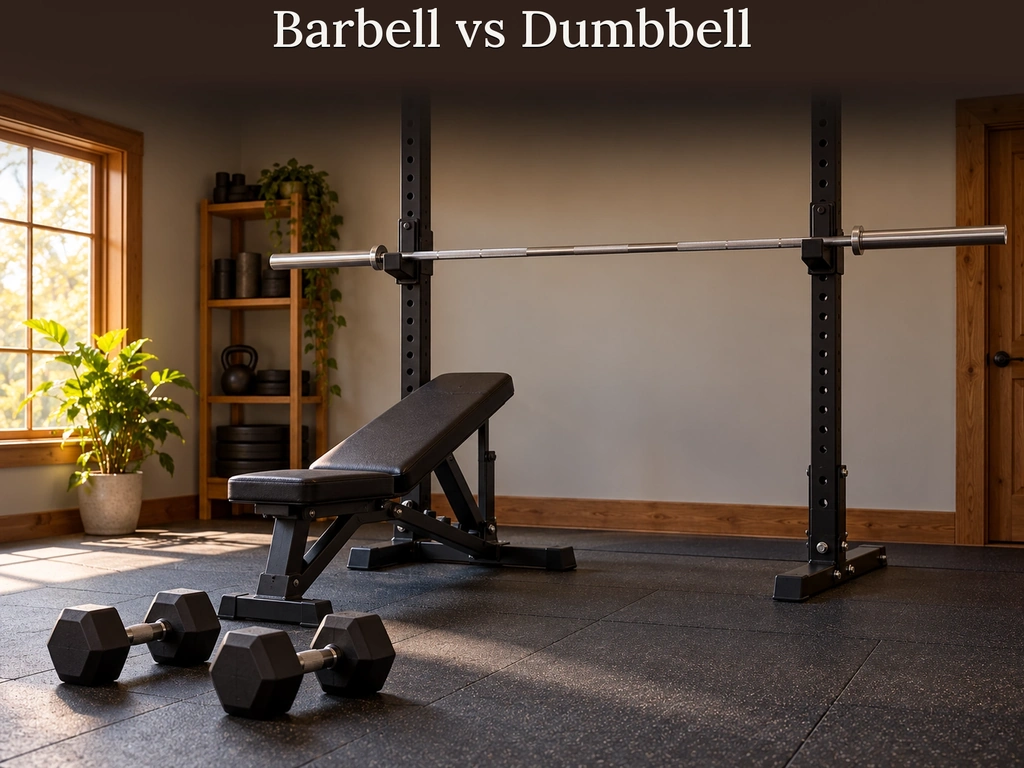
Barbell vs Dumbbell: What Should You Buy First for a Home Gym?

Founder
I founded HomieGym to help you make informed decisions about training at home. My background includes university-level sports science education, practical coaching, gym training and combat sports.
Choose dumbbells or a barbell for your first home setup by comparing the complete equipment, useful loads, room, and handling requirements.
When choosing between a barbell and dumbbells for a home gym, I favor dumbbells first for a compact, flexible setup. Choose a barbell first when your priority is practicing barbell lifts and you can provide the plates, supports, floor, and working space those lifts need.
I compare the complete routine each setup can support, including the loads you can get into position and any equipment you still need to buy.
Table of Contents
Barbell vs Dumbbell for Your First Home Setup
Start with dumbbells for a shared room or a varied general strength routine; start with a barbell for a deliberate barbell training space. Those are buying priorities, rather than a claim that one implement produces better results for everyone.
| Your situation | First choice | Condition to check |
|---|---|---|
| Shared room, equipment put away afterward | Adjustable dumbbells | Range, steps, and storage access |
| Squat, bench press, and deadlift practice | Barbell setup | Compatible rack, safeties, bench, and plates |
| Several exercise stations in a circuit | Fixed dumbbell pairs | Enough pairs and storage |
| Heavy lower-body loading is the priority | Often a barbell | Usable load, floor, handling, and room |
| Uncertain goals and a limited first purchase | A suitable dumbbell pair | Enough load for the planned exercises |
The difference between a barbell and a dumbbell begins with how you hold the weight. A barbell connects both hands to one long bar. Dumbbells give each hand a separate weight, allowing different hand positions and single-arm exercises. Those differences change exercise options and setup, without making either category a complete program on its own.
Compare the Cost of Complete Setups
Dumbbells can require fewer supporting purchases for a basic routine, but the cheapest complete option depends on the exercises and weight range. I compare the equipment list for the same training week before deciding which purchase offers better value. Set a total budget, then price every item needed to perform that week's exercises. If the bar uses most of the budget and leaves no money for the required plates or supports, choose a simpler routine you can fully equip.
For dumbbells, first distinguish fixed, selectorized, and plate-loaded designs. Fixed pairs are ready immediately, but several pairs need storage. Selectorized pairs change weight through a mechanism and have model-specific ranges and handling instructions. Plate-loaded handles require compatible plates and secure collars, along with time to change the load.
A barbell purchase normally expands into a bar, matching plates, collars, and appropriate storage. Add a suitable rack and safety supports for back squats, then a bench for bench presses. A deadlift-focused setup may not need a bench at all. Pay for the supports your chosen lifts require before adding a bundle accessory.
Illustrative prices, not current quotes: compare a two-session week of goblet squats, dumbbell Romanian deadlifts, floor presses and bent-over rows with barbell back squats, Romanian deadlifts, bench presses and rows. Both cover squat, hinge, push and pull patterns, but they train different exercises. Choose usable working loads and weight steps for each route before accepting its basket.
| Required purchase | Dumbbell route | Barbell route |
|---|---|---|
| Resistance | $500 pair | $250 bar + $300 plates + $30 collars |
| Press and squat supports | Floor press; no bench | $500 rack with suitable catches + $200 bench |
| Floor and storage | $100 protection; existing storage | $100 protection + $50 storage |
| Delivery | $50 | $120 |
| Initial total | $650 | $1,550 |
Both layouts must fit the room, handling and floor requirements; this example assumes no paid assembly. The dumbbell route leaves $900 unspent for the general routine. It does not supply barbell squat or bench-press practice. If those exact lifts are your goal, save for their complete station. Add tax and any required instruction or installation to the actual quotes.
Choose a flat or adjustable bench around the pressing positions you plan to use.
- Count what is included. A single adjustable dumbbell is not a pair, and a bar listing may exclude plates and collars.
- Check the next load you will need. Compare useful expansion options with the cost and storage of replacing a limited set.
- Include delivery and the room. Floor preparation, storage, assembly, and coaching can affect the first purchase.
A combined barbell and dumbbell set can share plates only when the components are compatible. For example, Rogue specifies Olympic plates with nominal 2-inch center openings for its Ohio Bar. That does not establish compatibility with small threaded dumbbell handles or a connector sold in a different kit.
Compare standard and Olympic barbells to understand the sleeve systems before planning to share plates.
Check the exact sleeve diameter, plate bore, loadable length, collars, and intended use. A connector that joins two handles also needs its own load and exercise instructions. Do not assume it behaves like a rackable straight bar. The home gym essentials guide helps place that equipment list within the rest of the room.
Allow for Training Space as Well as Storage
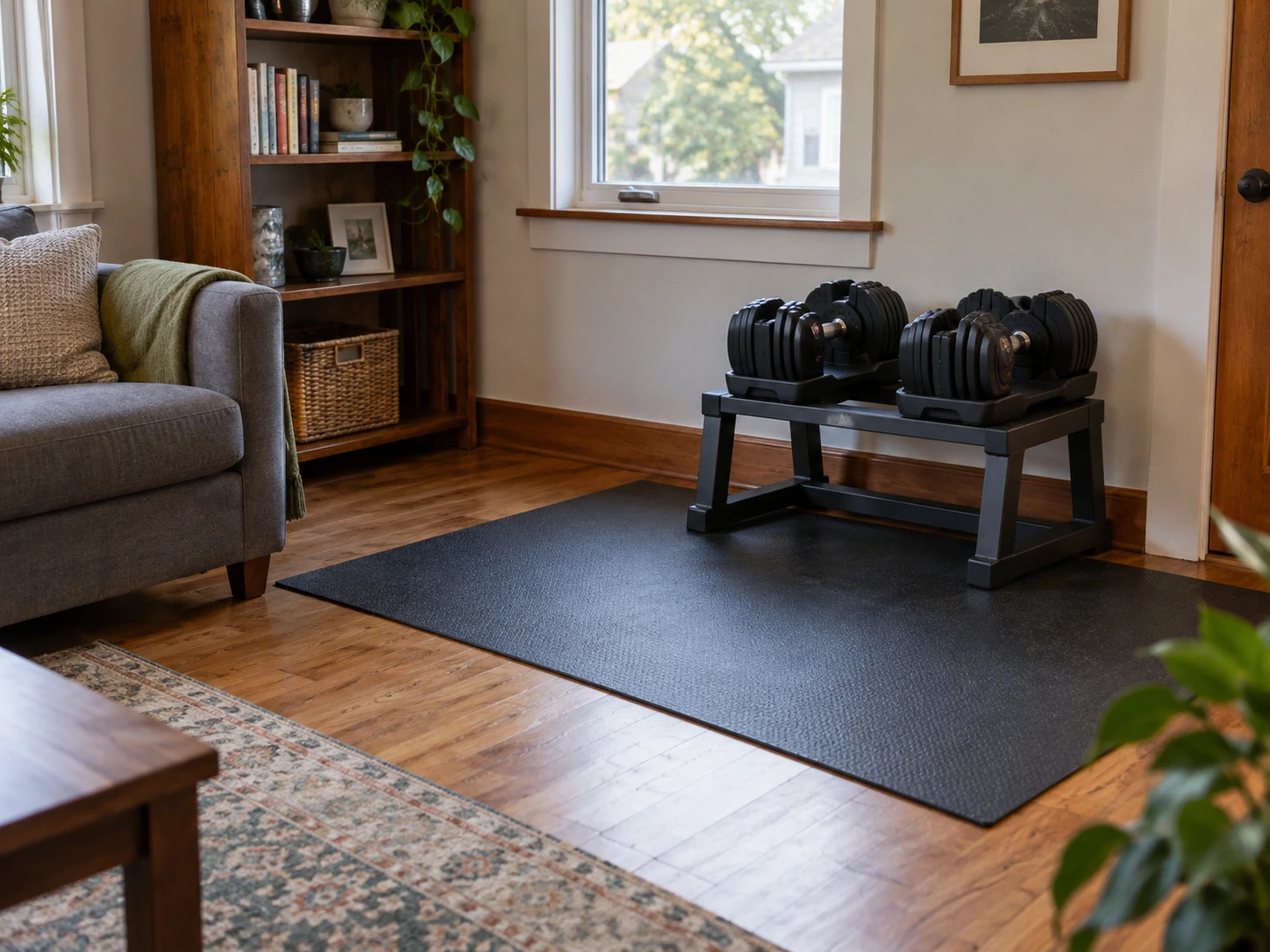
An adjustable dumbbell pair is usually easier to put away than a complete rack and barbell setup. Still, you need space to pick it up, perform each exercise, and return it without hitting furniture. A small storage footprint does not describe the whole workout area.
With a barbell, measure the complete bar and access beyond both sleeves. According to Rogue, the stainless Ohio Bar is 86.75 inches long. That is one model's dimension, rather than a universal requirement for every bar. A wall just beyond its end can leave it technically inside the room but awkward to load.
Measure rack depth, bench position, entry and exit, and the path used to move plates. Doors, ceiling fixtures, and furniture can restrict a lift even when the equipment fits on the floor. Check overhead clearance separately if an overhead press is part of your plan.
For a barbell room, I prefer a layout that can stay ready between sessions. If every workout requires shifting a sofa, assembling supports, and carrying plates through a doorway, include those tasks in the decision. Equipment you can leave accessible may fit your routine better, even if another option has a lower initial equipment price.
Match the Tool to Your Exercises and Loading
A barbell makes the most sense when getting better at barbell lifts is part of the goal. Dumbbells make sense when you want separate hand positions, single-arm options, and several movements from a smaller equipment collection. I give the exercises you intend to repeat more weight than a claim about which tool is universally better.
Use the beginner barbell routine to check which lifts and supports that choice must cover.
For heavy lower-body exercises, a barbell can offer a practical route to loading both sides with more plates. If heavy squats and hinges already drive your training, check whether a starter dumbbell pair would run out of usable load before choosing it for its compact size. With dumbbells, you must also be able to pick up, hold, and position the pair. Your grip or the setup can become the limit before the selected exercise feels demanding enough. A supported split squat can change that loading problem, but it also changes the exercise you are practicing.
Dumbbells allow each arm to carry its own load and can make differences between sides easier to notice. Independent movement does not automatically correct an imbalance. Load selection, technique, and what caused the difference still matter. A freely chosen grip may suit a movement better, but separate weights do not establish a universal safety advantage.
Muscle growth, or hypertrophy, is also a programming question. The 2026 American College of Sports Medicine position stand supports progressive resistance training across several forms of exercise. Its broad equipment findings are not a direct demonstration that barbells and dumbbells produce identical growth in every exercise and program.1 Choose a setup that supplies repeatable, appropriately challenging exercises for the muscles you want to train.
The weights on the two implements are not interchangeable test scores. In a study of 12 resistance-trained men, maximum chest-press loads differed between dumbbell and barbell conditions. It was an acute strength and muscle-activity comparison, not a long-term trial of muscle growth or home-gym safety.2 A universal dumbbell-to-barbell conversion would hide those task differences.
Look at the size of the available weight increase, too. Adding 2.5 pounds to each dumbbell increases the pair by 5 pounds; adding one 1.25-pound plate to each end of a bar increases its total by 2.5 pounds. Those are arithmetic examples, not standard increments for every product. Ironmaster, for example, lists 2.5-pound adjustments per dumbbell for its 75-pound Quick-Lock set; read the actual settings and loading instructions for the model you are considering.
Before ordering, list a squat, a hip hinge such as a Romanian deadlift, a push, and a pull that work with the proposed equipment. Our full-body dumbbell workout shows how those choices can become a routine. Check both the lightest and heaviest loads for that routine, plus the size of each increase. A pair that suits your squat can still start too heavy for a smaller upper-body exercise.

Check How You Will Start and Finish Each Set
Choose equipment you can get into position and put away under control. A weight being manageable during an exercise does not establish that you can lift it from the floor, position it for a press, or recover from a missed repetition.
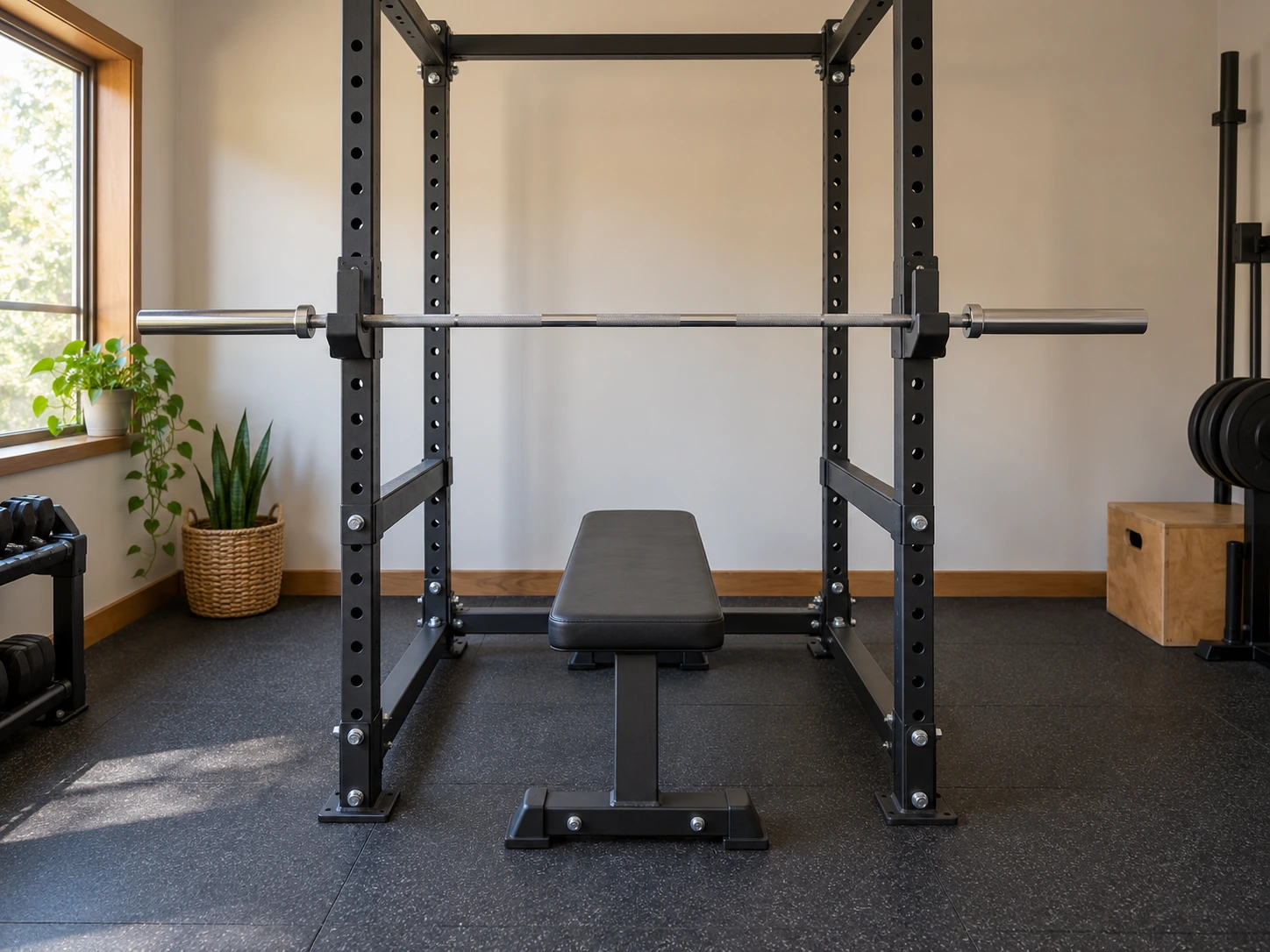
Barbell back squats and bench presses need appropriate supports. The National Strength and Conditioning Association's professional standards pair appropriate safety equipment, such as power racks, with attentive spotting for free weights supported on the trunk or moved over the head or face. These standards concern supervised facilities; home training still needs the exact equipment instructions and competent help with setup and spotting. Include suitable safeties in the purchase, rather than relying on a pair of hooks to cover a failed lift.
For dumbbells, rehearse the whole sequence with an easy load: pick up, get into position, perform the set, and return the weights. Do not make dropping the pair your planned exit. Adjustable mechanisms have model-specific handling limits, and a dumbbell floor press still requires a workable way to start and finish.
I favor push-ups while a pressing station lacks the necessary supports or a workable way to start and finish. If you do want barbell bench presses, compare the weight bench options and the power rack setups together. Bench fit, supports, and your lifting position must work as one arrangement.
Choose the Setup You Can Use This Month
Buy dumbbells first when you can name a complete routine, store the pair conveniently, and work within its range. Choose a barbell first when barbell training is the priority and the room, complete purchase, and support arrangement are already feasible.
- Write the exercises you expect to perform twice a week.
- Check every required load, support, and transition into position.
- Measure the training and storage arrangements, then compare complete purchase lists.
You can add the other implement later when it solves a specific limitation. A barbell room may benefit from dumbbells for supported rows or smaller exercises; a dumbbell setup may eventually need more convenient heavy lower-body loading. Let that need determine the next purchase.
This content is for general equipment and exercise education. It does not replace individual instruction or medical advice. Seek qualified guidance when a health condition, pain, or uncertainty about technique affects your training.
FAQs
Which is better, a barbell or dumbbell?
Dumbbells are often the better first purchase for a shared room, while a barbell suits a dedicated space and barbell-specific goals. Compare the complete equipment, usable loads, and exercises before choosing.
What is the difference between a barbell and a dumbbell?
A barbell is one long bar held with both hands, while a dumbbell is a separate weight held in one hand. A pair of dumbbells lets the arms move independently, which changes grip and exercise options.
Should beginners buy dumbbells or a barbell first?
Beginners can start with either, provided the starting load, exercises, and support equipment suit them. I favor dumbbells when a compact general routine is the goal, and a complete barbell setup when practicing those specific lifts is the reason for training at home.
Do you need both barbells and dumbbells?
No, you can begin with one category if it supports a balanced, progressively challenging routine. Add the other when it supplies an exercise or loading option your current setup lacks.
Can you compare dumbbell and barbell weights directly?
You can compare the stated pounds, but you should choose a working load separately for each exercise and implement. Two 25-pound dumbbells total 50 pounds; that does not predict which barbell load you can perform for the same repetitions.
References
- Currier BS, D'Souza AC, Fiatarone Singh MA, et al. American College of Sports Medicine position stand. Resistance training prescription for muscle function, hypertrophy, and physical performance in healthy adults: an overview of reviews. Med Sci Sports Exerc. 2026;58(4):851-872. doi:10.1249/MSS.0000000000003897.
- Saeterbakken AH, van den Tillaar R, Fimland MS. A comparison of muscle activity and 1-RM strength of three chest-press exercises with different stability requirements. J Sports Sci. 2011;29(5):533-538. doi:10.1080/02640414.2010.543916.