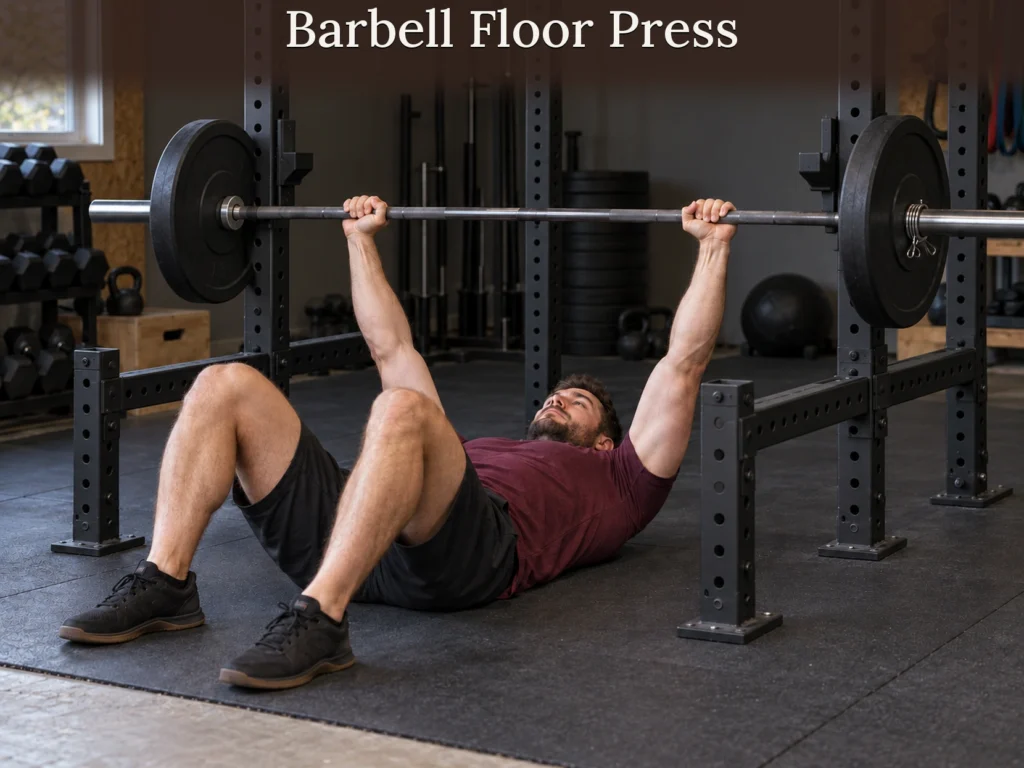
Barbell Floor Press: Setup, Form, and Working Sets

Founder
I founded HomieGym to help you make informed decisions about training at home. My background includes university-level sports science education, practical coaching, gym training and combat sports.
The barbell floor press trains your chest, triceps, and front shoulders while the floor limits how far your upper arms travel behind your body. I recommend it when that shorter pressing range serves your training and you can set up a reliable unrack, catch, and return. The rack setup still needs to work at floor height.
This guide uses a bent-knee, feet-flat version. Start by checking whether your rack can accommodate the movement, then learn the pause before adding weight.
Table of Contents
What the Barbell Floor Press Trains
The floor press is a compound pressing exercise: your chest and front shoulders help move the upper arms, and your triceps straighten the elbows. It is useful for practicing a controlled press from a consistent bottom position. It does not isolate your triceps or remove your chest from the movement.
Your posterior upper arms, the backs of the upper arms above the elbows, meet the floor during the descent. Compared with a similar bench-press setup, that contact limits shoulder extension, or how far the upper arm moves behind the torso. The exact bar height depends on your proportions and grip.
I choose this variation for a deliberate pause or a workable pressing option when a bench is unavailable. For a goal centered on bench pressing, keep practicing the bench press when the equipment and movement suit you. A shorter range also does not guarantee shoulder comfort, so stop a painful repetition rather than forcing the lift.
Set Up the Bar, Supports, and Safeties
Use a compatible rack with adjustable J-cups and catch supports as the starting station for this guide. J-cups hold the bar before and after the set. Safeties receive it if you cannot finish a repetition. Both need to work with your bar, body position, and the rack manufacturer's instructions.
A rack built for standing exercises may not adjust low enough for a floor press. Before loading plates, rehearse the entire route with an unloaded bar you can manage. If the standard bar is already too heavy, use a suitable lighter training bar or another exercise.
- Check the hardware. Confirm that the rack is secured as required, both cups and safeties are seated correctly, and the bar rests on approved support areas. Leave space around both sleeves for loading.
- Find a reachable start. Lie down with knees bent and feet flat. Position the cups so you can clear them with a short controlled press while keeping your shoulder blades set against the floor.
- Rehearse the full repetition. Your upper arms must touch down gently without the bar hitting the safeties during an ordinary repetition.
- Check the catch and exit. With the light bar resting on both safeties, verify clearance above your torso and neck and a clear route to get out. Rehearse this without deliberately failing a repetition under load.
- Rehearse the return. Make sure you can guide the bar back into both cups and confirm that both ends are supported before releasing your grip.
If the rack's hole spacing cannot provide both normal movement and catch clearance, change the station or exercise. A different floor covering can also change your height relative to the supports, so repeat the checks after changing the setup. Follow the actual bar, plate, collar, and rack instructions.
A competent handoff can help you reach the starting position, but a handoff alone does not provide failed-repetition protection. Agree on assistance and return before starting. Do not plan to roll a loaded bar over your torso, tip plates off, or remove collars as your escape.
How to Do the Barbell Floor Press
Lower until your upper arms make gentle floor contact, pause, then press to straight elbows with control. Keep the same feet-flat position throughout the set so the bottom position and effort are repeatable.
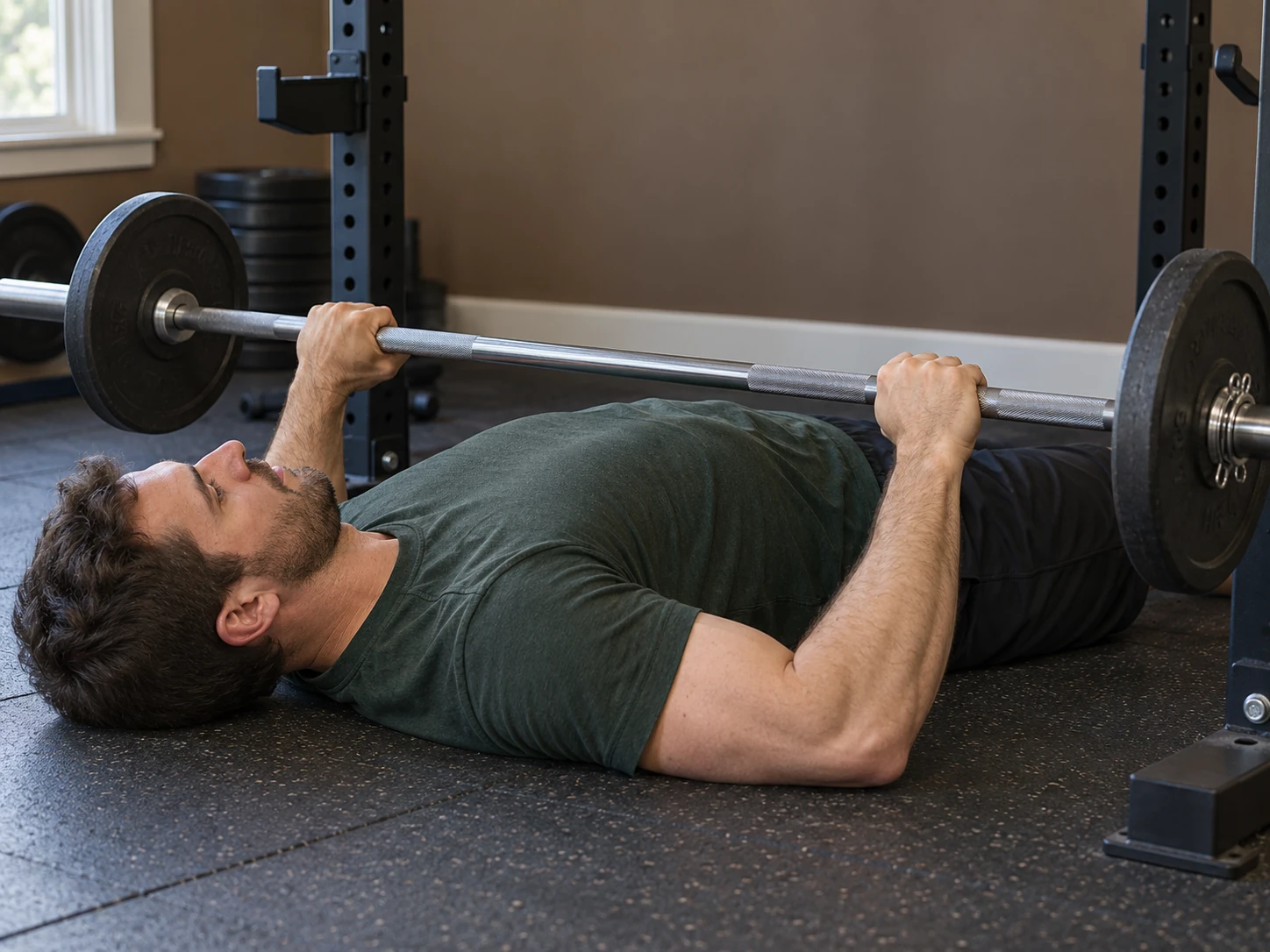
- Set your base. Lie under the bar, bend your knees, and place both feet flat. Keep your head, upper back, and hips supported. Set your shoulder blades against the floor with a small natural back arch.
- Take a closed grip. Wrap your thumbs around the bar. Choose a width that lets your wrists stay over your forearms near the bottom, with elbows angled away from your torso rather than forced straight out to the sides.
- Brace and unrack. Firm your abdomen to steady your trunk. Clear both cups, then bring the bar over your chest into a balanced start with straight elbows.
- Lower under control. Bend your elbows and keep both sides moving together. Your forearms should stay close to vertical when viewed from the front. Avoid letting the bar drift toward your face.
- Pause on gentle contact. Let the posterior upper arms meet the floor without striking your elbows. Hold the bar steadily for a brief pause. Do not bounce or relax your grip and shoulders.
- Press and return. Straighten both elbows while keeping your hips down. After the final repetition, steady the bar, guide it back to both cups, and check support before letting go.
If you cannot finish a repetition, lower the bar under control onto the safeties you checked. Let both supports take the weight, then move clear by the route you rehearsed once the bar is supported and still. If your station cannot provide that return and exit, choose another press before loading it.
Do not force the bar to your chest. Some body proportions allow chest contact; others leave a gap. The upper-arm floor contact controls the bottom position. Stop the descent earlier if you lose control or develop pain, and reassess the exercise before continuing.
Fix Bouncing, Wrist Drift, and Uneven Pressing
Reduce the load when you cannot pause, keep the bar level, or return it reliably. A heavier repetition with a bounce or rising hips changes the task you are trying to practice.
| What happens | What to change |
|---|---|
| Elbows strike the floor | Lower more slowly and use less weight. |
| Wrists fold far backward | Set the bar over the forearm and keep a full grip. |
| Bar drifts toward the face | Rehearse a balanced route over the chest with a lighter bar. |
| One end rises first | Check grip spacing and reduce the load. |
| Hips lift into a bridge | Keep hips down and finish the set before form changes. |
| Shoulders shift during unracking | Recheck cup height and body position before the next set. |
I treat an unreliable unrack as a setup problem before considering more technique cues. If clearing the hooks makes you reach and lose upper-back contact, another repetition will not fix the station. Adjust it unloaded or choose a different press.
Stop for sharp pain, numbness, dizziness, or a sudden loss of control. If symptoms persist or recur, get appropriate medical advice. A qualified coach can help when a light rehearsal still leaves the bar route or support arrangement unclear.
Choose a Load and Plan Your Working Sets
Start with a load that lets you pause every repetition and finish with about 2 to 3 controlled repetitions remaining. This is an effort estimate, often called repetitions in reserve. Allow more margin while learning, especially if you are still unsure how difficult the next repetition will be.
The 2026 American College of Sports Medicine overview supports progressive resistance training and found that training to momentary muscle fatigue did not consistently improve outcomes (1). You can work hard without intentionally reaching a repetition you cannot complete.
| Part of the session | Starting example |
|---|---|
| Rehearsal and warm-up | Easier sets to check the station and practice the pause |
| Working sets | 2 sets of 6 to 10 repetitions |
| Rest between working sets | 2 to 3 minutes, longer if needed for control |
| Effort | About 2 to 3 controlled repetitions remaining |
This is a modest starting example, not a study-tested optimal floor-press dose. Warm-up sets prepare you for the work and are separate from the two working sets. You do not need a maximum-strength test to choose a manageable starting load.
Place the floor press in an existing press slot. For example, if you bench press on Monday and Thursday, you could use the floor press for Thursday's two press sets rather than adding a third pressing day. Check how that change affects your goal, and account for overhead presses and direct triceps work elsewhere in the week.
Reach 10 repetitions in both working sets with the same pause, range, and intended effort before considering the smallest practical load increase. After increasing, return toward six repetitions and build again. Log the total weight of the bar and plates, along with repetitions and any setup change. Keep the load unchanged if the available increase is too large.
One difficult session does not automatically require a deload, a planned reduction in training demands. If performance or control repeatedly worsens, review the load, number of sets, spacing between press sessions, and recovery. For a wider plan with lower-body and pulling work, use the full-body barbell workout guide.
Floor Press or Bench Press: Choose by Range and Setup
Choose the floor press when you want its floor-limited range and can provide a suitable station. Choose the bench press when you want to train that lift and can control its longer available descent. Pick by the movement you need to practice, rather than assuming one press is better for everyone.
| Decision | Floor press | Bench press |
|---|---|---|
| Bottom position | Upper arms meet the floor | No floor contact limits the upper arms |
| Available range | Usually shorter with a similar grip | Allows a deeper descent |
| Body support | Stable floor surface | Suitable weight bench |
| Bar handling | Reachable low supports and checked catch clearance | Checked bench, rack, and catch arrangement |
| Practice specificity | Paused floor-press skill | Bench-press skill through its intended range |
A floor press still trains your chest. However, the shorter range does not establish equal muscle growth, and there is no fixed floor-press-to-bench weight ratio you need to reach. Select and progress the load for each exercise separately. If shoulder discomfort prompted the change, judge the actual movement response rather than assuming the floor makes pressing pain-free.
Adjust Your Grip or Change the Press When Needed
A grip change can make the bar easier to control, but it also changes your pressing position. Rehearse any new width with a light load. A somewhat closer grip is an option if your wrists remain stacked and your elbows move comfortably; touching your hands together is unnecessary.
A curl-bar floor press offers angled hand positions. Check that the bar's usable support span fits your rack and that its shape rests securely on the approved contact areas. Many short curl bars do not span normal rack supports. A rackable specification applies to that particular bar, not every EZ or curl bar.
I would switch exercises before forcing an awkward grip or improvising a bar start from the floor. A manageable dumbbell press or suitable push-up may be a more practical route when the available bar and rack do not work together. Choose an alternative you can start, perform, and finish under control.
FAQs
Can you do a barbell floor press without a rack?
Yes, a barbell floor press can be performed without a rack, but it still needs a workable start, return, and failed-repetition plan. A handoff alone does not establish all three. This guide uses a compatible rack station; choose another press if you cannot provide that arrangement.
Should the bar touch your chest during a floor press?
The bar may touch your chest during a floor press, depending on your proportions, grip, and setup. Let gentle upper-arm floor contact define the bottom instead of forcing extra descent to reach your chest.
Should your legs be straight or bent?
Both straight-leg and bent-knee floor presses are valid variations; this guide uses bent knees with feet flat. Keep your hips down and use the same leg position each session so your repetitions remain comparable.
Can a floor press replace the bench press?
Yes, a floor press can replace a bench-press slot when its shorter range and setup suit your goal. It does not provide the same practice as bench pressing through a longer range, so keep that difference in mind if bench-press performance is the priority.
This content is for informational and educational purposes only. It is not a substitute for professional medical advice, diagnosis, or treatment. Consult your healthcare provider before starting a new fitness program if you have a medical condition, an injury, or concerns about exercise.
References
- Currier BS, D'Souza AC, Fiatarone Singh MA, et al. American College of Sports Medicine position stand. Resistance training prescription for muscle function, hypertrophy, and physical performance in healthy adults: an overview of reviews. Med Sci Sports Exerc. 2026;58(4):851-872. doi:10.1249/MSS.0000000000003897