
Cable Machine Core Exercises: 6 Moves and an Ab Workout

Founder
I founded HomieGym to help you make informed decisions about training at home. My background includes university-level sports science education, practical coaching, gym training and combat sports.
Cable machine core exercises let you train your abs by curling your trunk, resisting a sideways pull, and controlling a diagonal movement. I recommend learning one exercise from each task before adding more variations, because changing the handle position is useful only when you understand what your body is supposed to do.
The routine below uses a crunch, a Pallof press, and a cable chop. You will also find standing, kneeling, and low-to-high alternatives, with instructions for choosing the version that fits your equipment. You need an adjustable cable station, a compatible rope and single handle, and enough clear space for the cable to travel without touching your body.
Jump to sample workout, crunches, Pallof presses, chop, and lift.
Table of Contents
Cable Machine Ab Workout: Exercises, Sets, and Reps
Start with the three exercises below, using a light practice set before each unfamiliar movement. Check that the pulley adjustment is locked and the attachment is secure, then rehearse getting into position and returning the weight stack to rest. The crunch involves controlled trunk flexion, meaning you bring your ribs toward your pelvis; the Pallof press asks you to resist turning, while the chop introduces a deliberate diagonal turn. Choose the version whose intended movement you can repeat under control.
This is my suggested starting routine for a generally healthy adult who can perform the movements comfortably. The set and rep choices are a practical example, not a tested protocol or a requirement to do all six exercises in this guide. If you are still learning the chop, practice it separately with very light resistance and use the first two exercises for your working sets.
For the Pallof press and chop, the listed repetitions apply to each side. Finish one side, return the stack to rest, then reset and complete the other side before taking the listed rest. Take a longer break between sides if needed to keep the second side controlled. Choose loads that leave you able to perform another two or three good repetitions; stop earlier if your position changes or the cable starts pulling you off balance.
| Exercise | Sets and reps | Rest | Setup |
|---|---|---|---|
| Kneeling cable crunch | 2 sets of 10 to 15 | 60 to 90 seconds | High pulley, rope, mat |
| Standing Pallof press | 2 sets of 8 to 10 per side; 2-second pause | 60 to 90 seconds after both sides | Chest-height pulley, handle |
| High-to-low cable chop | 2 sets of 8 to 10 per side | 60 to 90 seconds after both sides | High pulley, two-hand grip |
You can replace the kneeling crunch with the standing version, or the standing Pallof press with the half-kneeling version. Treat the low-to-high lift as an alternative diagonal task to learn, rather than an extra exercise you must tack onto every session. Stop a movement that causes pain instead of forcing the prescribed range.
Cable Machine Crunches: Kneeling and Standing Variations
Cable machine crunches train a controlled curl of the trunk against resistance. Keep your hands in roughly the same place beside your head while your ribs move toward your pelvis. A large bow at the hips changes the movement, even if the weight stack rises.
Kneeling Cable Crunch
Attach a rope to a high pulley and place a firm mat in front of the station. With a light load selected, take the rope while standing, bring the ends beside your temples, and lower onto the mat facing the pulley. Keep the cable clear of your face and leave enough travel for the full curl and return.

- Settle your hips above or slightly behind your knees, with your elbows bent and hands staying beside your head.
- Exhale as you curl your ribs toward your pelvis. Let your upper trunk round through a comfortable range.
- Pause where you can hold the curl without sitting back or dragging the rope with your arms.
- Uncurl slowly to the starting position, keeping control of the upward pull.
- After the final repetition, bring one foot forward and stand while holding the rope. Guide it back toward the pulley until the stack rests, then release it.
Watch your waistband in a side view. A large backward shift suggests you are sitting toward your heels to move the load. Reduce the weight and shorten the motion until the curl is easier to distinguish. Use an unloaded floor crunch if the lightest cable setting is too demanding or you cannot kneel and stand while controlling the rope.
Standing Cable Crunch
The standing cable crunch offers the same general curling task without kneeling. It also asks you to manage your balance against a high cable.

- Face the high pulley with a rope attachment. Hold the ends beside your temples and plant your feet about hip-width apart.
- Soften your knees and choose a position where the cable clears your head and remains under control.
- Curl your ribs toward your pelvis, keeping your hands beside your head and your hips relatively still.
- Return slowly without letting the cable lift your heels or pull you into an exaggerated backward arch.
- After the set, step toward the station and guide the rope upward until the stack rests before letting go.
A standing crunch can turn into a squat when the resistance is too heavy. Check whether your knees bend further on every rep while your trunk barely curls. I would reduce the load before changing stance repeatedly to make the stack move. Choose the kneeling version when its support makes the intended motion easier to repeat.
Cable Machine Ab Exercises for Stability and Rotation
Pallof presses keep your trunk facing forward while the cable pulls from the side. Chops and lifts move the hands diagonally, and their technique depends on whether the chosen version includes body rotation. The versions below specify that difference so you can practice one clear task at a time.
| Exercise | Hand movement | Trunk task |
|---|---|---|
| Pallof press | Forward and back | Resist turning |
| High-to-low chop | Diagonal downward | Controlled turn with the hips |
| Low-to-high lift used here | Diagonal upward | Keep chest and pelvis facing forward |
Standing Pallof Press
Set a single handle around chest height and stand side-on to the station. Your hands press forward while the cable pulls sideways.
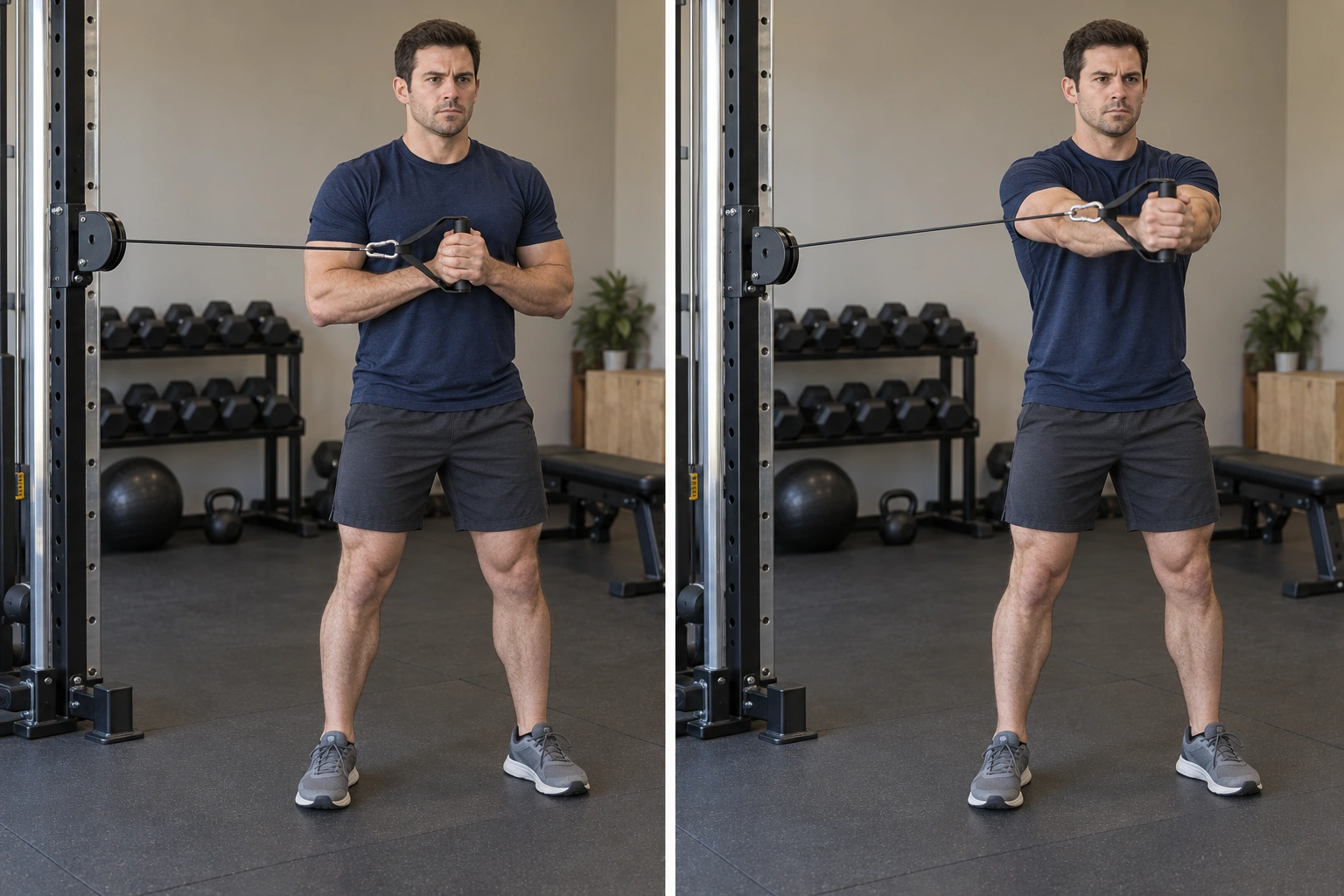
- Hold the handle with both hands at your chest, feet comfortably apart and knees slightly bent.
- Take up the slack without walking so far away that you lose a stable stance.
- Press forward, keeping your breastbone and belt buckle facing the same direction.
- Pause for two seconds while breathing, then bring the handle back to your chest.
- After the set, step toward the pulley and guide the handle back until the stack rests. Turn around to work the other side.
The farther your hands move from your torso, the harder it can become to resist the turn. If your chest follows the handle toward the machine, reduce the load or use a shorter press while learning. Keep that shorter range consistent so your training log records comparable repetitions.
Half-Kneeling Pallof Press
This version uses one knee on a mat and the other foot planted in front. Lower the pulley to chest height in that position and use a load you can control while kneeling and standing.

- Take the handle with both hands, then kneel side-on with the knee nearest the station on the mat and the opposite foot forward. Keep the front foot and rear knee separated sideways for balance.
- Hold the handle at your chest and keep your ribs above your pelvis.
- Press forward without shifting your pelvis toward the cable or leaning away from it.
- Pause for two seconds while breathing, then return the handle to your chest under control.
- After the set, stand while keeping the handle close, step toward the pulley, and guide it back until the stack rests. Turn around and switch the forward leg to mirror the setup.
Keep the same knee position relative to the station when you repeat the exercise. Use the standing press if kneeling feels uncomfortable or balance overwhelms the exercise. A wider, steady base is more useful here than making the position deliberately wobbly.
High-to-Low Cable Chop
For this rotational chop, place the pulley above shoulder height and use a handle designed for a two-hand grip. Take it while facing the station, then step into a side-on stance with the cable clear of your head.

- Begin with your hands near the machine-side shoulder, knees softly bent and weight balanced over your feet.
- Guide the handle down and across toward the opposite hip, letting your chest and hips turn together.
- Allow your feet to pivot as needed rather than fixing your knees in place while forcing a large twist.
- Stop within a controlled range and retrace the diagonal slowly.
- After the set, step toward the pulley and guide the handle back until the stack rests. Reposition to work the other side.
Keep a slight bend in your elbows without turning the movement into a forceful downward arm yank. If the cable drags you back between repetitions, use less weight. This version is a smooth strength exercise; rapid swings and forced end-range twisting do not belong in the routine above.
Low-to-High Cable Lift
Use the low-to-high lift here as a diagonal arm movement against a steady trunk. Keep your chest and hips facing forward in this variation. Other versions include a turn, so use the same version consistently when comparing your sets.

- Attach a rope to a low pulley. Face the station and bend your hips and knees to pick up the rope. Stand, then turn side-on with feet apart and an end in each hand near the machine-side hip.
- Brace your trunk and guide the rope diagonally across your body toward the opposite shoulder.
- Keep your pelvis and chest facing forward, allowing your elbows to bend comfortably as you guide the rope. Stop before you need to lean back or shrug to lift higher.
- Lower along the same path under control. After the set, step toward the pulley and lower the rope until the stack rests before releasing it or changing sides.
A high finish is optional; forcing the hands overhead can turn the last part into a backbend. Use a lower finish or lighter resistance when your shoulders dictate the range. The lift can replace the chop for a different diagonal task, but the two versions do not train identical movement control.
How to Do Abs on a Cable Machine With Controlled Form
Choose the body action first, then select a load that lets you repeat it. A useful form check names something visible: a hand position that stays fixed, a torso that stays facing forward, or hips that turn along with the chest.
Keeping a Crunch From Becoming an Arm Pull
During a crunch, keep the rope ends beside your temples as the shape of your trunk changes. If your hands travel from your head toward your waist while your back stays nearly the same shape, you are pulling the rope down with your arms. Set the stack down, choose a lighter load, and practice a smaller curl.
A side-on recording of a light set can show the difference between curling the trunk and rocking at the hips. It cannot measure which muscle is working hardest. I prefer this visible check to chasing a stronger burning sensation, because fatigue alone does not tell you whether you repeated the intended exercise.
Knowing When Your Trunk Should Move or Stay Still
The instruction to keep your trunk still applies to the Pallof press and the lift variation taught here. The chop deliberately allows a controlled turn. The crunch curls your trunk forward. Match the cue to the exercise you are doing.
Before starting a set, rehearse the intended motion without much resistance. Check your pulley height after changing between standing and kneeling. A setup that pulls upward into your face, catches clothing, or runs out of travel needs changing before you add weight. Our broader cable machine exercise guide explains how the cable's direction affects the movement.
How to Progress Your Cable Ab Workout
Progress when you can repeat the chosen movement without changing its range, stance, or purpose. Keep the same exercises long enough to compare them: switching from standing to kneeling, changing the pulley, and increasing the stack together makes the result hard to interpret.
Adding Reps, Pauses, or Resistance
Use the table's lower rep target initially. If you finish both sets comfortably and could repeat a few more clean reps, add a repetition next time. Once you reach the top of the range on both sets for two sessions, try the smallest available increase and return toward the lower rep target.
For Pallof presses, preserve the two-second pause while adding repetitions. Extending that pause is another option, but record the change instead of counting a longer hold as the same rep. If the next stack increment makes you twist or lean, stay with the lighter setting. Avoid hanging improvised weights from a selector pin.
There is no need to grind every set to failure. ACSM's 2026 review supports effective resistance training without requiring momentary muscular failure; the exact routine here remains an editorial example. (1)
Fitting Core Work Around Your Main Training
Begin with one or two core sessions in your week, leaving at least a day between them and accounting for exercises already in your strength program. If today's full-body session already contains Pallof presses, that work counts. You can practice the crunch on another day instead of repeating every core exercise after every workout.
Place a demanding core session after the main lifts if fatigue would otherwise make your pressing, rowing, or lower-body work harder to control. Keep early practice light when learning a new pattern. For a combined weekly schedule, use the full-body cable workout plan and choose the core slot that fits it.
For your next session, choose a crunch and a Pallof variation you can set up confidently. Add the diagonal movement once you can explain and demonstrate whether your trunk should turn or stay still.
FAQs
Should You Use Cable Crunches and Pallof Presses in the Same Routine?
Yes, cable crunches and Pallof presses can complement each other because one trains a controlled curl and the other trains resistance to turning. Start with a manageable amount of each and account for core work already included elsewhere in your program.
Can You Do These Core Exercises With One Cable Pulley?
Yes, these variations use one cable outlet, provided it adjusts to the required heights and has enough travel. You also need compatible attachments and a light enough starting resistance for the exercise.
References
- Currier BS, D'Souza AC, Fiatarone Singh MA, et al. American College of Sports Medicine position stand. Resistance training prescription for muscle function, hypertrophy, and physical performance in healthy adults: an overview of reviews. Med Sci Sports Exerc. 2026;58(4):851-872. doi:10.1249/MSS.0000000000003897.