
Cable Machine Workouts: A Full-Body Plan for 2 or 3 Days a Week

Founder
I founded HomieGym to help you make informed decisions about training at home. My background includes university-level sports science education, practical coaching, gym training and combat sports.
Cable machine workouts can cover your legs, back, chest, and core with an adjustable pulley and a few attachments. I would start with two alternating full-body sessions because you can practice the same movements often enough to compare your performance, while keeping the exercise list manageable.
The A/B plan below gives you the exercises, sets, repetitions, rest periods, and a two-day or three-day schedule. It uses one cable outlet at a time. You need a compatible handle, short bar, rope, ankle cuff, and a station that permits the listed movements, with a fixed handhold for the standing leg curl. Equipment substitutions follow the technique instructions.
Jump to Workout A, Workout B, weekly schedules, exercise instructions.
Table of Contents
Full-Body Cable Machine Workout: The A/B Plan
Alternate Workout A and Workout B on separate training days. Each session combines lower-body work, an upper-body pull, a chest press, and a core exercise. Do the five exercises in your scheduled session, rather than combining both tables into one long workout.
This is an editorial starting plan for generally healthy adults who can perform these movements comfortably. It is not a study-tested routine or a personalized prescription. The exercises cover several major movement patterns, but the plan does not give every muscle its own isolation exercise. Someone preparing for a particular sport or pursuing advanced bodybuilding goals will need a more specific program.
Use a light practice set before each unfamiliar movement. The listed sets are working sets, meaning the sets you record after practicing and warming up. For an exercise marked per side, complete both sides to finish one set. Rest briefly between sides if necessary, then take the listed break after both.
Workout A: Exercises, Sets, and Reps
| Exercise | Working sets | Reps | Rest |
|---|---|---|---|
| Low-cable squat | 2 | 8-12 | 2 minutes |
| Standing single-arm cable row | 2 | 8-12 per side | 2 minutes |
| Standing single-arm cable chest press | 2 | 8-12 per side | 2 minutes |
| Standing cable leg curl | 2 | 10-15 per side | 60-90 seconds |
| Standing Pallof press | 2 | 8-10 per side, 2-second pause | 60-90 seconds |
The squat and leg curl involve different actions: the squat bends and straightens the hips and knees together, while the curl asks you to bend the working knee with the thigh relatively still. Keep both movements controlled. If you cannot set up the cuff securely or use a fixed handhold, follow the substitution section before attempting the curl.
Workout B: Exercises, Sets, and Reps
| Exercise | Working sets | Reps | Rest |
|---|---|---|---|
| Cable Romanian deadlift | 2 | 8-12 | 2 minutes |
| Half-kneeling single-arm cable pulldown | 2 | 8-12 per side | 2 minutes |
| Standing single-arm cable chest press | 2 | 8-12 per side | 2 minutes |
| Cable-assisted reverse lunge | 2 | 8-10 per side | 90-120 seconds |
| Kneeling cable crunch | 2 | 10-15 | 60-90 seconds |
The Romanian deadlift, often shortened to RDL, is a hip hinge: your hips move backward while your knees remain slightly bent. The reverse lunge adds a single-leg task. Its cable serves partly as a counterbalance, so a larger stack number does not automatically mean a harder exercise for the front leg.
The press appears in both sessions deliberately. Repeating it lets you practice the setup and compare repetitions without introducing another attachment or bench arrangement. You can replace it later with a compatible variation once the original movement is consistent.
Cable Machine Workouts for 2 or 3 Days a Week
Begin with two days if you are new to resistance training or have a busy training week already. Consider three days once two sessions feel manageable and you can recover between them. ACSM's 2026 guidance emphasizes regular resistance training for the major muscle groups at least twice weekly, with the prescription adapted to the individual. That supports the frequency principle, not this exact A/B routine (1).
Two-Day Schedule
| Day | Session |
|---|---|
| Monday | Workout A |
| Thursday | Workout B |
Repeat this arrangement the following week. Monday and Thursday are examples; choose any two days that leave recovery time between sessions. Keep the exercises and machine settings consistent initially so you can tell whether your repetitions and control are improving. Other resistance workouts count toward your weekly workload, so do not treat this as an automatic addition to a complete existing lifting program.
Three-Day Schedule
| Week | Monday | Wednesday | Friday |
|---|---|---|---|
| 1 | A | B | A |
| 2 | B | A | B |
Continue the sequence instead of restarting with A every Monday. Moving from two sessions to three raises your weekly workload even if the sets stay the same. Make that the only major change at first. If performance keeps falling or you remain too fatigued to use controlled technique, return to two days or reduce the working sets while reassessing recovery and other activity.
How to Follow the Cable Machine Workout Plan
Work down the chosen table one exercise at a time. Finish its working sets before changing the attachment or pulley height. This makes it easier to record the settings and gives you a predictable place to rest, especially on a shared station.
Warming Up for the Exercises in Your Session
Use a few minutes of comfortable movement to get ready, then rehearse the first exercise with little or no resistance. For the squat, practice the depth and stance without a challenging cable load. For the RDL, practice moving the hips backward before asking the stack to resist that movement.
Before each subsequent exercise, do a light set that lets you check the attachment, cable path, and range. Add another practice set if the movement still feels unfamiliar. These sets should leave you fresher for the working sets, not tired before they start. Stop and change the setup if the cable rubs your body, the stack runs out of travel, or the station shifts.
Choosing Starting Weights and Rest Times
Pick a weight that allows the bottom of the listed repetition range with about two or three controlled repetitions still available. You do not need to prove that estimate by attempting extra repetitions until the movement fails. Current ACSM guidance does not require training to failure for results. (1)
If your eighth row requires a torso twist, the load is too heavy for an eight-repetition set in this plan. If you reach twelve repetitions and could easily complete many more, try the next small increase after resting. Use the machine label as a record for that machine, since cable arrangements and friction can make the same printed number feel different on another station.
The rest periods in the tables are starting points. Take longer if you are still too breathless or unsteady to repeat the movement well. For one-sided exercises, use the same weight and target repetitions on both sides, starting with the side that finds the task harder. Do not make the stronger side's extra repetitions a reason to overload the other side.
Exercise Setup and Technique
Use these instructions with the exercise tables. Check that every attachment and adjustable pulley is locked according to your station's manual. Keep hands clear of the moving stack, and return the load under control before adjusting the machine. A movement that causes pain needs to be stopped and reassessed, rather than completed to satisfy the table.
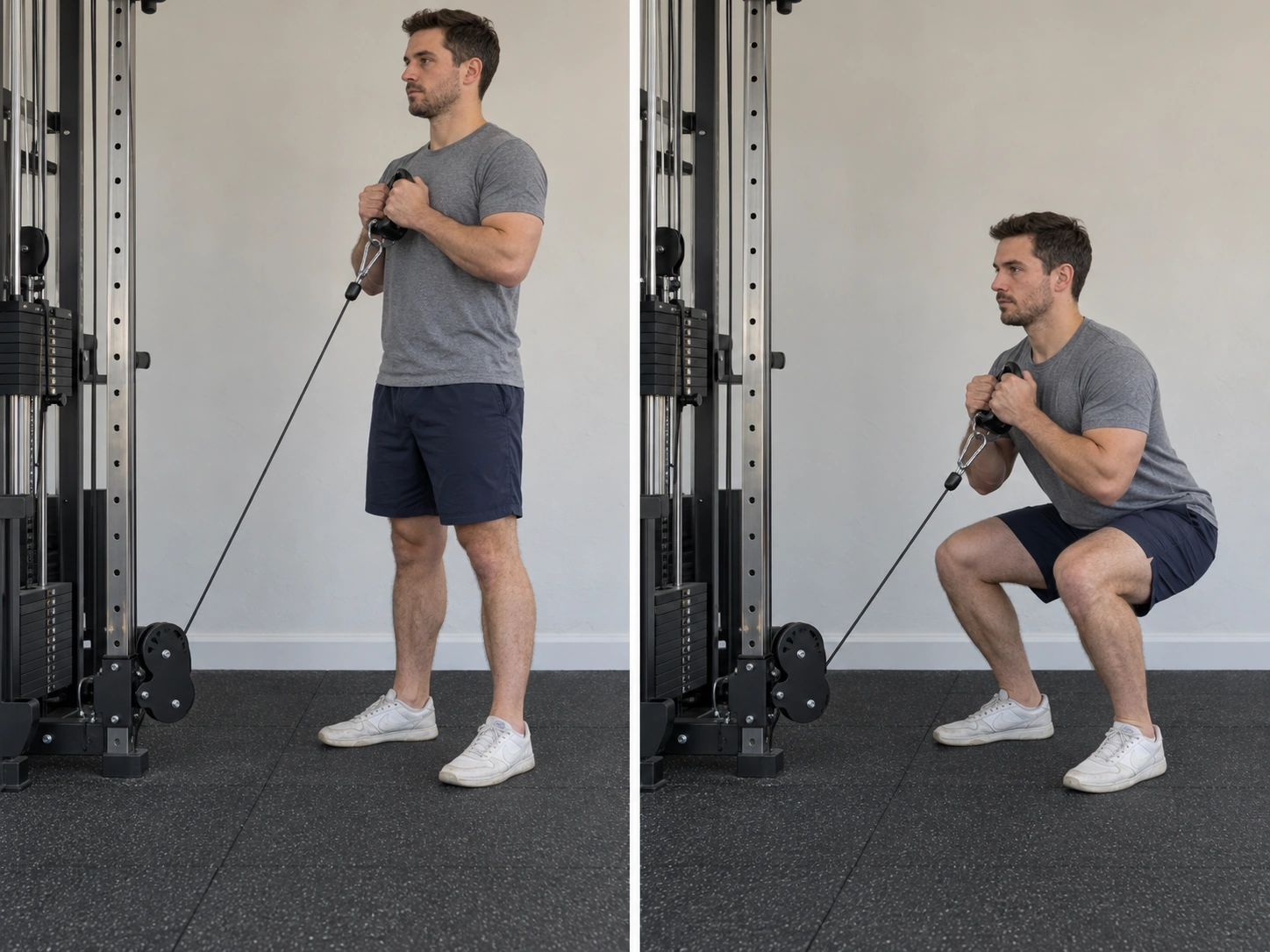
Low-cable squat. Face a low pulley and take a compatible handle in both hands close to the station.
- Bring the handle close to your chest and step back only far enough to give the cable room to travel. Set your feet at a comfortable squat width.
- Bend your hips and knees together, keeping the whole foot supported. Descend to a depth you can control.
- Push through your feet to stand, without leaning backward against the cable.
- After the set, move toward the pulley under control until the stack settles, then release the handle.
If the pull drags you toward the tower or turns the exercise into a hanging counterbalance squat, reduce the load and adjust your distance.
Standing single-arm cable row. Set a single handle around lower-chest height. Take it close to the pulley, then step back into a staggered stance facing the station.
- Start with the working arm reaching forward and your trunk steady.
- Draw the elbow toward your side, bringing the handle toward the lower ribs. Keep your chest facing ahead.
- Let the arm reach forward again without dropping the stack or rotating to gain extra reach.
- After the set, move closer under control and let the stack settle before releasing the handle or changing sides.
Reduce the load if your body has to rock. The standing arrangement lets you row without a seat, but balance can limit the resistance before your back does.

Standing single-arm cable chest press. Set the handle around chest height. Take it close to the machine, keep it beside your chest, and turn away into a staggered stance.
- Begin with the elbow slightly below shoulder height and the cable clear of your arm.
- Press forward while keeping your ribs and pelvis facing ahead.
- Return slowly until the upper arm reaches a comfortable position beside the torso. Avoid twisting to finish the press.
- After the set, move closer under control and let the stack settle before releasing the handle.
If getting into position already pulls you off balance, lower the resistance before starting the working set.

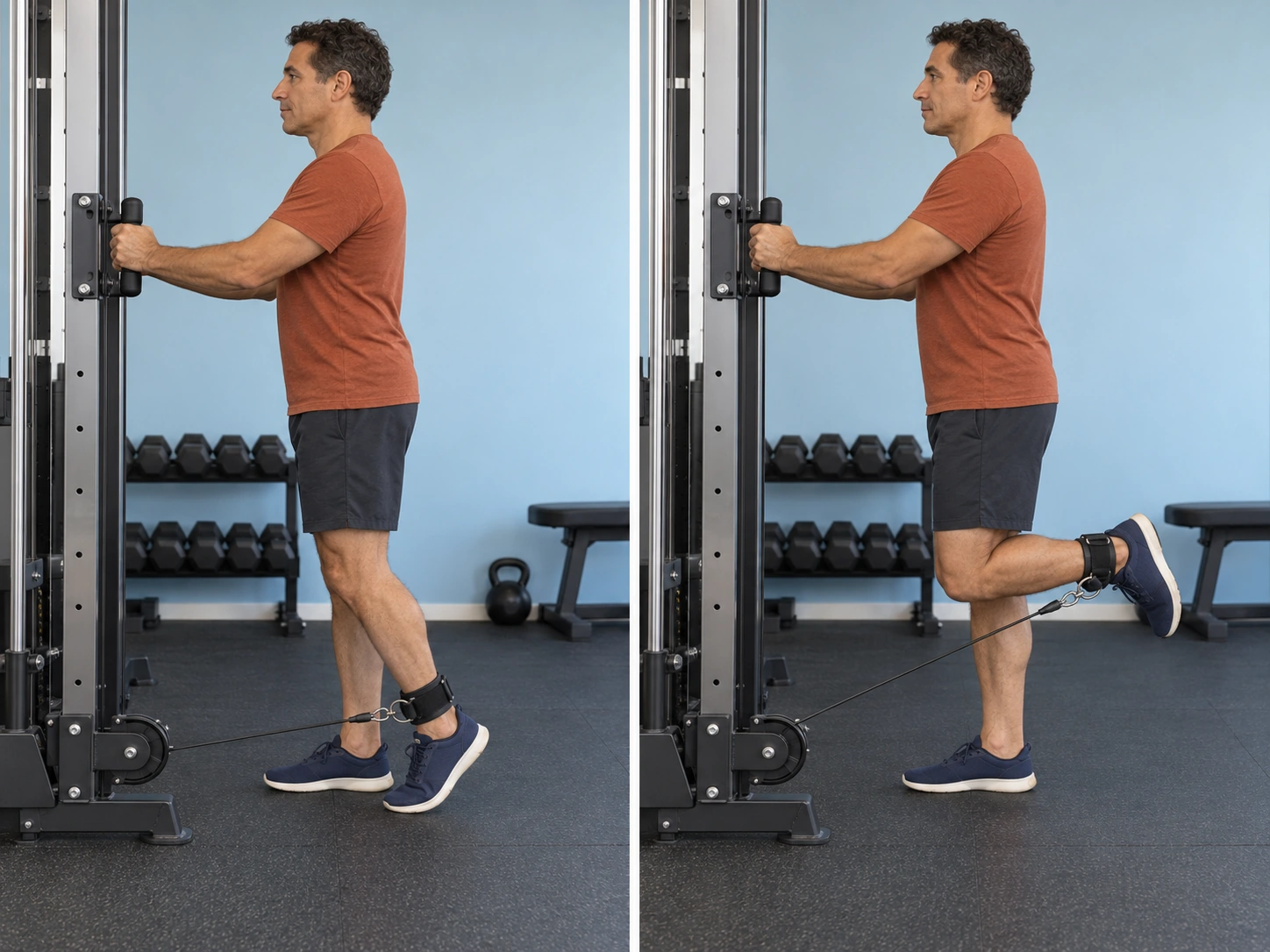
Standing cable leg curl. With the stack resting, secure the manufacturer-compatible cuff around the working ankle and connect it to a low pulley.
- Face the machine and hold its fixed handhold. Stand far enough away for the cable to remain clear.
- Bend the working knee to bring the heel backward, keeping the thigh mostly in place.
- Lower the foot slowly. Avoid swinging the whole leg behind you or arching your back to lift it higher.
- Set the working foot down and move toward the pulley until the stack settles before removing or changing the cuff.
Start light enough that balance and cuff movement do not dictate the repetition.
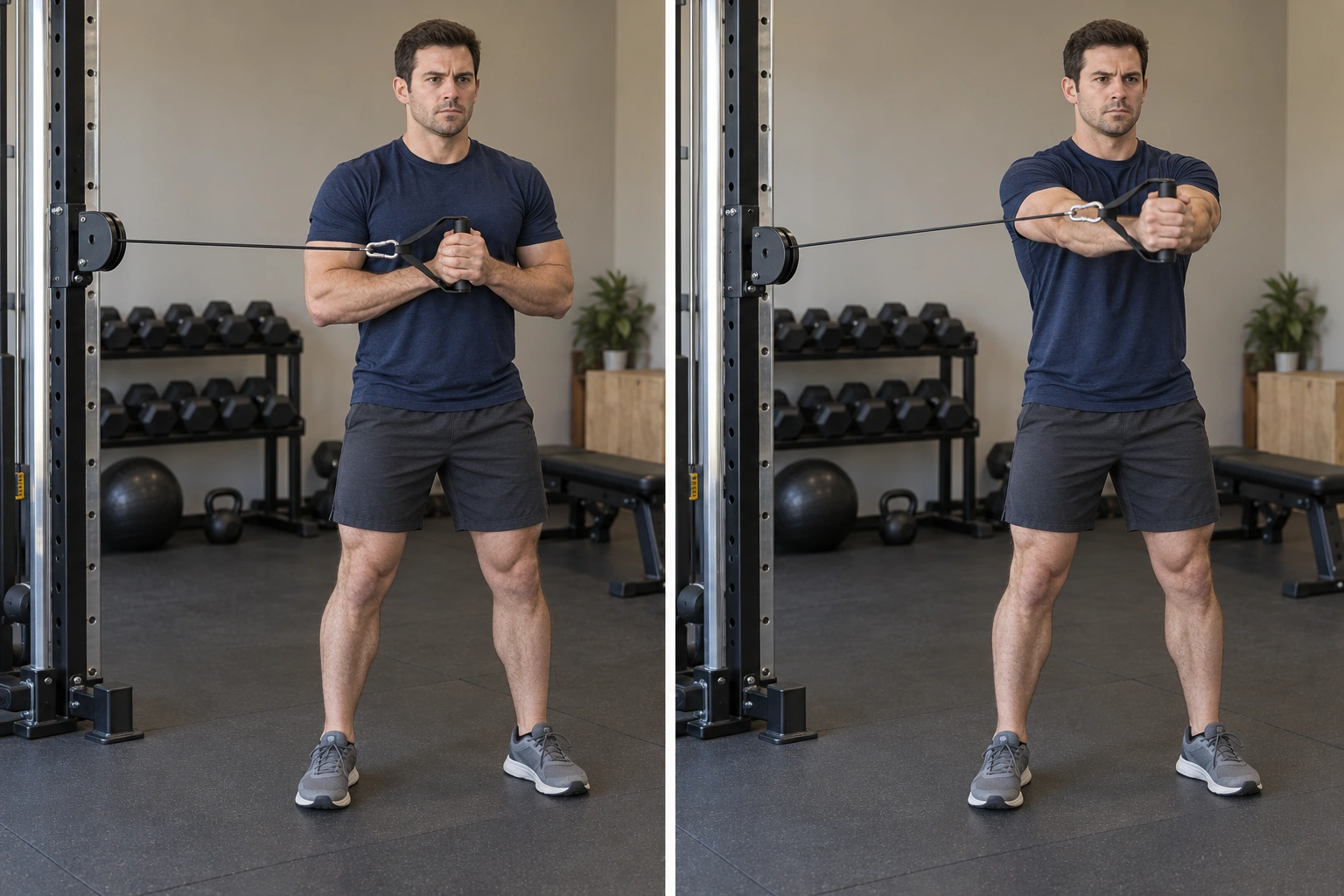
Standing Pallof press. Set a handle at chest height. Take it close to the pulley with both hands, then step out and turn side-on with your feet about shoulder-width apart.
- Hold the handle at the center of your chest, with your chest and pelvis facing ahead.
- Press it straight forward and pause for two seconds without letting the cable turn you.
- Bring the handle back to your chest under control. Complete the prescribed repetitions, then move toward the pulley until the stack settles.
- Turn to face the opposite direction and repeat with the cable pulling from the other side.
If your torso rotates or leans toward the station, lower the resistance.
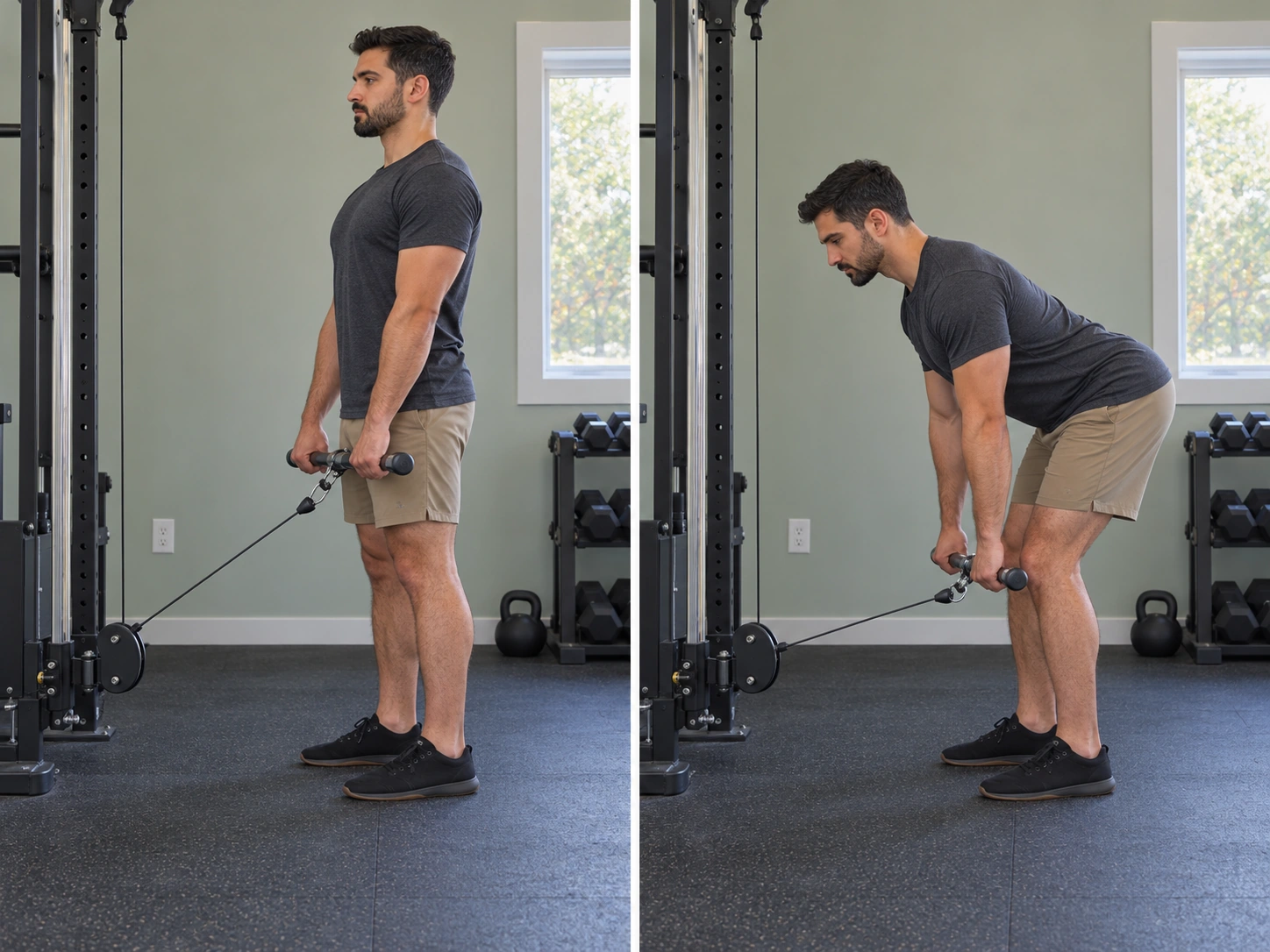
Cable Romanian deadlift. Face a low pulley with a short bar attached. Bend at the hips and knees to take it near the station, stand, then step back under control.
- With a light load, test both the upright and deepest hinge positions. The cable must stay clear and have enough travel without hitting either limit.
- Stand with your feet about hip-width apart, knees softly bent, and arms reaching down toward the cable.
- Move your hips backward while your trunk inclines as one controlled unit. Keep the same soft knee bend rather than sinking into a squat.
- Stop before you need to round your lower back, then bring your hips forward to stand tall.
- After the set, step toward the pulley under control until the stack settles, then release the bar.
Your available range depends on your control and setup; the handle does not have to reach the floor.
Half-kneeling single-arm cable pulldown. Attach a handle high on the station. Take it while standing close to the pulley, then lower into the kneeling position under control with a manageable load.
- Face the pulley with the working-arm-side knee on a mat and the opposite foot planted. The working arm should reach upward without the stack lifting your body.
- Pull the elbow down toward your side. Keep your ribs from flaring and avoid leaning backward to turn the movement into a row.
- Pause, then let the arm reach upward under control.
- After the set, rise and move closer under control until the stack settles before releasing the handle. Mirror the kneeling setup for the other arm.
If you cannot enter or leave the position while controlling the handle, reduce the load. A heavy two-arm pulldown requires a station with its intended seat and thigh restraint.

Cable-assisted reverse lunge. Face a low pulley and hold a single handle in your right hand, with the arm extended comfortably toward the outlet.
- Keep the front right foot planted and step the left foot backward.
- Lower both knees through a comfortable range, keeping the front knee tracking with the foot.
- Push through the front right foot to return. Keep the handle arm steady instead of rowing it toward your chest.
- After the set, move closer until the stack settles before switching hands. Mirror the setup for the other leg.
Use a light cable pull that helps you balance without dragging you forward. Keep the setting stable while learning: it changes the counterbalance as well as the resistance.

Kneeling cable crunch. Attach a rope high on the station. Take the ends close to the pulley, lower into kneeling facing the station under control, and hold them beside your temples.
- Curl your ribs toward your pelvis while your hands stay near your head.
- Uncurl slowly to the starting position. Avoid pulling with your arms or sitting far backward to move the stack.
- After the set, rise and move toward the pulley under control until the stack settles, then release the rope.
The intended action is a controlled trunk curl. Use a load you can manage while getting into and out of the kneeling position.

For broader guidance on what the pulley changes and how to choose movements, use our cable exercise foundation guide. It explains how pulley position changes the exercise and gives you a wider library of movements.
How to Progress Your Cable Workout
Keep the exercise order and setup consistent while you build repetitions. Changing the handle, stance, range, and weight together makes it difficult to tell what improved. Progress should leave you able to recognize the same exercise in your next session.
When to Add Reps or Weight
For an 8-12 repetition exercise, start with a load you can control for at least eight repetitions in each working set. Over subsequent sessions, work toward twelve without losing the intended movement or the small repetition reserve. Once both sets reach twelve clean repetitions for two sessions, try the smallest available increase next time and return toward the lower end of the range.
For example, a row might progress from 10 and 9 repetitions to 11 and 10, then eventually 12 and 12. These numbers illustrate a process, not a timetable you must meet. If the next stack increment is too large to allow eight controlled repetitions, stay with the current weight or choose a suitable alternative. Never improvise an unsecured extra plate or attachment.
For the assisted lunge, improve balance, range, and repeatability first. Keep the assistance consistent when comparing repetitions. For the Pallof press, count only repetitions where you hold the forward position without rotating. A heavier press with a shorter reach or no pause is a different task.
What to Record After Each Session
Record the exercise, machine, attachment, pulley setting, weight label, repetitions in each set, and any meaningful change in stance or range. A short note such as "second set: torso started turning on rep 11" is more useful than a vague rating that the session felt hard.
| Exercise | Setup | Result | Next session |
|---|---|---|---|
| Single-arm row | Same station, handle, lower-chest pulley | 10 and 9 per side; controlled | Same load; try one more clean rep |
| Pallof press | Chest-height pulley, same foot position | 8 and 8 per side; last pause shortened | Repeat load and complete each pause |
Use the log to make one sensible adjustment. If several exercises deteriorate together, consider sleep, other training, illness, and overall fatigue before assuming every exercise needs more weight. One disappointing session is a reason to observe, not rewrite the whole plan.
Cable Workout Substitutions for Your Equipment
A substitution should preserve the session's main purpose while fitting the equipment you actually have. Choose it before the session and keep it long enough to practice. Do not create an unstable rig to imitate a movement from a different machine.
No Seat or Thigh Pad
This plan uses a standing row and a manageable half-kneeling pulldown, so it does not require a seated row station or thigh restraint. If you want to replace the pulldown with a heavy bilateral seated version, use a station with its intended seat and thigh pads. A loose bench under a high pulley does not provide that restraint.
If kneeling is uncomfortable, replace the pulldown with the standing row you already learned, using the same sets and repetition range. This keeps an upper-body pull in the session, but changes it from an overhead pull to a row. Record the substitution in your log so you compare it with other rowing sessions.
No Ankle Cuff or Second Cable Outlet
You do not need a second outlet: every prescribed exercise uses one at a time. Without a compatible cuff, replace Workout A's leg curl with the cable RDL from Workout B, using two sets of 8-12 repetitions. This changes knee-bending work to a hip hinge, so it is a practical lower-body substitution rather than an equivalent hamstring isolation exercise.
If you have a comfortable bodyweight squat but cannot hold the low-cable setup securely, use the bodyweight version with the same starting repetition range. For the reverse lunge, you can similarly remove the cable and use a fixed handhold for balance. Once the available version becomes too easy, reassess the equipment and program instead of adding arbitrary repetitions indefinitely.
The Lightest Weight Is Too Heavy
Do not shorten every repetition or swing the handle to make the minimum setting work. Check whether the station has a manufacturer-approved lower-resistance configuration. If it does not, use an exercise with suitable resistance on another piece of equipment or leave that cable variation out while learning an unloaded version.
A bodyweight squat can replace the cable squat. A floor crunch can replace the kneeling cable crunch: lie on your back with knees bent and feet supported, curl the ribs toward the pelvis without pulling your head, then lower under control. An unloaded Pallof press does not provide the sideways pull used in this exercise. For that movement, use another cable station with a manageable minimum resistance.
How to Add Extra Body-Part Work to Your Cable Training Plan
Add focused work only after you understand how the base plan fits your week. Do not append all four body-part routines to the A/B plan. Their exercise libraries offer choices and more detailed coaching; their complete sample sessions would substantially increase the work you are already doing.
Use the back exercise guide to compare rows and pulldowns or learn a face pull.
The chest exercise guide explains press setups and fly variations when you want another option for pushing work.
For a lower-body substitution, the leg exercise guide covers additional hip and knee movements.
The core exercise guide compares crunches, stability work, and diagonal movements.
For a first adjustment, I would replace one appropriate exercise before adding a whole new block. If you eventually add an accessory, start with a small amount, such as one or two working sets, and monitor whether the next planned session remains manageable. Keep the purpose explicit: extra practice for a movement or focused work for an area, rather than collecting exercises because the station allows them.
Start with two training days, record both sessions, and build controlled repetitions. Keep that version while it is useful. A third day or a new exercise should solve a clear need in your training, not make a readable plan harder to follow.
FAQs
Should You Do Workout A and Workout B on the Same Day?
No, Workout A and Workout B are separate full-body sessions, and combining them doubles the listed working sets. Alternate them across your training days so each session remains manageable.
What Should You Do If You Miss a Workout?
Do the missed session on your next suitable training day, then continue alternating A and B. Avoid cramming both sessions into one day or removing recovery time just to restore the calendar.
References
- Currier BS, D'Souza AC, Fiatarone Singh MA, et al. American College of Sports Medicine position stand. Resistance training prescription for muscle function, hypertrophy, and physical performance in healthy adults: an overview of reviews. Med Sci Sports Exerc. 2026;58(4):851-872. doi:10.1249/MSS.0000000000003897.