
Cable Machine Leg Exercises: 8 Moves and a Lower-Body Workout

Founder
I founded HomieGym to help you make informed decisions about training at home. My background includes university-level sports science education, practical coaching, gym training and combat sports.
Cable machine leg exercises can train your thighs and glutes with squats, hinges, leg curls, and supported movements at the hip. I would build a first session around a squat, a hinge, and a leg curl, then choose extra exercises only when they fill a gap in your training.
You need a low pulley, compatible handles or a rope, and a secure ankle cuff for the cuff exercises. A fixed machine handhold makes the standing single-leg movements much easier to control. The eight options below include setup instructions and alternatives when your station cannot accommodate a movement.
Jump to the sample workout, squats and lunges, glute exercises, standing leg curl, or Romanian deadlift and hip adduction.
Table of Contents
Cable Machine Leg Workout: Exercises, Sets, and Reps
Start with these three exercises. They give you a squat that bends the hips and knees, a hinge that moves mainly at the hips, and a curl that bends the knee. The other exercises in this guide are options for changing the session, not another five movements to add automatically.
Warm up with a few minutes of easy walking or cycling, then practice several comfortable bodyweight squats and hip hinges. Perform a light practice set of each cable exercise before its working sets. During that set, check the whole cable path and confirm that you can enter and leave the position without fighting the weight.
For a one-leg exercise, the listed repetitions apply to each leg. Complete one side, lower the stack before switching sides or moving the cuff, take about 30 seconds to reset, then do the other side. Rest for the table's interval after both sides. Use extra rest between sides if you need it to keep the same control.
| Exercise | Sets | Reps | Rest | Equipment or substitute |
|---|---|---|---|---|
| Low-cable squat | 2 | 8 to 12 | 2 minutes | Low pulley + two-hand handle; bodyweight squat |
| Cable pull-through | 2 | 10 to 15 | 2 minutes | Low pulley + rope; cable RDL |
| Standing cable leg curl | 2 per leg | 10 to 15 per leg | 60 to 90 seconds | Low pulley + ankle cuff + fixed handhold |
Choose a load that leaves about two or three good repetitions available when you stop. This is called repetitions in reserve: you could continue with the same posture and movement, but end the set before that becomes a struggle. ACSM's 2026 position stand supports training with two or three repetitions in reserve without requiring failure (1).
The exercise order, repetition ranges, and rest periods are my suggested starting point; the review did not test this exact workout. Try it twice in a week with at least one day between sessions if it fits your existing training. If you already have two lower-body days, replace comparable exercises instead of adding two more sessions. Without a cuff, keep the squat and hinge and use an available dedicated leg-curl machine for the knee-bending exercise.
How to Do Squats on a Cable Machine
You can squat on a cable machine by holding a low-pulley attachment in front of your chest and moving through a controlled squat. The cable pulls forward as well as downward, so your distance from the pulley changes the exercise. Set up close enough to keep your feet planted, with enough clearance to lower without the handle or cable hitting the frame.
Low-Cable Squat
This version trains the thighs and glutes while you hold one two-hand attachment. Use a short V-handle or another handle the manufacturer intends you to grip with both hands. Start light enough to lift it to your chest and return it comfortably.
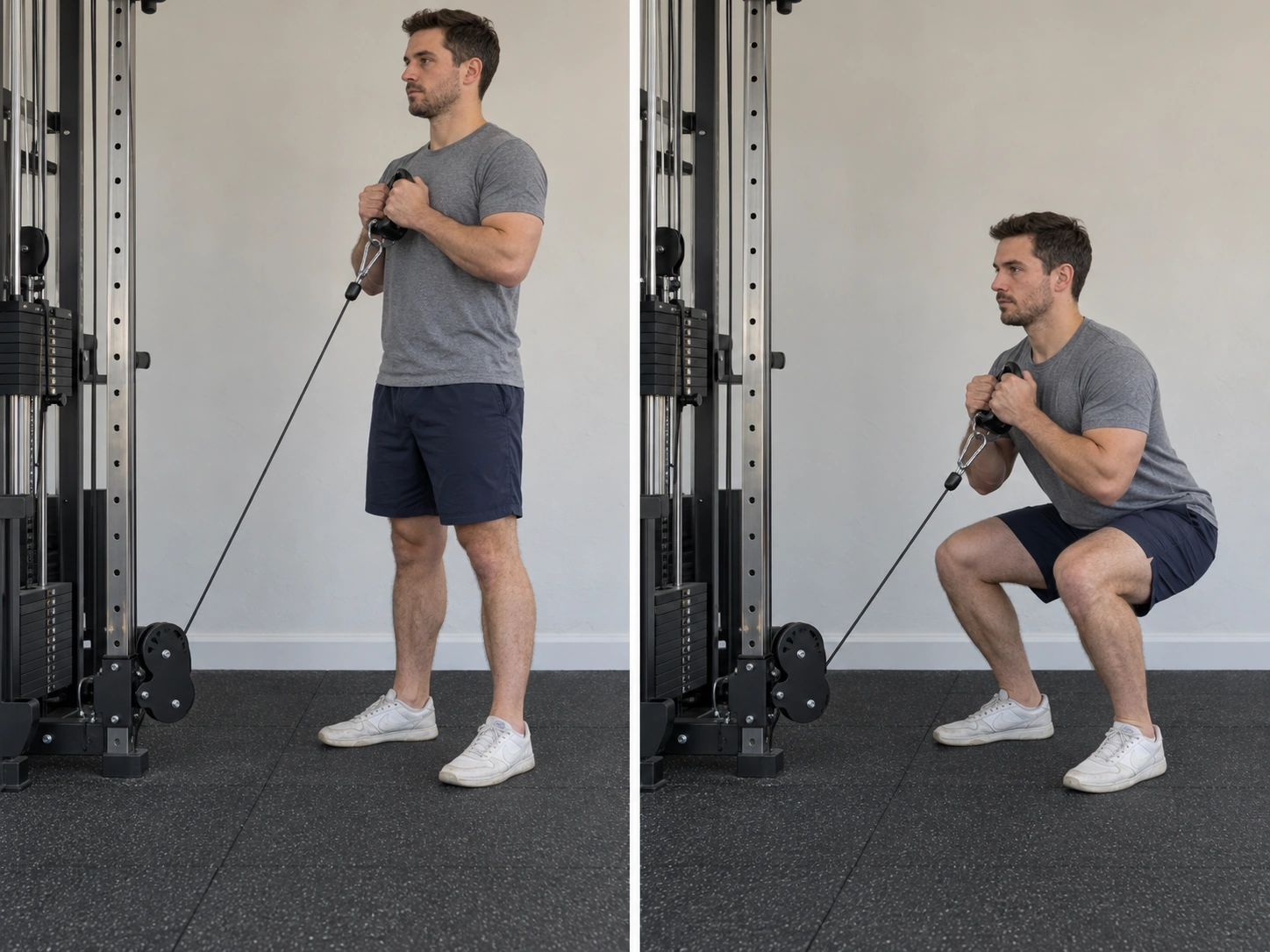
- Set the pulley low. Face the machine, take the handle with both hands, and bring it close to your chest with your elbows bent. Stand about shoulder-width apart, with your toes turned out slightly if that feels natural.
- Take a small step back to clear the machine. Keep your whole foot on the floor and your abdomen firm, then bend your hips and knees together.
- Lower to a depth you can control while your knees follow the direction of your toes. Keep the handle near your chest rather than reaching it toward the stack.
- Push through both feet to stand. Repeat smoothly, then step toward the pulley and lower the attachment until the stack rests before releasing it.
Check that your heels stay down and your torso does not rock backward as you rise. If you have to hang back against the handle, reduce the load and reassess your distance. More stack weight can increase the forward pull before it gives your legs the challenge you wanted.
A bodyweight squat is the simpler starting option. When the cable becomes difficult to hold but your legs still have plenty left, a dumbbell goblet squat or dedicated squat machine may offer a more useful progression.
Cable-Assisted Reverse Lunge: A Related Single-Leg Option
A reverse lunge lets you work one leg at a time. Here, a light cable held in front provides a counterbalance while you step backward. It changes the balance demand, but it is not a fixed support you can hang from.

- Face the low pulley with a D-handle in your right hand and your right foot planted. Keep your arm extended comfortably toward the pulley, your shoulders level, and the cable clear of your feet.
- Step your left foot back onto its toes. Keep the feet separated sideways, as though they were on two parallel tracks.
- Bend both knees to lower your body. Keep the front foot planted and the right knee following your toes. Stop before the rear knee touches the floor or your balance changes.
- Push through the front foot to stand and bring the rear foot forward. Finish the repetitions, settle the stack, and change hands and legs.
Your hand should stay quiet rather than rowing the handle as you stand. If you are pulling yourself forward or the cable is turning your shoulders, use less weight. Increasing the stack does not simply make this a heavier leg exercise: it changes the counterbalance and may assist part of the movement.
I prefer a bodyweight reverse lunge beside a fixed rail when someone needs reliable balance support. Once you can step and return consistently, a dumbbell lunge offers a clearer way to add downward load. Keep this as an alternative to the squat slot, rather than treating it as another name for a squat.
How to Use a Cable Machine for Glutes
Use a cable machine for glutes by choosing the direction you want the hip to work. A kickback moves the thigh behind you, hip abduction moves it sideways, and a pull-through trains both hips together in a hinge. These movements have different roles, so you do not need all three in every workout.
Standing Cable Glute Kickback
A kickback is useful when you want additional glute work without holding a heavy attachment in your hands. Secure a purpose-built cuff just above the ankle and connect it to the low pulley. The cuff should stay in place when the cable pulls forward.

- Face the machine and hold a fixed handhold. Step back only far enough to clear the pulley, then lean forward slightly from the hips. Keep the supporting knee soft.
- Lift the working foot just off the floor. Keep a small bend in that knee and brace your abdomen.
- Move the thigh backward without changing the angle of your torso. Stop when further travel would require you to arch your back or turn your pelvis.
- Bring the leg forward under control to the starting position. After the set, move closer until the stack rests, then remove or transfer the cuff.
Watch your waistband: it should remain level and face the machine. Lifting your foot higher can add lower-back movement once your hip has reached its available range. Reduce the range and weight if your ribs lift or your body swings.
Without a cuff, use a floor glute bridge: lie on your back with knees bent and feet planted, lift your hips until your trunk and thighs line up, and lower slowly. It gives you a different, supported way to extend the hips. Do not put your foot into an ordinary hand handle that can slip off.
Standing Cable Hip Abduction
Hip abduction means moving the leg away from your body's center line. It gives the muscles at the side of the hip a separate task from a squat or kickback. A light load is usually enough to reveal whether you can move the leg without tipping your body.

- Attach a cuff above your right ankle to the low pulley. Stand with your left side toward the machine and hold its fixed handhold with your left hand.
- Place your left foot securely, keeping a slight bend in the knee. Position the cable in front of the supporting leg, with enough clearance that it cannot rub against your shin.
- Lift the right foot slightly and move the leg out to the right. Keep your toes generally forward and stop before your pelvis tilts.
- Return toward the standing leg slowly, without letting the cable pull your feet together. Complete the set, lower the stack, and turn around to change sides.
The visible check is a level waistband and a nearly still torso. If your shoulder dips toward the machine as the leg rises, shorten the movement and lower the weight. You do not need to reach a prescribed height with your foot.
For a cuff-free alternative, lie on your side with the lower knee bent and lift the straight upper leg a short distance, keeping the pelvis stacked. This removes the standing balance task, although its resistance differs from the cable version.
Cable Pull-Through
The pull-through uses a low cable behind you to resist hip extension, the action of straightening your hips. It suits the hinge slot in the sample session when you have a rope and enough clear floor space. Check that the rope and cable can travel between your legs without catching clothing or touching the machine's base.
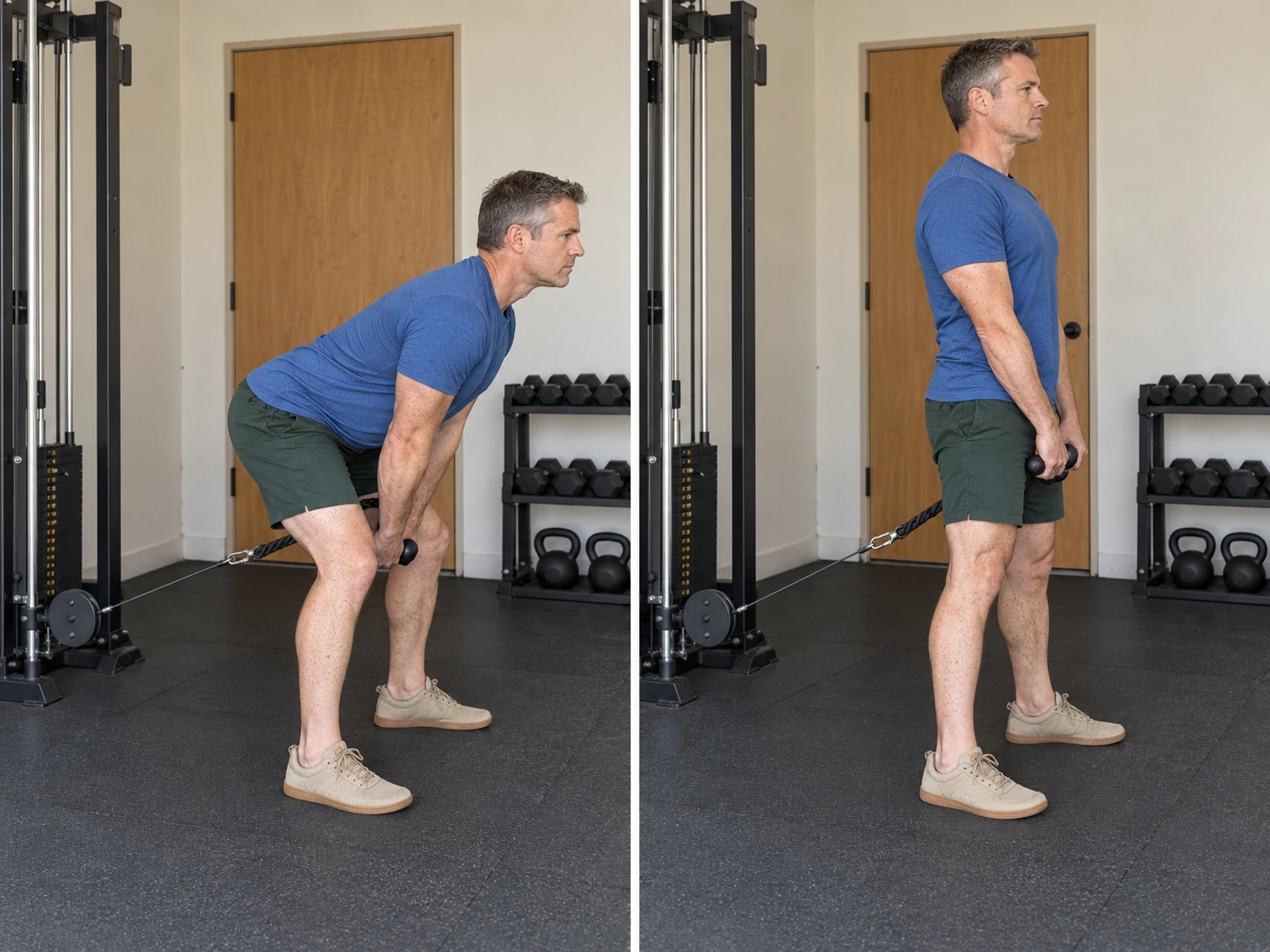
- With a light load selected, face away from the low pulley and take one rope end in each hand between your legs. Step forward carefully until the cable has tension.
- Stand with feet slightly wider than hip-width and knees gently bent. Keep your arms long and your abdomen firm.
- Push your hips backward, allowing the rope to travel back between your thighs. Your torso tips forward from the hips while your knees retain a modest bend.
- Press through your feet and bring your hips forward to stand upright. Keep your hands low; finish without leaning backward.
- Lower into the next hinge under control. At the end, take small steps backward toward the pulley while holding the rope, let the stack settle, and then release it.
Your hips should travel back more than down. If you turn the movement into a deep squat or curl the rope upward with your arms, reduce the weight and rehearse the hinge. The rope follows your hips rather than swinging ahead of them.
Use the facing-the-machine Romanian deadlift if the between-leg cable route is awkward. If either version pulls you off balance, practice an unloaded hinge before adding resistance elsewhere.
How to Do Leg Curls With a Cable Machine
Do standing cable leg curls with an ankle cuff attached to a low pulley, holding the machine while you bend one knee. The hamstrings work to bring your heel toward the back of your thigh. Keep the upper leg still so the movement remains a knee curl rather than a kickback.
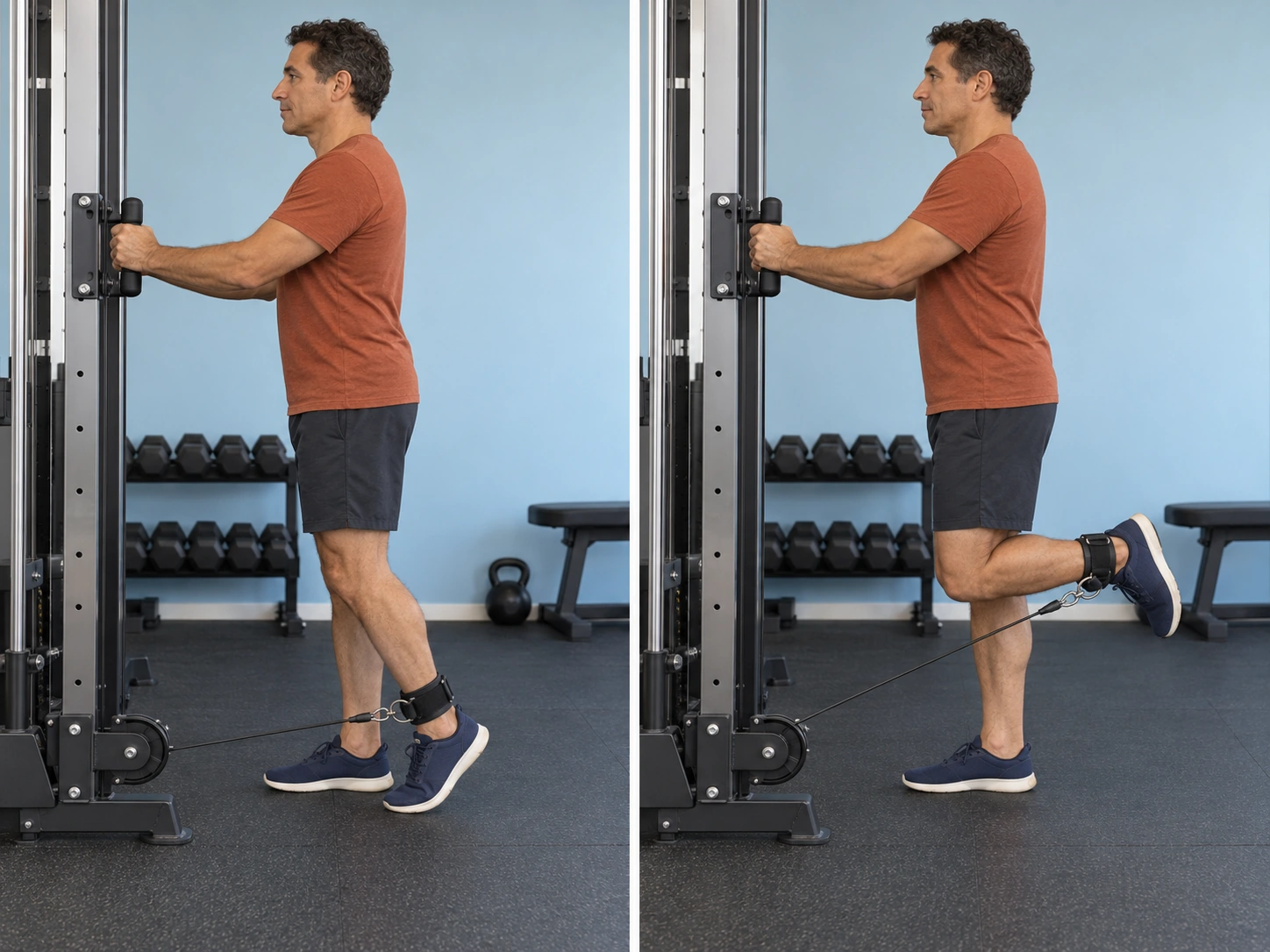
- Secure the cuff just above your ankle and connect it to the lowest pulley setting. Face the machine and hold a fixed handhold with both hands.
- Stand far enough back for the cable to clear your shoe. Keep the supporting knee slightly bent and lift the working foot just enough to clear the floor.
- Bend the working knee and bring your heel backward and upward. Keep that thigh roughly vertical, with the knee near its starting position.
- Pause briefly at a comfortable bend, then straighten the knee slowly until you return to the starting position. Avoid snapping the knee straight or dropping the stack.
- After the repetitions, place the foot down and move toward the pulley until the weight settles. Change the cuff and repeat on the other side.
Watch the working knee from the side. If it swings backward while your heel barely rises, you are moving mainly at the hip. Reduce the load and concentrate on folding the lower leg toward the thigh. If the cuff rotates or the cable rubs your supporting leg, stop and reset it before another repetition.
A fixed machine handhold is part of this setup. Do not balance against a movable bench or improvise a platform to force more range. A dedicated seated or lying leg-curl machine is the practical alternative when the pulley position, cuff, or support does not fit you. A hinge can train the hamstrings too, but it does not reproduce this knee-bending movement.
More Cable Leg Exercises: Romanian Deadlifts and Hip Adduction
The Romanian deadlift offers another hinge setup, while hip adduction trains the inward movement of the thigh. Choose the RDL instead of the pull-through if facing the stack feels easier to manage. Use adduction when you specifically want direct inner-thigh work.
Cable Romanian Deadlift
For the cable Romanian deadlift, or RDL, face a low pulley and hold a short bar in front of you. The glutes and hamstrings help straighten the hips while your trunk holds its position. You need room for the bar to descend and for the stack to travel through the entire repetition.
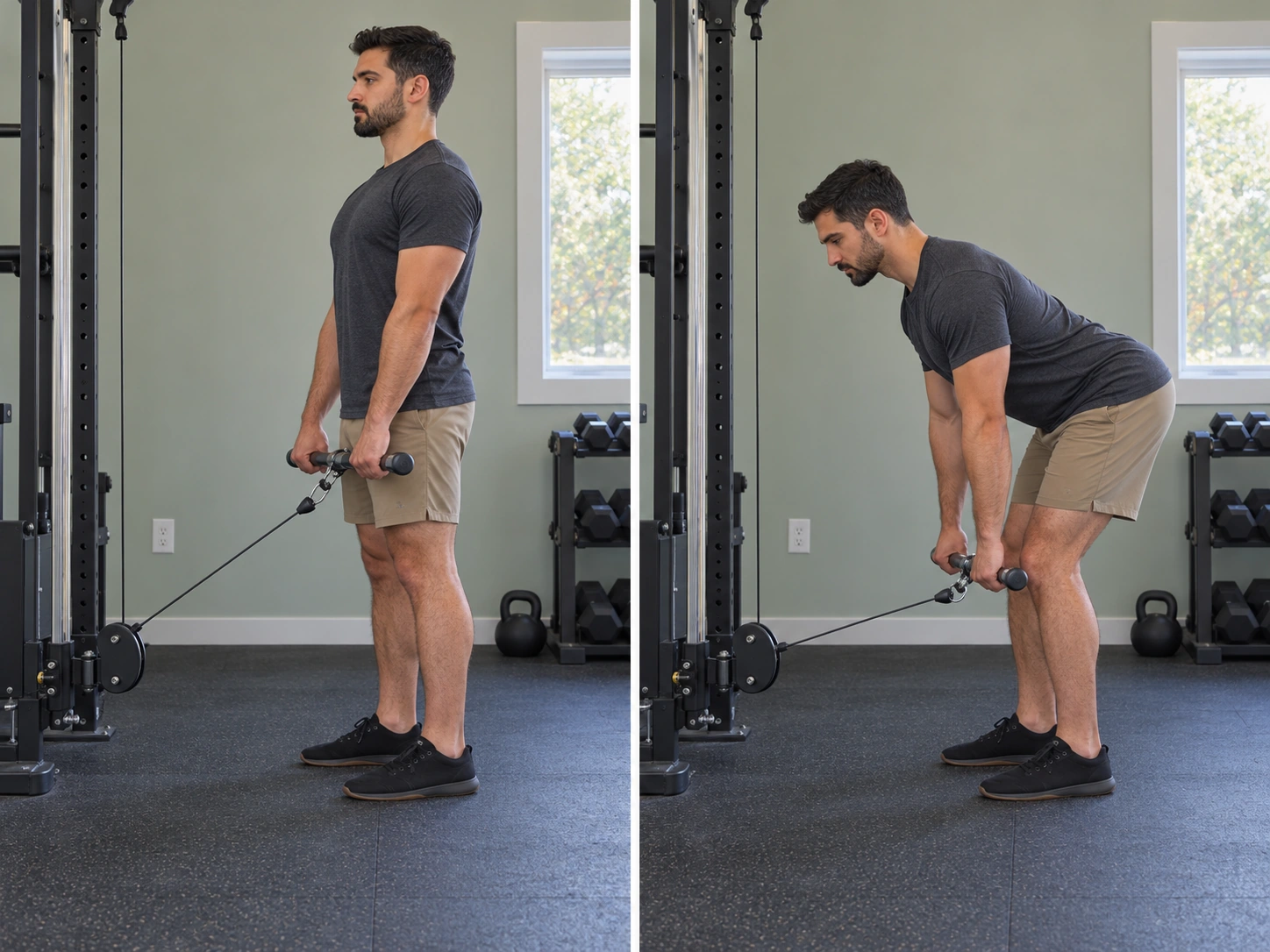
- Attach a short bar to the low outlet. Bend your hips and knees to pick it up with an overhand grip, stand, and take a small step back. Keep your feet around hip-width apart.
- Hold the bar in front of your thighs with straight arms. Soften your knees, brace your abdomen, and send your hips backward.
- Let the bar descend in front of your legs as your torso inclines. Keep the knee bend fairly constant and stop before your back rounds or the stack touches down.
- Bring your hips forward to stand tall, keeping your arms long. Reverse the movement slowly for the next repetition.
- Finish upright, step toward the machine while keeping hold of the bar, and lower it until the stack rests. Do not release the handle under tension.
There is no requirement to reach the floor. If reaching lower makes your shoulders round or your knees keep bending, shorten the descent. Set your distance with a light practice repetition: you need tension at the bottom without reaching the machine's cable-travel limit at the top.
I would switch to a dumbbell RDL when the stack's forward pull becomes harder to manage than the hinge itself. Practice the same hips-back movement without weight first if you cannot yet keep your trunk steady.
Standing Cable Hip Adduction
Hip adduction brings the leg toward the center of the body. Unlike abduction, the cuff belongs on the leg nearest the machine. This makes the low cable pull that leg outward while you control its inward movement.
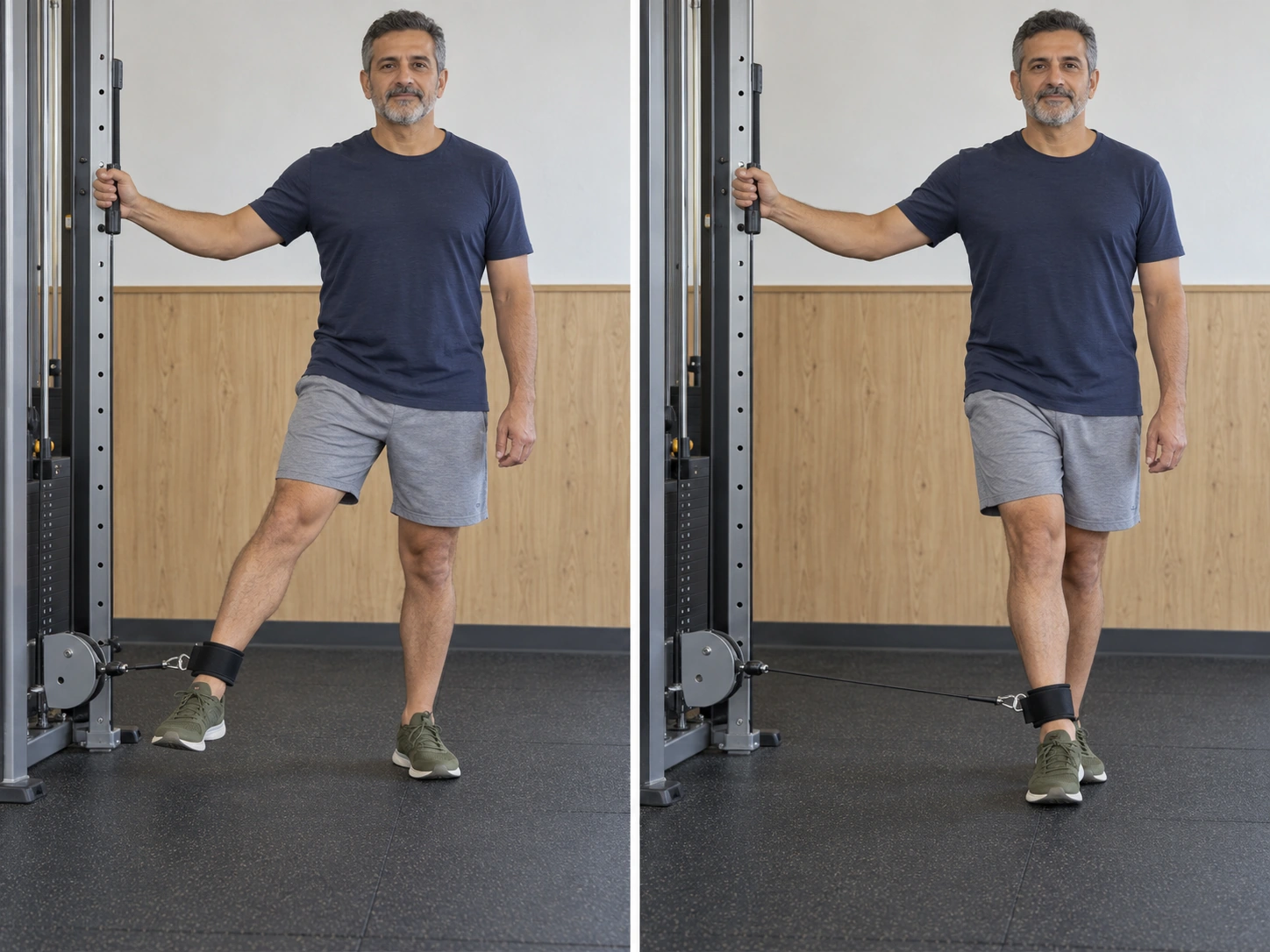
- Stand with your right side toward the low pulley and the cuff above your right ankle. Hold a fixed machine handhold with your right hand.
- Plant your left foot with the knee slightly bent. Let your right leg start a short distance out toward the machine, keeping your pelvis level.
- Draw the right foot inward until it is just in front of the left foot. Keep the toes generally forward and the torso still.
- Return the leg outward slowly, resisting the cable. Stop before it pulls your pelvis sideways. Settle the stack before changing sides.
Keep the path low and clear of your supporting shoe. Twisting your toes inward or sweeping the leg far across your body adds movement without making the exercise easier to control. Reduce the weight if you need either compensation.
Without an ankle cuff, try a side-lying inner-thigh raise: bend the upper knee and place that foot on the floor in front, then lift and lower the straight bottom leg a short distance. A dedicated hip-adduction machine offers another supported option if one is available.
How to Progress Your Cable Machine Leg Workout
Progress by repeating the same useful movement more successfully before increasing its difficulty. Record the machine, pulley height, attachment, load, and repetitions. Those details help distinguish stronger legs from a changed cable angle or a shorter movement.
Choosing Exercises for Your Equipment
A single low outlet can cover the sample workout if it has the right attachments and a usable handhold. A high-pulley-only station cannot perform these low-cable versions as written. Two visible outlets also do not necessarily mean two independently loaded cables, so follow the machine's instructions before combining them.
Keep the squat, hinge, and curl as your initial choices. If you want extra glute work later, start with one or two sets of 10 to 15 kickbacks or hip-abduction repetitions per leg after the main work, and reassess how you recover. You can also replace an accessory on another leg day instead of making this session longer.
For a cable leg workout, a station's usable resistance and cable travel matter more than the number printed on the stack. If your squat or RDL is limited by balance, grip, or the position and travel of the cable, use a suitable free-weight or leg-machine exercise for that part of your plan. Keep the cable for movements it accommodates well.
To combine lower-body training with upper-body work, use the full-body cable workout plan to organize the week. Substitute these movements into its lower-body slots instead of stacking this entire session onto it.
Adding Load Without Losing Balance
For the sample routine, add repetitions within the listed range first. When you complete both sets at the upper end with the same control and about two or three repetitions still available for two sessions, try the smallest load increase next time. Return toward the lower end of the range while you adjust.
If the next stack increment is too large, keep the current weight and repeat it until the repetitions are more consistent. For cuff work, use only a manufacturer-approved small increment if the machine supports one. Hanging spare plates from the selector pin is not a substitute.
The assisted lunge needs a different progression. Make the step, depth, and return consistent first, then gradually reduce reliance on the cable or move to a supported bodyweight version. Treating a larger stack number as automatic progress makes little sense when that cable also supplies the counterbalance.
For the next session, pick the three exercises your equipment supports, write down the setup, and leave enough rest to repeat the same movement. If an exercise causes sharp or persistent pain, stop that movement and seek individual advice rather than trying to solve it by adding support or weight.
FAQs
Can You Train Your Legs on a Cable Machine Without an Ankle Cuff?
Yes, you can perform cable squats, assisted reverse lunges, pull-throughs, and Romanian deadlifts with suitable hand attachments. Curls, kickbacks, and standing hip movements need a secure cuff for the versions shown here; use an appropriate off-cable alternative rather than slipping your shoe through a hand handle.
Can Cable Exercises Replace Every Leg Machine?
No, a cable station cannot reproduce every leg machine's support, loading capacity, or movement path. A dedicated leg press or leg curl may let you load your legs more steadily, so choose equipment around the movement you need instead of improvising a leg-press or leg-extension rig.
References
- Currier BS, D'Souza AC, Fiatarone Singh MA, et al. American College of Sports Medicine Position Stand. Resistance Training Prescription for Muscle Function, Hypertrophy, and Physical Performance in Healthy Adults: An Overview of Reviews. Medicine & Science in Sports & Exercise. 2026;58(4):851-872. doi:10.1249/MSS.0000000000003897.