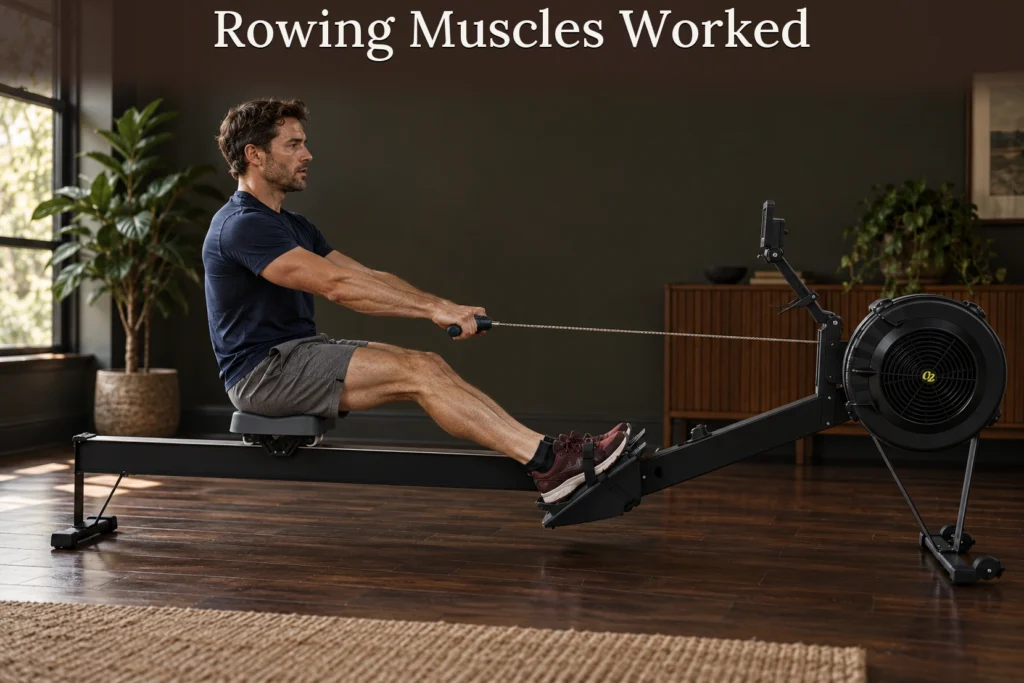
What Muscles Does a Rowing Machine Work? A Stroke Guide

Founder
I founded HomieGym to help you make informed decisions about training at home. My background includes university-level sports science education, practical coaching, gym training and combat sports.
See how your legs, trunk, back, and arms contribute through the rowing stroke, and where a full-body cardio workout needs complementary strength work.
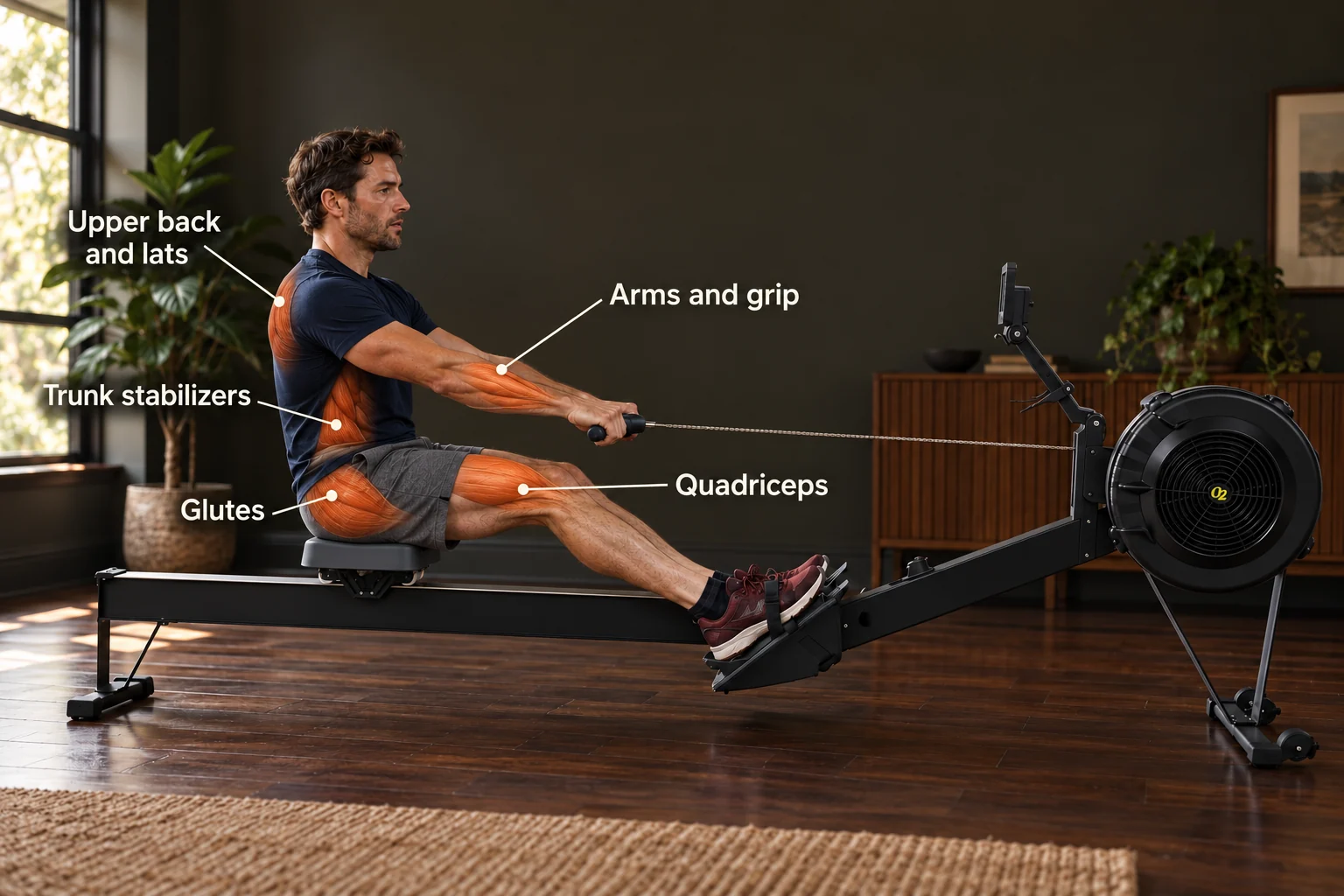
A rowing machine works the quadriceps, glutes, hamstrings, back, abdominal muscles, and arms, with smaller muscles helping control the shoulders, grip, and ankles. Those muscles contribute at different times. Your legs begin the drive, your hips and trunk transfer the effort, and your arms finish the pull.
I use the stroke sequence to explain what those muscles are doing. It helps you connect the leg push to the handle pull, while keeping full-body cardio separate from complete strength training.
Table of Contents
What Muscles Does a Rowing Machine Work?
The quadriceps, glutes, hamstrings, trunk, back, and arm muscles either produce movement or hold you in position to transfer force. Your arms, for example, remain long at the start of the drive while maintaining the connection to the handle.
The table follows the conventional sliding-seat stroke in Concept2's muscle guide. It describes each region's main job; it does not rank muscle growth.1
| Region | Main muscles | Job in the stroke |
|---|---|---|
| Front thighs | Quadriceps | Straighten the knees during the drive |
| Hips and rear thighs | Glutes and hamstrings | Help extend the hips |
| Trunk | Abdominals and spinal extensors | Control posture and torso movement |
| Back and shoulders | Lats and shoulder-blade muscles | Move the upper arms and position the shoulders |
| Arms and hands | Elbow flexors and finger flexors | Finish the pull and hold the handle |
| Lower legs | Calf and shin muscles | Contribute around the ankle through the cycle |
On a seated cable-row machine, you pull a weight stack from a largely fixed seat. On the cardio rower described here, the sliding seat lets your legs contribute to each stroke. The similar names describe different exercises.
How the Muscles Work Through Each Rowing Phase
The catch, drive, finish, and recovery describe one continuous stroke. The legs start the drive, the torso opens, and the arms finish the pull; on the return, the arms move away before the torso tips forward and the knees bend. Blend the sequence rather than pausing at every boundary.2
Catch: Get Ready to Push
At the catch, your knees are bent, your arms are straight, and your torso leans forward from the hips. Your shins are roughly upright within a comfortable range. The grip and trunk help maintain a position from which you can connect the next leg push to the handle.
I look for a comfortable start that you can repeat. Reaching farther by collapsing your torso changes the position you are about to load. Push through the foot supports with long arms, and use the full rowing setup and technique guide to check foot straps and posture.
Drive: Legs First, Then Hips and Arms
The quadriceps at the front of your thighs straighten the knees as you push away from the front. The glutes and hamstrings help open the hips as the drive develops. Extension means straightening a joint or opening its angle. Most hamstrings cross both the hip and knee, so helping extend the hip is one of their jobs, even though they can also bend the knee.3
As the torso opens, the latissimus dorsi, usually shortened to lats, help move the upper arms backward. The rhomboids and trapezius help position and control the shoulder blades. The biceps and other elbow flexors bend the elbows to bring the handle toward the lower ribs, while the finger flexors maintain your grip.4
Pulling hard with your elbows as soon as the seat moves can make the stroke feel like an arm exercise. I prioritize a connected leg push before a stronger arm pull: the handle should move with the push, rather than your elbows trying to do the whole job.
Finish: Control the End of the Pull
At the finish, the legs are extended, the handle is below the ribs, and the torso leans back slightly. The abdominal muscles help control the torso while the back and arms support the end of the pull. A larger backward lean adds motion you must reverse; make the normal finish comfortable before trying to pull harder.
The trunk remains active across the stroke. In a brief study of six elite male rowers, researchers recorded abdominal, spinal-extensor, and thigh-muscle activity on two ergometer designs. Those recordings show activity during the task; the small trained sample gives no individual target for a beginner's effort.5
Recovery: Return Without Rushing
During recovery, the arms straighten, the torso tips forward from the hips, and the knees bend as the seat returns. The triceps help straighten the elbows; the rest of the return repositions your body for another push. Recovery uses less pulling effort, but it still involves muscle activity.
In 20 trained rowers, measurements from eight leg muscles showed different timings across the cycle. The tibialis anterior at the front of the shin began its activity during recovery. This describes the sampled muscles, not an instruction to pull yourself forward with your toes.6 Use an unhurried return to arrive ready for the next drive; a static muscle map cannot show every change in timing.
Does Rowing Work Your Abs, Back, and Arms?
Yes, rowing uses your abs, back, and arms. The abs help control the torso, the back supports posture and contributes to the pull, and the arms connect you to the handle before finishing the stroke. Your abs can work without curling your trunk as you would in a crunch.
Electromyography, or EMG, records electrical activity associated with muscle activation. It helps researchers examine when muscles work. EMG amplitude does not directly rank force between different muscles, and a brief activation test does not measure later muscle growth.6
If your forearms tire early, check your grip and the timing of the arm pull. That feeling does not establish that your legs were inactive. A tired or painful lower back also needs attention to workload and movement; it is not a target sensation to chase.
What Full-Body Rowing Leaves Out
Full-body rowing involves several regions in one repeated movement. It does not load every muscle equally or cover every movement pattern. The demanding part brings the handle toward you; sending it forward again does not reproduce pressing a challenging weight away from your body.
Keep room for pressing exercises for the chest and triceps, overhead work when appropriate, and leg exercises with loads you can progress separately. Standing on one leg, carrying a weight, and controlling sideways movement also ask for skills that seated rowing does not reproduce.
For muscle development, I want exercises whose resistance and repetitions can be adjusted to the muscles being trained. The 2026 American College of Sports Medicine position stand supports resistance training for muscle size and function, with progression supporting continued gains.7 That is broader strength-training evidence, rather than a muscle-growth forecast from rowing.
Use the rowing machine benefits guide when deciding how this conditioning work fits alongside comfort and your other training goals.
Use the Muscle Map to Improve Your Next Session
Start with a controllable stroke and choose one visible checkpoint. You do not need to squeeze every named muscle deliberately or try to feel every region equally.
- Watch the start of the drive: let the legs push while the arms stay long.
- Check the finish: keep the backward lean small and the shoulders relaxed.
- Give the handle a clear return path before sliding forward.
On a Concept2, the damper controls airflow and changes how the stroke feels; pushing harder can still increase intensity without moving that lever. Its numbers do not transfer directly to the resistance levels of a magnetic rower such as the Stamina X.8 Choose a setting that lets you keep the sequence before treating a higher number as progress.
Keep rowing for the conditioning you want, then identify a separate strength exercise for any movement you want to develop more directly. If pain persists or changes how you row, stop and get appropriate professional advice instead of trying to make a muscle map explain the symptom.
This article provides general educational information, not an assessment of an injury or a personalized training prescription.
FAQs
Is rowing more of a leg or arm exercise?
Rowing relies on a leg-driven stroke, with the trunk and arms contributing as it develops. The handle pull finishes work that began at the foot supports, so treating the movement as an arm-only pull misses much of the exercise.
Is rowing a good chest-building exercise?
No, rowing is not a primary chest-building exercise: the demanding part of the stroke is a pull toward your body. Include a suitable press if developing your chest is a specific goal.
Does rowing work your calves?
Yes, calf muscles contribute during the rowing cycle, including activity around the drive. That involvement differs from progressively loaded calf raises through a deliberately chosen range.
Does a rower really work 86% of your muscles?
The 86% figure is too specific to use without a defined counting method and supporting measurement. The phase-by-phase description explains when the muscles contribute and what they do.
References
- Concept2. Muscles used while rowing. Accessed October 23, 2026.
- Concept2. Indoor rowing technique. Accessed October 23, 2026.
- Betts JG, Young KA, Wise JA, et al. Appendicular muscles of the pelvic girdle and lower limbs. In: Anatomy and Physiology 2e. OpenStax; 2022. Section 11.6. Accessed October 23, 2026.
- Betts JG, Young KA, Wise JA, et al. Muscles of the pectoral girdle and upper limbs. In: Anatomy and Physiology 2e. OpenStax; 2022. Section 11.5. Accessed October 23, 2026.
- Nowicky AV, Horne S, Burdett R. The impact of ergometer design on hip and trunk muscle activity patterns in elite rowers: an electromyographic assessment. J Sports Sci Med. 2005;4(1):18-28.
- Vieira TM, Cerone GL, Stocchi C, Lalli M, Andrews B, Gazzoni M. Timing and modulation of activity in the lower limb muscles during indoor rowing: what are the key muscles to target in FES-rowing protocols? Sensors. 2020;20(6):1666. doi:10.3390/s20061666
- Currier BS, D'Souza AC, Fiatarone Singh MA, et al. Resistance training prescription for muscle function, hypertrophy, and physical performance in healthy adults: an overview of reviews. Med Sci Sports Exerc. 2026;58(4):851-872. doi:10.1249/MSS.0000000000003897
- Concept2. Damper setting 101. Accessed October 23, 2026.