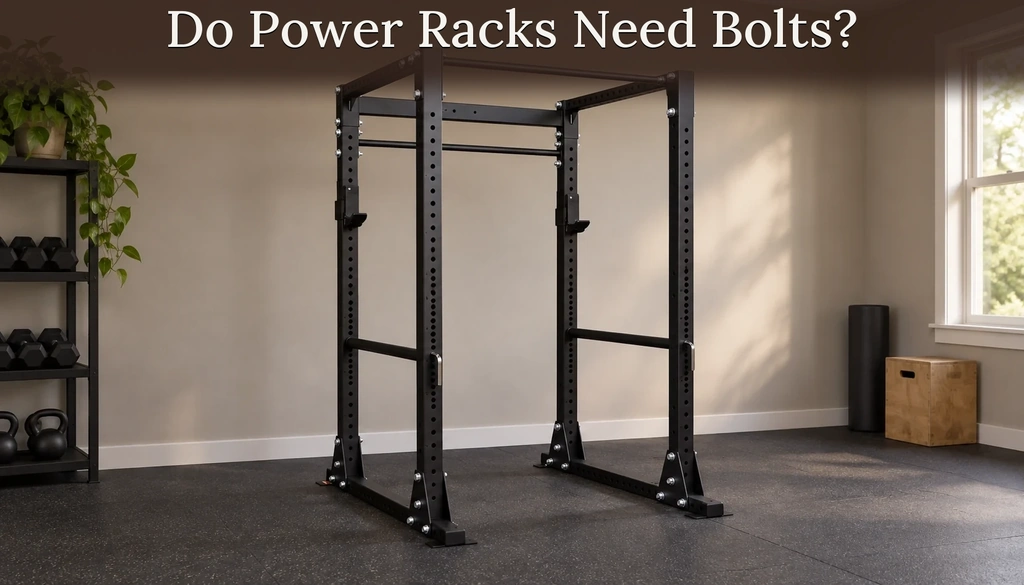
Do Power Racks Need to Be Bolted Down?

Founder
I founded HomieGym to help you make informed decisions about training at home. My background includes university-level sports science education, practical coaching, gym training and combat sports.
Equipment editor on our team: Milutin Tucakov
Check whether your exact rack and attachments require anchoring, and what to confirm about the floor, platform, and installation before use.
Some power racks need to be bolted down, and some are designed for freestanding use. The answer depends on the exact rack, configuration, attachments, and installation surface. A heavy frame or a wide base does not overrule the manufacturer's mounting instructions.
I would settle this before buying the rack, especially in a rental or a room where drilling is restricted. Choose a configuration whose documented installation you can carry out, rather than planning to make a bolt-down rack work with extra plates or improvised bracing.
Table of Contents
Do Power Racks Need to Be Bolted Down?
Some power racks must be anchored; others permit freestanding use in a specified configuration. A rack can remain unbolted only when its current instructions permit that exact configuration and use. Check both the rack manual and the instructions for every attachment.
Two Rogue racks demonstrate why a general answer fails. The Bolt-Together R-3 product page says it must be bolted to the floor before use, and its assembly instructions include floor anchoring. The RML-390F has a self-stabilizing flat-foot base that Rogue says does not need floor bolts, but the same page prohibits Band Pegs and Safety Spotter Arms on that rack.
| Exact setup | Documented requirement | Decision |
|---|---|---|
| Rogue Bolt-Together R-3 | Must be bolted to the floor before use | Plan an approved anchored installation |
| Rogue RML-390F | No floor anchoring needed; Band Pegs and Safety Spotter Arms prohibited | Use only within its stated restrictions |
| REP PR-4000, 41-inch depth with Rear Base Stabilizer | US FAQ allows this configuration without bolts | Check attachments before relying on the exception |
| PR-4000 with Iso Arms, Spotter Arms, or Globe Pull-Up Bar | US FAQ requires anchoring plus Front Foot Extensions | A rear stabilizer alone does not satisfy that instruction |
REP's current US PR-4000 FAQ gives the 41-inch-depth Rear Base Stabilizer exception, then explicitly requires floor anchoring and front extensions for the listed attachments. Apply those conditions together. An optional stabilizer is not blanket permission to use every attachment without bolts.
I would ask the manufacturer to resolve any conflict between a regional accessory page, an older manual, and the current US rack instructions. Keep the answer tied to your rack version and parts list. Until the conflict is resolved, do not assume the least restrictive sentence approves the complete setup.
Why Attachments Can Change the Anchoring Requirement
Attachments can apply force outside the rack's base or pull on it in a different direction. Reracking, catching a bar, pulling on a cable, and using an outside attachment are different loading situations. The maker's rules account for the configuration, not just the total pounds on the bar.
The attachment guide separates catch, storage and training accessories before checking their fit.

An outside spotter arm projects beyond the front uprights, so a bar caught on it loads a different area from a safety spanning the inside of a cage. A band attachment can also change the direction of force. This helps explain why permission for one activity does not establish permission for another, even on the same frame.
A flat-foot base, rear stabilizer, front extension, and storage extension are different parts. Follow the exact combination specified by the maker. With the RML-390F, for example, attaching a part that physically fits does not remove Rogue's explicit restrictions on Band Pegs and Safety Spotter Arms.
Storing plates low on a rack may change how it feels, but stored weight is not an approved substitute for required anchors unless the manufacturer specifically permits that arrangement. The plates may be removed during training, and a hand shove against an empty frame does not reproduce a loaded catch or moving attachment.
The Floor and Anchors Must Suit the Installation
Anchoring is a connection between the rack and a suitable supporting surface. A hole in a footplate does not identify the right anchor, and an anchor is not suitable merely because its diameter fits that hole.
Start with the exact rack's manual. The R-3BT instructions distinguish wood from solid concrete and specify different anchoring hardware for those surfaces. That is model-specific guidance; it does not establish a universal bolt size or permission to attach another rack to any wood floor.
For a concrete installation, the base material, condition, thickness, edges, embedded objects, and selected anchor's instructions all need attention. Ask a qualified installer to confirm the method if those conditions are unknown. Hilti's concrete-scanning guidance identifies rebar, tendons, conduits, and other concealed objects as things that may be located before drilling anchor holes. Do not drill an unidentified slab by guesswork, particularly where post-tensioning or concealed services may be present.
For a wood floor or platform, confirm what the fixing is meant to engage and whether that assembly is approved for the rack and loads. A thin finish layer and the building structure are different things. Bolting a rack to a loose sheet does not, by itself, show that the complete assembly is secure.
| Surface | What to confirm | If unknown |
|---|---|---|
| Concrete | Base material, thickness, edges and concealed objects | Have a qualified installer assess the method |
| Wood floor or platform | Approved assembly and material the fixing engages | Obtain the rack maker's approval and a suitable design |
| Floor covering | Required contact between foot and support | Check the exact rack manual before laying flooring |
Use the anchor manufacturer's current installation requirements alongside the rack instructions. Those requirements can cover hole preparation, embedment, spacing, tightening, and other conditions that vary by product. This guide cannot supply one drilling depth or torque value that works across racks, anchors, and floors.
Rubber Flooring and Platforms Need Their Own Check
Rubber flooring protects surfaces in some uses, but it is not an anchor or structural approval. The installation must still connect the rack to the supporting material in the way its instructions require.

The R-3BT manual specifically recommends removing a section of rubber so the feet anchor directly to the floor. Follow that instruction for that rack rather than assuming a longer bolt through a compressible layer is an equivalent installation.
A platform adds another assembly to assess: its materials, construction, connection to the rack, position in the room, and permitted use. Confirm whether the rack manufacturer approves that platform arrangement before choosing its construction or fixings. Obtain a suitable design and fixing method for the actual setup rather than adapting a generic online cut list.
I would resolve that question before buying the flooring. Otherwise, you may cover the very points that need inspection or direct mounting. Our home gym flooring guide can help compare surface options once the installation requirements are known.
A platform or rubber layer also does not establish that an upstairs room can support the complete setup, and neither guarantees that lifting noise will stay inside the room. Keep surface protection, building suitability, and rack anchoring as separate checks.
What to Confirm Before the First Loaded Set
Before loading the rack, confirm the approved configuration, completed assembly, mounting method, and safety-system setup. Use the current manual for the exact model, and keep the attachment instructions with it so a later addition does not bypass an installation condition.
Review rack parts and setup if the manual's support and catch terminology is unfamiliar.
- Record the rack model, version, depth, base parts, and intended attachments.
- Find the anchoring instruction and every exception or attachment restriction.
- Confirm the floor or platform and permitted fixing method.
- Complete assembly and tightening in the specified order, with the required assistance.
- Inspect the connection, J-cups, safeties, and clear training area before use.
Assembly bolts and floor anchors are different connections. Do not use an anchor torque value for the frame bolts or copy a setting from another rack. The R-3BT manual, for example, calls for hand-tight hardware during assembly and full tightening at its final stage. If your instructions do not give the detail you need, ask the manufacturer before proceeding.
Recheck the installation as the manual directs and whenever you alter the configuration. Stop using the rack if a foot lifts, an anchor moves, the frame shifts unexpectedly, or a connection is damaged. Do not use a loaded lift to diagnose an uncertain installation.
If drilling is impossible, compare only configurations with documented freestanding use and acceptable activity restrictions. Use the power rack category to identify candidates, then confirm the manufacturer's installation instructions before ordering.
FAQs
Do home power racks have to be bolted down?
Some home power racks must be bolted down, while others permit freestanding use in a specified configuration. Home use does not waive the manufacturer's anchoring requirement or attachment restrictions.
Can weight plates replace bolts on a power rack?
No, added plates do not replace required anchoring unless the manufacturer explicitly approves that arrangement for your exact rack and use. A rack that feels stable when pushed by hand has not been verified for a loaded catch or attachment movement.
Can you bolt a power rack to a platform?
A power rack can be bolted to a platform only when the rack instructions and a suitable platform design permit that connection. Confirm the whole assembly and fixing method; a universal plywood recipe cannot establish suitability for every rack.
How tight should power rack bolts be?
Tighten power rack hardware according to the exact rack's assembly instructions and the selected anchors according to their separate instructions. There is no single torque value for every frame bolt and floor anchor.
This is an installation decision guide, not a drilling procedure, anchor specification, or structural assessment. Follow current manufacturer instructions and use a qualified installer when the supporting surface or fixing method is uncertain.