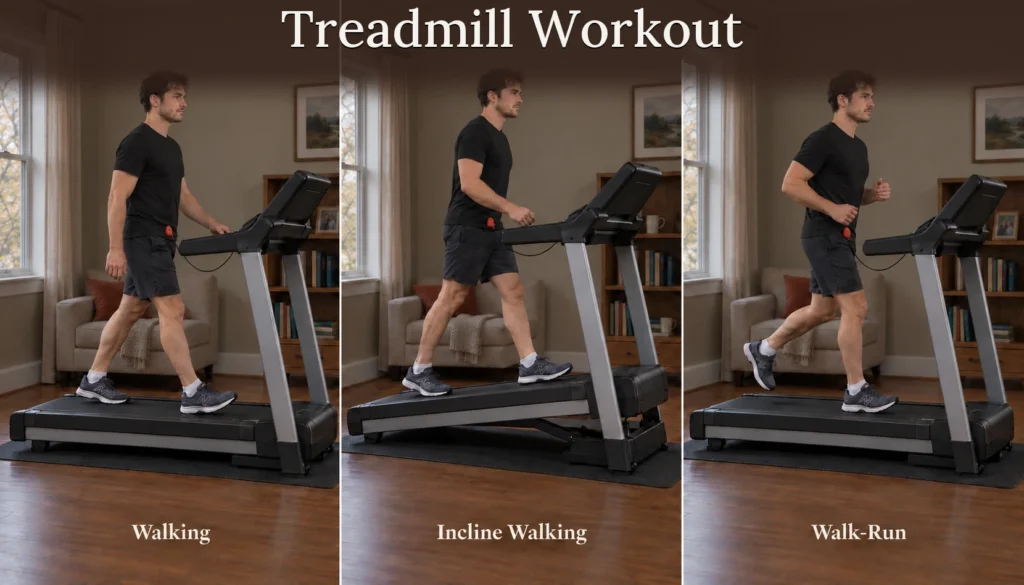
Treadmill Workout: 3 Simple Plans for Home

Founder
I founded HomieGym to help you make informed decisions about training at home. My background includes university-level sports science education, practical coaching, gym training and combat sports.
Equipment editor on our team: Milutin Tucakov
A treadmill workout can start with a brisk walk, with incline walking and short jogging intervals available when you want a different challenge. You do not have to become a runner to build a regular treadmill routine, and your starting pace can reflect your current fitness.
My preference is a session you can repeat comfortably enough to make it part of your week. The three plans below give you a walking option, an uphill option, and a gradual introduction to jogging. You can choose the one that fits today, then use the progression guidance to decide when a little more work makes sense.
Table of Contents
Choose Your Treadmill Workout
Start with the 20-minute walking plan if you are new to treadmill training. The incline plan adds short uphill blocks, while the walk-run plan introduces jogging with longer walking recoveries. Each includes time to ease in and slow down.
Choose one starting plan
| Plan | Total time | Choose it when |
|---|---|---|
| Walking | 20 minutes | You want a straightforward starting session with few setting changes. |
| Incline walking | 25 minutes | Level walking feels familiar and you want short uphill blocks. |
| Walk-run | 30 minutes | You walk confidently and want to introduce short jogs with walking recovery. |
These are starting examples to adjust to your fitness and the machine's instructions. If the walking plan is too long, choose a shorter easy session and build from there. Repeat a comfortable plan before adding speed, incline, or more minutes. Your next workout should be based on how the last one went.
Set Up the Treadmill and Find Your Pace
Before you start, learn how to use a treadmill's start, stop, speed, and incline controls while the belt is stationary. Read your model's manual, including its startup procedure and required clearance. A machine that fits against a wall may still need clear space behind the belt during use.
- Check that the deck is stable, the belt area is clear, and the required space around the machine is unobstructed. Keep children and pets away from the treadmill.
- Attach the safety tether securely to your clothing and identify the normal stop control. Follow the manual's instructions for using and checking the safety key.
- Start at a slow speed using the mounting procedure taught for your machine. Wait for speed changes to take effect before making another adjustment.
- Slow down at the end, stop the belt, and wait until it is stationary before stepping off. Remove the safety key and secure the machine as the manual directs.
For example, the SOLE F63 manual requires a clipped safety tether, cautions that settings change gradually, and tells users to hold a handrail when adjusting controls. Follow your own model's instructions rather than assuming every treadmill starts or stops in the same way.
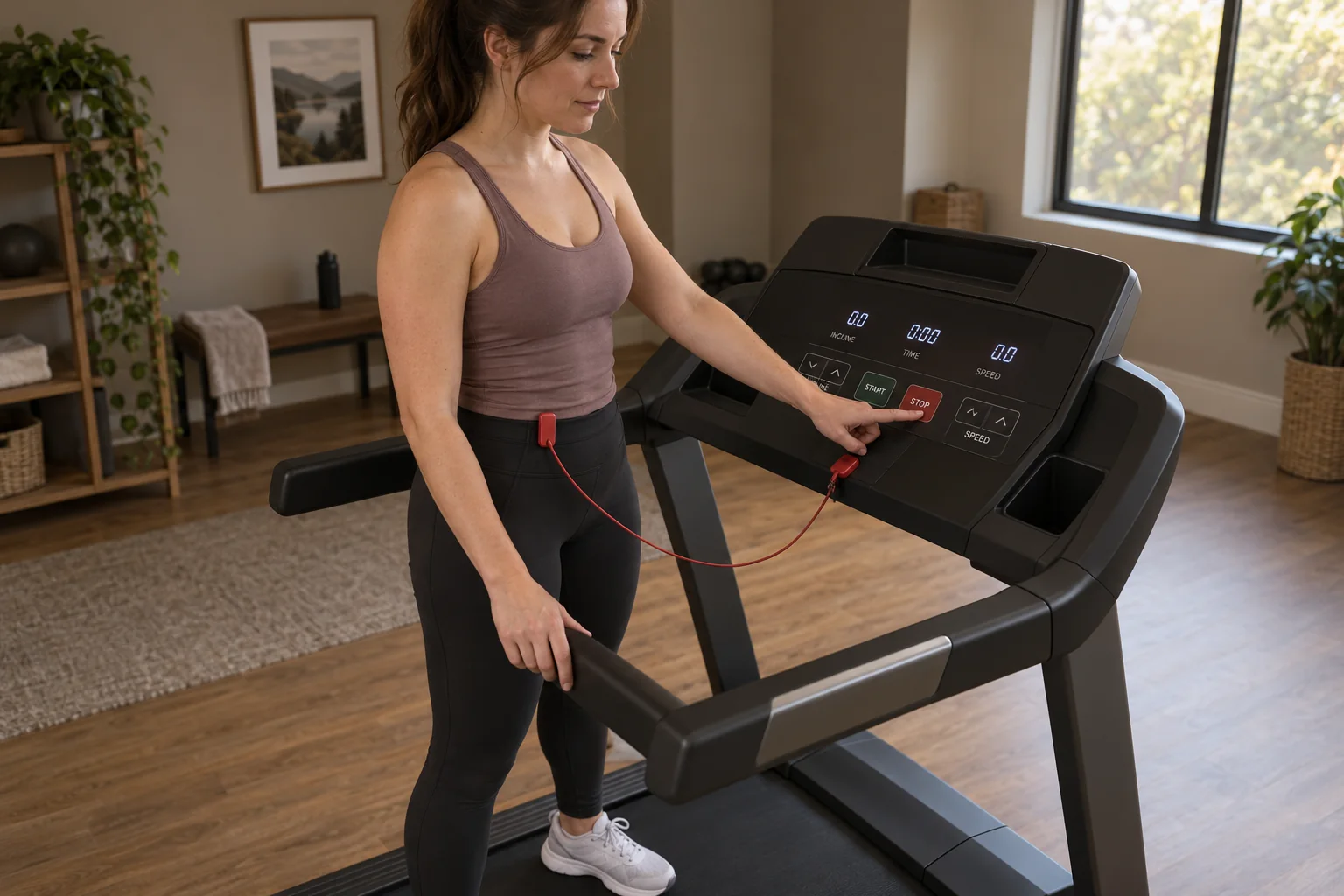
Once you are walking, find a pace that lets you look forward and stay comfortably within the belt area. You should not be repeatedly drifting toward the rear or taking hurried steps to keep up. If that happens, reduce the speed. Use support as the manual directs; if you need to hang on throughout the working block, the speed or incline may be too demanding.
The talk test helps you choose a treadmill cardio workout by effort. At moderate intensity, you can talk but cannot sing; vigorous activity allows only a few words before you pause for breath. The CDC also notes that the same activity can feel different to people with different fitness levels. Choose your pace from your breathing and control, not from a universal mph target.
For each plan, spend the first five minutes walking easily and increasing pace gradually, then finish with five minutes of easier walking. The American Heart Association recommends roughly five to ten minutes for warming up and cooling down; extend either part when needed. A session with a longer warm-up or cool-down will take longer than the example total.
Three Treadmill Workouts You Can Follow
Choose one plan for the session. Use manual mode if it lets you change settings predictably, and keep the first attempt comfortable enough to learn the transitions. The totals include the warm-up and cool-down. Start each timed block when you begin changing the settings. Gradual acceleration, deceleration, or incline adjustment counts within that block, so a one-minute jogging block may include less than a full minute at jogging speed. Never rush the controls to match the clock; extend the session or simplify a block if you need more time.
20-Minute Walking Treadmill Workout
Walk easily for five minutes, spend ten minutes at a comfortable brisk pace, then slow down for five minutes. This is the plan I would use to establish your starting pace: there are few setting changes, so you can pay attention to your stride and breathing.
20-minute walking plan
| Phase | Time | What to do |
|---|---|---|
| Warm-up | 5 minutes | Walk easily and increase pace gradually. |
| Brisk walk | 10 minutes | Choose a controlled pace that allows conversation. |
| Cool-down | 5 minutes | Reduce speed gradually and finish with easy walking. |

During the working block, aim for a pace you can maintain without pulling on the rails. If your breathing becomes too hard for comfortable conversation or your stride gets rushed, ease the speed down. A slower walk is still a useful starting session; the talk test describes effort rather than a speed you must reach.
If you needed to slow down repeatedly, use an easier working pace next time. Avoid trying to make up the effort with a faster finish.
25-Minute Incline Treadmill Workout
Use three short uphill walks separated by easier, flatter walking. Incline is the upward slope of the treadmill deck. An incline treadmill workout is an option when you already walk comfortably and want to change the challenge without adding jogging. Keep the uphill pace slow enough to stay balanced and breathe steadily.
25-minute incline walking plan
| Phase | Time | What to do |
|---|---|---|
| Warm-up | 5 minutes | Walk easily at a level or familiar low setting. |
| Uphill blocks | 15 minutes | Repeat 3 minutes gradually raising to a mild incline + 2 minutes lowering to easier, flatter walking, three times. Setting changes count within each block. |
| Cool-down | 5 minutes | Return to easy walking and slow down gradually. |
Start with a small increase from level walking. For example, if your machine displays a percentage grade, you could try 1% or 2% and judge the effort before going higher. This is a suggested first adjustment, not an ideal incline for everyone. If the console shows numbered levels, check the manual rather than treating a level as a percentage.
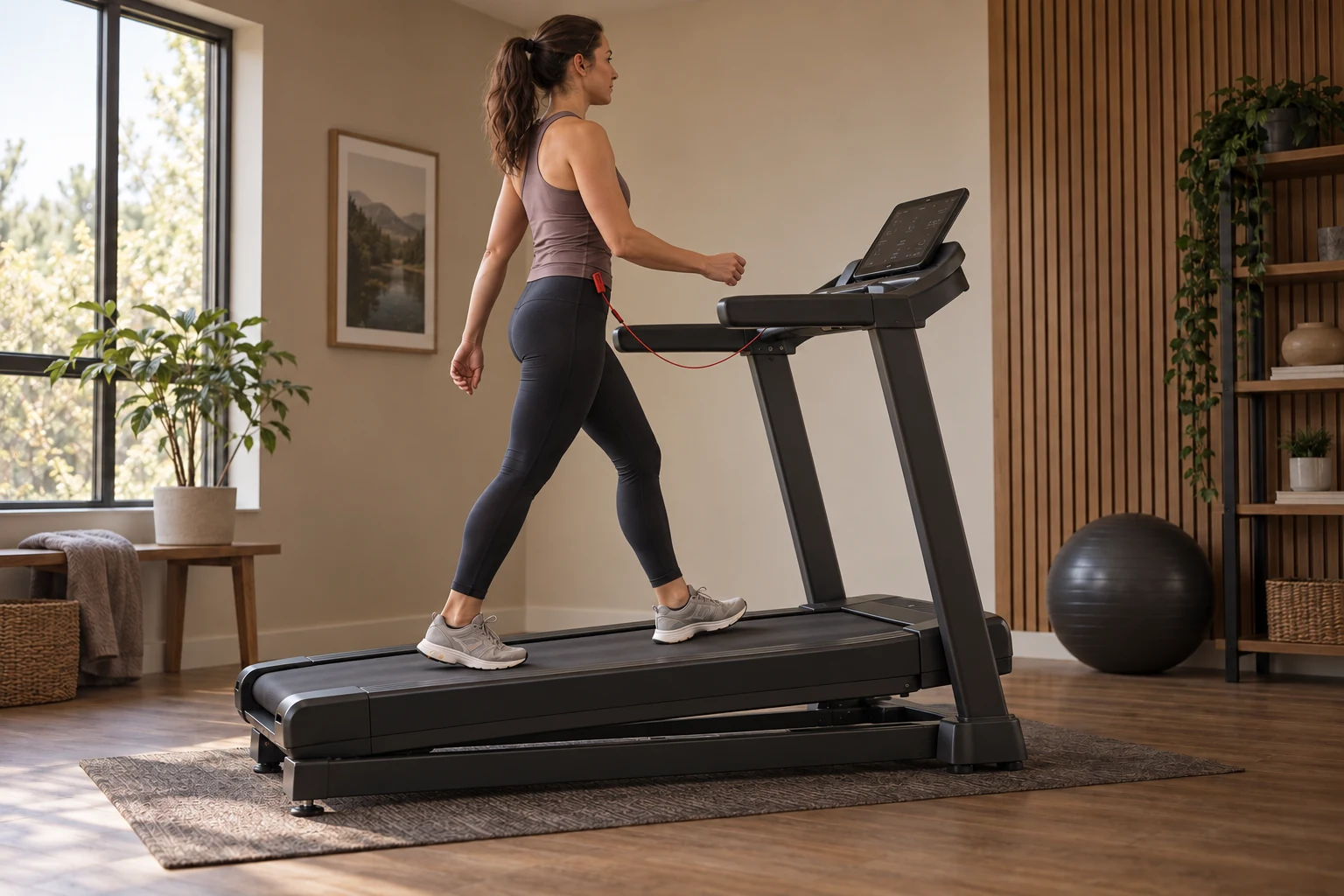
When walking uphill on a treadmill, allow the machine to reach the setting before deciding whether to change it again. During each easier block, lower the incline and, if needed, the speed so your breathing settles before the next climb. If two minutes does not give you enough recovery, extend the easy block or finish with level walking. The session can be longer or have fewer climbs.
I would lower the incline if you begin hanging back from the handrails or taking strained steps. The point of incline walking here is a repeatable uphill effort. You do not need a steep setting to complete the plan, and you can return to the walking workout if the inclined position feels uncomfortable.
30-Minute Walk-Run Treadmill Workout
Alternate a one-minute block of gradually increasing speed toward comfortable jogging with a three-minute block of gradually returning to walking, repeating the pair five times. This plan suits someone who already walks confidently on the treadmill and wants to introduce running. Skip the jogging until walking and speed changes feel familiar.
30-minute walk-run plan
| Phase | Time | What to do |
|---|---|---|
| Warm-up | 5 minutes | Walk easily and build toward your usual comfortable walking pace. |
| Walk-run blocks | 20 minutes | Repeat a 1-minute block gradually increasing toward comfortable jogging + a 3-minute block gradually returning to walking, five times. Speed changes count within each block. |
| Cool-down | 5 minutes | Walk easily and reduce speed gradually before stopping. |
To learn how to run on a treadmill, increase speed gradually until you reach an easy jogging rhythm. Keep your gaze forward and use a stride that feels controlled. There is no required jogging speed in this plan. Use the controls carefully, with handrail support as instructed by the manufacturer, and stay on the belt through the gradual transition back to walking.
The walking recovery should let your breathing settle. If you are still struggling when the next jogging block is due, walk for longer, shorten the next jog, or continue the session as a walk. A session can stay useful even when you change the interval lengths.
I would keep these first intervals below an all-out effort. More intense intervals are not automatically a better choice: an eight-week trial in 44 inactive, healthy men found no statistically significant difference in fitness improvement between its high-intensity interval and continuous treadmill groups.1 That small study used different protocols from these plans; it does not establish which approach is best for you.
Build Your Weekly Treadmill Routine
Begin with a duration and frequency you can recover from and repeat. I suggest trying two or three manageable sessions across the week as an initial schedule, then adjusting from how you feel during the workout and afterward. You can start with fewer sessions or shorter walks if that is more realistic.
One possible starting week: take the comfortable walking plan on Monday and Wednesday, then add Friday only if recovery has been manageable. Tuesday and Saturday could hold short, familiar full-body strength sessions, with Thursday and Sunday for rest or easy everyday movement. If strength work is also new, introduce it gradually rather than adding five unfamiliar workouts at once. Keep incline blocks and jogging for a later week once level walking feels familiar.
The CDC recommends at least 150 minutes of moderate-intensity aerobic activity, 75 minutes of vigorous activity, or an equivalent combination of the two each week, plus muscle-strengthening activity on two days. Activity can be spread into smaller amounts. Treat that as a weekly health guideline to build toward, rather than a requirement to complete in your first week.
For example, three 20-minute sessions add up to 60 minutes on the treadmill, but only the portions at moderate or vigorous effort count toward those specific aerobic targets. Easy warm-ups, recoveries, and cool-downs still have a purpose. You do not need to make them harder to improve the number in your weekly log.

Keep a brief log of the plan, working speed, incline, completed minutes, and how the effort felt. When a session becomes comfortable on repeated attempts, change one detail while keeping the others familiar. That makes it easier to tell whether extra time, a faster pace, or a steeper grade changed the challenge.
If a change leaves you too tired to repeat your planned sessions, return to the previous version. For strength work alongside your cardio, our full-body dumbbell workout gives you a separate starting routine. Plan the week so harder sessions do not all compete for the same recovery time.
Is a Treadmill Good for Weight Loss?
Yes. Treadmill walking or running can support weight loss by using energy and helping you build regular activity. Weight loss depends on a calorie deficit, where energy intake is lower than expenditure over time. The CDC explains that activity combined with reducing calorie intake can create that deficit, and that the activity needed for weight management varies by person.
For a treadmill workout for weight loss, my first choice is the plan you can repeat across the week. A hard session that leaves you skipping the next two planned walks may be less workable than several manageable sessions. Keep track of completed workouts and your eating habits before assuming you need a faster belt speed.
There is no fixed treadmill routine that guarantees a certain number of pounds lost. Use the console's calorie figure as an estimate. I would avoid automatically eating back that displayed amount. If your goal is to lose weight on a treadmill, judge progress over a consistent period alongside your food intake, rather than expecting one workout to explain a daily scale change.
There is no universal daily walking duration that guarantees weight loss. Start with manageable sessions, then build weekly activity while monitoring food intake and progress. Walking can be the main part of this plan. You do not need to introduce running purely because you want to lose weight. If the treadmill is a poor fit for your balance, comfort, or room, our stationary bike beginner plan offers another cardio option.
FAQs
How long should I walk on the treadmill?
Start treadmill walking with a comfortable duration you can repeat. The 20-minute example includes ten brisk minutes, which you can shorten or keep easier before gradually adding working time.
How long should I run on the treadmill?
Begin a walk-run treadmill session with short jogging blocks and enough walking between them to recover. The five one-minute blocks include gradual acceleration toward jogging, so shorten or remove them when your stride feels rushed or recovery is insufficient.
How many calories do you burn on a treadmill?
Treadmill calorie burn depends on body weight, duration, speed and incline; the CDC’s rough reference is about 140 calories for 30 minutes of walking at 3.5 mph for a 154-pound person. That reference is not a measurement of your session or the mixed-effort plans above, so treat expenditure and console figures as estimates.
Can a treadmill burn belly fat?
Treadmill exercise can support overall fat loss, which may include belly fat, but no established setting reliably selects that area. Broader localized-exercise research found no consistent spot reduction and did not directly test these treadmill plans.2
What is the 12-3-30 treadmill workout?
The 12-3-30 treadmill routine uses a 12% incline, 3 mph speed, and a 30-minute working session. That incline can be demanding; it is a separate method, and you do not need to achieve those settings to follow the plans here.
Choose Your Next Treadmill Session
For your next session, choose one plan and leave enough time to ease in and cool down. If you are new to treadmill training, take the walking version or a shorter easy walk. If level walking already feels familiar, choose either the incline plan or the walk-run plan according to the kind of effort you want to practice.
This content is for informational and educational purposes only. It is not a substitute for professional medical advice, diagnosis, or treatment. Consult your healthcare provider before starting a new fitness program, particularly if you have a health condition, symptoms, or concerns about balance or exercise. Stop if you develop concerning symptoms such as chest pain or dizziness; seek appropriate medical help rather than trying to finish the plan.
References
- Arboleda-Serna VH, Feito Y, Patiño-Villada FA, Vargas-Romero AV, Arango-Vélez EF. Effects of high-intensity interval training compared to moderate-intensity continuous training on maximal oxygen consumption and blood pressure in healthy men: a randomized controlled trial. Biomedica. 2019;39(3):524-536. doi:10.7705/biomedica.4451. Read source
- Ramirez-Campillo R, Andrade DC, Clemente FM, Afonso J, Pérez-Castilla A, Gentil P. A proposed model to test the hypothesis of exercise-induced localized fat reduction (spot reduction), including a systematic review with meta-analysis. Hum Mov. 2022;23(3):1-14. doi:10.5114/hm.2022.110373. Read source