Dumbbell Back Exercises: A Practical Home Workout Guide

Founder
I founded HomieGym to help you make informed decisions about training at home. My background includes university-level sports science education, practical coaching, gym training and combat sports.
Equipment editor on our team: Milutin Tucakov
For dumbbell back exercises at home, start with a row, add a reverse fly for the rear shoulders, and consider a pullover later. I would choose the variation you can repeat without swinging your torso.
Below, you will find the technique for each variation, the mistakes worth watching, and a short back workout to put them together.
Table of Contents
Which Dumbbell Back Exercises Should You Choose?
With an incline bench, I would start with a chest-supported row. With a flat bench, choose a one-arm row; without suitable support, try a bent-over row if you can comfortably hold the position. These rows work the upper back and rear shoulders, alongside other pulling muscles. Mayo Clinic's bent-over row guide describes it as an exercise for the back of the shoulder and upper back.
The table is a way to choose dumbbell exercises for back training based on your setup. It is not a sequence to complete from top to bottom. Three rows that all feel much the same can make the session longer without giving you three useful reasons to keep them.
| Exercise | When I would use it | Main limitation |
|---|---|---|
| Chest-supported dumbbell row | You have an incline bench and want support while rowing. | The bench must let your arms and dumbbells move freely. |
| One-arm dumbbell row | You have a stable bench or suitable support and prefer working one side at a time. | You need to resist twisting as the weight rises. |
| Bent-over dumbbell row | You have no bench and can maintain a comfortable hip hinge. | Holding your torso can become the limiting task. |
| Dumbbell reverse fly | You want a lighter exercise for the rear shoulders and upper back. | It generally needs a much lighter weight than a row. |
| Dumbbell rear delt row | You prefer a bent-elbow upper-back movement to a fly. | A wider elbow path still needs a controlled torso. |
| Dumbbell pullover | You have suitable equipment and can move comfortably overhead. | It also involves the chest and is not a lat-only exercise. |
| Dumbbell renegade row | You already control a plank and want to combine it with a row. | Balance or trunk control may limit the row before your back does. |
If you are looking for the best dumbbell back exercises, start with the first three options and pick the one that fits. You do not need to buy a bench before trying a back session. If you are planning a wider setup, our home gym essentials guide helps you think through the space and equipment you will actually use.
The starter back workout combines your chosen row with a lighter reverse fly. Review the technique for those movements, then use the card for sets and rest. The pullover and renegade row can wait.
How to Do the Rows and Other Back Exercises
Try an easier practice set before the working sets of each exercise. Use it to check your stance, your available range, and whether the dumbbell clears the bench or your legs. You should know where the weight is going before you make the set demanding.
For the rows, finish the set when you need to swing, twist, or repeatedly change your torso angle to lift the weight. A shorter set with consistent repetitions is easier to assess than one where every repetition uses a different movement.
Chest-Supported Dumbbell Row
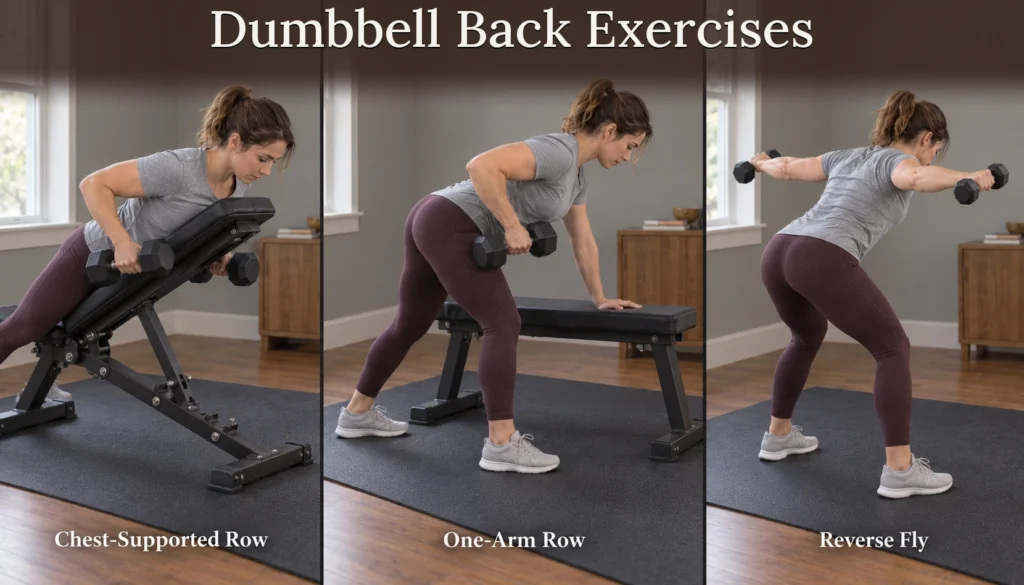
A chest-supported dumbbell row is a useful first choice when you have an adjustable bench. Lie facing the backrest, keep your feet firmly on the floor, and let the dumbbells hang below your shoulders. Start with a modest incline, around 30 to 45 degrees, then adjust it so your chest is supported and the weights have room to travel.

- Set the backrest securely and check that your feet can stay planted.
- Hold the handles with palms facing each other and keep your neck in line with your torso.
- Bring your elbows back, letting the dumbbells move toward the sides of your ribs.
- Lower the weights under control until your arms are extended, without dropping into the bottom.
To check your chest-supported row form, watch whether your chest stays on the pad as you pull. If you lift off to finish every repetition, reduce the weight. You should also be able to breathe without pressing your throat into the top of the bench.
In a chest-supported row, the lats (the broad muscles along the sides of your back), muscles around the shoulder blades, rear shoulders, and biceps contribute to the pull. Your biceps help bend the elbows; chest support reduces the work of holding your torso in position. You may also see this called an incline dumbbell row. Here, that means rowing while lying against an incline bench.
One-Arm Dumbbell Row
A single-arm dumbbell row lets you work each side separately. Place your free hand on a stable bench and use a staggered stance, keeping both feet on the floor. Move your hips back and lean forward from them until the working arm can hang freely. This is a hip hinge. Keep your back in its natural curve, then pull your elbow back beside your body.

ACE also describes a version with the free hand and same-side knee on the bench. In that setup, the hand sits below the shoulder and the knee below the hip. Its key instruction is to pull without rotating your torso or changing your spine position. Choose the setup that lets you maintain a stable position; the photograph shows the version with both feet on the floor.
When checking your one-arm row form, watch the shoulder on the working side. If it rolls toward the ceiling to bring the weight higher, stop the pull sooner or lighten the dumbbell. Lower it slowly enough that you can keep your torso facing the floor.
You can do a dumbbell row without a bench using a support that is stable, rated for the load, and positioned at a useful height. Avoid a chair that slides or folds. With no suitable support, put your free hand on your front thigh, use a light weight, and check that you can hold the position. Do the same number of controlled repetitions on each side, starting with the side that finds them harder.
Bent-Over Dumbbell Row
The bent-over dumbbell row lets you pull with both arms at once. Stand with your feet at a comfortable width, soften your knees, and move your hips back to hinge forward. Keep your abdomen firm and your back in its natural curve, without deliberately rounding or over-arching it, as the dumbbells hang beneath your shoulders. Row by bringing your elbows back, then lower with control.

I would use this as the main row in a dumbbell back workout without a bench only when holding the hinge feels manageable. You do not need to force your torso perfectly parallel to the floor. Find an angle where the arms can move and your position stays consistent.
A common dumbbell row form mistake is standing taller as the weights rise, then folding forward again as they lower. The movement starts to depend on your whole body lifting the dumbbells. Reduce the load and see whether the same torso angle lasts through the set.
A dumbbell bent-over row works the same pulling muscles as other rows, while your trunk and hip muscles also help hold the position. That extra demand can be useful, but it can also limit the exercise. If holding the hinge is what ends the set, a supported row is worth trying. Persistent lower-back discomfort needs assessment rather than a heavier set or more repetitions.
Dumbbell Reverse Fly and Rear Delt Row
A bent-over dumbbell reverse fly uses a wider arm movement and much lighter dumbbells. Hinge forward, let your arms hang, keep a soft bend in your elbows, and raise your arms out to the sides toward shoulder height. Use a smaller comfortable range if needed, and stop before you throw the weights upward or lift your torso. Lower them gently and reset for the next repetition.

For a supported option, face an incline bench with your chest on the pad and your feet on the floor. ACE's incline reverse fly guide describes raising the arms toward shoulder height while keeping the torso stable and avoiding an arch in the lower back.
Use the bench adjustment guide before setting the backrest for chest support.
The reverse fly works the rear shoulders and upper-back muscles involved in moving the shoulder blades. This is why I would put it after the main row, using a weight that lets you keep the elbow bend consistent. A dumbbell you can row comfortably may be far too heavy for a fly.
A dumbbell rear delt row is another option: keep the elbows bent and let them travel wider than they do in the close-elbow row. Pull toward your upper ribs, stopping before you shrug or rotate to finish. It remains a row, with a shorter lever than the fly. For another upper-back exercise with dumbbells, try this variation instead of the fly if the wide arm movement is difficult to control. You do not need both in the starter session below.
Dumbbell Pullover
A dumbbell pullover moves the weight through an overhead arc while you lie on a bench or the floor. NSCA's exercise guidance describes involvement of the lats and chest, along with the serratus (muscles around the ribs) and the long head of the triceps (part of the muscle at the back of the upper arm). Calling it a dumbbell lat pullover does not make it an exercise exclusively for the lats.
Lie lengthwise on a stable bench with your head and torso supported and your feet planted. Use a light dumbbell with a grip and retention system suitable for this movement. For a fixed dumbbell, support the inside of one head with both palms. Use a removable-plate or selector model only if its manufacturer permits that grip and overhead movement. Keep your elbows slightly bent, lower the weight toward the space behind your head, then bring it back above you. Stop the lowering phase before you need to arch your back or flare your ribs to go farther.
During the pullover, keep the elbow bend nearly unchanged and lower slowly enough to stop at any point. On the floor, the surface limits how far the weight can travel behind your head; avoid bouncing it off the floor. Skip the exercise if you cannot establish a secure grip or move comfortably overhead.
I treat a dumbbell pullover for back training as an optional addition. You can begin with rows and a reverse fly while you learn those movements. A pullover also does not reproduce the resistance direction of a cable pulldown.
Dumbbell Renegade Row
The dumbbell renegade row combines a plank with an alternating row. Start with hands on stable, nonrolling dumbbells, feet set wide enough to help you balance, and your body in a controlled plank. Shift enough weight onto one arm to row with the other, then return the dumbbell gently to the floor.
Check that your dumbbells are suitable for supporting body weight before trying this. A round dumbbell that rolls, a loose plate-loaded handle, or an adjustable model whose manufacturer forbids using it as a support is a poor choice. Having an adjustable pair for ordinary rows does not mean you should support your body weight on its handles.
Keep your hips as level as you can. If they swing from side to side, or you cannot hold the plank without your lower back sagging, stop and use a supported row. I would leave renegade rows out of a first back session because the balancing task can end the set before you get much useful rowing done.
If your wrists or balance end the set before the rowing muscles do, choose a bench-supported row for your main exercise. Keep renegade rows for sessions where you specifically want to practice rowing while resisting a twist through the trunk.
Build a Dumbbell Back Workout With or Without a Bench
Use the table as a starting session for a generally healthy adult who is new to these movements. Choose the column that matches your equipment, then adjust the load and amount of work to your current training. I would begin with the sets and repetitions below, then adjust them using the weight and progression checks in the next section.
| Part of session | With a bench | Without a bench | Starting amount |
|---|---|---|---|
| Practice | Easy set of your chosen supported row | Easy set of the bent-over row | 5 to 8 controlled repetitions before working sets |
| Main row | Chest-supported row, or one-arm row with a flat bench | Bent-over row, or one-arm row with suitable support | 2 sets of 8 to 12 repetitions; per side for one-arm rows |
| Lighter exercise | Incline reverse fly | Bent-over reverse fly | 2 sets of 10 to 15 repetitions |
| Optional later addition | Pullover, if the overhead position and equipment are suitable | No extra exercise required | Start with 1 set of 10 to 15, after the main work |
For the rows, begin with about 90 to 120 seconds of rest between working sets. With a one-arm row, complete both sides, then take that rest; pause between sides if you need to recover your position. For the reverse fly, start with 60 to 90 seconds. Take longer if your breathing or grip has not recovered enough to repeat the exercise with control.
I would start with two dumbbell back workouts each week, separated by at least one day, if they fit your wider program. ACSM's 2026 guidance emphasizes training all major muscle groups at least twice a week and adapting the plan to the individual. That guidance does not mean adding two extra back sessions on top of a full-body routine that already contains rows.
The bench-and-dumbbell routine shows how a row can share a session with presses and lower-body work.
If you follow our full-body dumbbell workout, use your chosen row in its pulling slot. Count the work you already do before adding more. A dumbbell-only back workout can also sit within a split routine, but the rest of the week still needs to cover your other muscle groups.
For dumbbell back exercises at home, leave enough space that the weights do not hit furniture, the bench, or your legs. If the bench and stand make the room cramped, lay out the session before loading up. These exercises do not require a large collection of weights, though your main row and reverse fly will usually need different loads.
Check bench dimensions and access if its base or stand makes that training area cramped.
Choose Your Weight and Make Progress
Choose a weight that makes the final repetitions demanding while leaving you able to do about two more controlled repetitions. This is an estimate, especially at first. If you are swinging before the bottom of the suggested range, start lighter. If every repetition is easy, increase gradually and reassess your technique.
For the main row, keep the weight the same while you work from eight toward twelve repetitions. When both sets reach twelve with the same range and torso position, try the smallest available increase at the next session. For a one-arm row, reach that target on both sides before increasing the weight. Expect the repetition count to drop. If it falls below eight or changes how you move, return to the previous weight.
| Session | Weight per dumbbell | Repetitions | Next decision |
|---|---|---|---|
| 1 | 20 lb | 10, then 9 | Keep the weight and aim for another controlled repetition. |
| 2 | 20 lb | 11, then 10 | Keep building within the range. |
| Later session | 20 lb | 12, then 12 | Try a small increase if the technique stayed consistent. |
For one-arm rows, record each side separately if their repetitions differ. A 20 lb entry means the dumbbell in your working hand weighs 20 lb, rather than the combined weight of a pair.
Adjustable dumbbells make this easier when the next weight step is manageable. With plate-loaded handles, check the stated handle weight and the plates on each side so your log reflects the total per dumbbell. Secure the collars as instructed. With selector-adjustable models, check that the selection is engaged before lifting the pair from its stand.
If the next fixed dumbbell is too heavy, I would keep the current pair and build more consistent repetitions before buying another set. A controlled lowering phase or a brief pause can make you pay closer attention to the movement, but neither creates an unlimited substitute for heavier weights.
For the fly, use the same approach within the 10 to 15 range, with smaller increases where possible. Track rows and flies separately. Improving your row does not mean the fly should use the same weight, and changing your exercise every session makes progress harder to compare.
FAQs
What Do Dumbbell Rows Work?
Dumbbell rows work the lats, upper-back muscles, rear shoulders and biceps, while the trunk helps hold position. A bent-over row adds more unsupported holding than a supported row, and feeling the arms work does not establish that the back is doing nothing.
Can Dumbbells Replace a Lat Pulldown?
Dumbbells cannot reproduce a cable lat pulldown’s resistance direction, although rows and pullovers can train your back. Gravity pulls a dumbbell downward while a cable follows its pulley position, so use a suitable pull-up or cable setup when you specifically need vertical pulling.
How Many Row Variations Do You Need?
Start with one row you can do consistently, adding another only for a specific reason such as changing an uncomfortable unsupported position or working one side at a time. Keep the main movement stable long enough to compare repetitions and load rather than switching between several similar rows.
Are These Exercises for Lower-Back Pain?
These are general strength exercises, rather than a treatment plan for lower-back pain. Stop a painful exercise and seek individualized advice for persistent symptoms, recent injury or a relevant condition, because chest support alone does not establish clinical suitability.
Put the First Session Together
Pick a supported row if you have a suitable bench, or a bent-over row if you can hold the hinge comfortably. Add a light reverse fly and record the weight and repetitions. You can leave the pullover and renegade row for later.
At the next session, repeat that setup and check whether your repetitions stayed controlled. I would make the next change from what you recorded: keep the load, add a repetition, or lighten it if your position kept changing.
This article provides general fitness information for adults. Exercise choices and training amounts should be adapted to your ability, health, and equipment.