
Power Rack Attachments: What Fits and What to Buy First

Founder
I founded HomieGym to help you make informed decisions about training at home. My background includes university-level sports science education, practical coaching, gym training and combat sports.
Equipment editor on our team: Milutin Tucakov
Power rack attachments can turn a basic squat-and-bench setup into a place for dips, landmine exercises, or cable work. Storage attachments can also help organize the plates around it. The useful upgrade is the one that adds something you will use in the space you already have.
I would complete the bar supports and safeties before adding extra exercises. From there, this guide helps you compare the main attachments, check which ones fit your exact rack, and decide whether the extra training or storage is worth the cost and room it takes.
Table of Contents
Power Rack Attachments to Buy First
For barbell squats and bench presses, complete the support and catch system before adding exercise variety. J-cups hold the bar before and after a set. Safeties provide a place for the bar to land when you cannot finish the repetition. Buying a power rack with attachments can cover both jobs, but a photo of a loaded cage does not tell you which parts arrive in the box.
| Priority | Attachment | What it should solve | Main check |
|---|---|---|---|
| 1 | J-cups and safeties | Support and catch the bar | Rack, depth, rating and setup |
| 2 | Plate or bar storage | Clear the training area | Clearance and permitted load |
| 3 | Pull-up, dip or landmine option | Add a planned movement | Attachment fit and rack stability |
| 4 | Cable or specialty station | Fill a specific training gap | Whole-system compatibility and space |
I would keep a usable pair of supplied safeties and spend the next dollar on a missing barbell or suitable bench before replacing catches for appearance alone. An upgrade needs a practical reason: a better setting for bench pressing, protection for bar knurling, or easier adjustments that you will use every session.
How to Check Whether an Attachment Fits
Use the exact rack model and the attachment's compatibility list together. Dimensions help eliminate a mismatch, while the manufacturer's documentation establishes which combinations it supports. Even parts sold under the same brand can belong to different rack families.

- Identify the frame. Record the brand, exact model, generation, height and depth option. Keep the original manual or order record.
- Measure both upright faces. A rectangular 2-by-3-inch upright has an orientation; an attachment designed around its wider face may not mount on the narrow face.
- Check the pin and holes. Match the specified pin system, retaining method and hole pattern. Do not substitute a smaller pin because it slides in easily.
- Check bracket clearance. Liners, welds, side holes, bolts and nearby crossmembers can affect whether a part seats and locks fully.
- Match the span. Parts connecting front and rear posts need the correct working depth. Parts crossing the rack also depend on its width.
- Confirm the load and installation. Read the rating for that component and any anchoring or configuration requirement before ordering.
The REP PR-1100 provides a concrete example. REP lists 2-by-2-inch uprights, one-inch holes and three-inch spacing. Its Strap Safeties 2.0 selection distinguishes the PR-1100's 24-inch version from the 26-inch PR-1000/1050 version. The same 1000 Series label does not make those lengths interchangeable.
For 2x2 power rack attachments, upright size narrows the choices, but the pin, bracket and working depth still have to match. The same applies to a 3x3 power rack: check the hole pattern and mounting orientation as well as the upright dimensions. REP explicitly says it cannot guarantee its strap safeties on non-REP racks because machining varies.
If a seller only says “universal,” ask for written confirmation naming both exact products. Filing a bracket, drilling the frame or replacing the supplied locking hardware changes the installation. I would choose a documented compatible part before trying to make a load-bearing accessory fit.
J-Cups and Safeties Have Different Jobs
J-cups support the bar at the start and finish of a set; safeties catch it below the lifting path. A second pair of J-cups can help two users keep separate starting heights, but it does not replace a catch system. When comparing J-hooks for a power rack, check the contact liner, how the cup locks, and the height settings you can actually use.

Pin-and-pipe safeties use a rigid catch across the rack. Strap safeties suspend a flexible catch between brackets. Spotter arms project from an upright and need a rack and installation approved for that outward load. Choose the catch system around the lifting position and permitted setup, rather than treating those designs as interchangeable accessories.
With straps, the bar's supported position depends on slack as well as bracket height. Check the actual catch position using an empty or suitable lighter bar and the manufacturer's instructions for the movement. For bench pressing, the normal repetition must clear the catches, while the supported bar stays clear of your relaxed body, head and neck and allows you to exit. A strap that hangs too low can leave the bar below the position where you need support. Do not copy hole numbers from another lifter or assume a setting that works for squats also works for bench presses.
Keep capacity labels attached to the part they describe. REP rates its 1000 Series Strap Safeties 2.0 at 700 pounds per pair, while its 5000 Series version has a different rating and dimensions. Those figures do not certify any improvised combination of rack, brackets and replacement straps.
I prefer to settle the bench and catch positions before buying dip handles or storage horns. If the rack's adjustment steps leave an awkward bar height, check a manufacturer-approved alternative rather than assuming thicker pads or a different bench position will solve it. Test the setup without working weight and learn the exit before the first hard set.
Add Storage and Training Options Without Blocking the Rack
The best next attachment fills a missing movement or clears useful floor space. Plate horns, a landmine and dip handles can all help, but they occupy different parts of the rack. Plan where each piece sits during squats, presses and plate changes, including the plates or barbell attached to it.
| Option | Useful when | Space or setup cost |
|---|---|---|
| Plate horns | Plates need accessible storage | Loaded plates project beyond the post |
| Landmine | Angled barbell work is planned | Bar and plate sweep extend outside the rack |
| Dip handles | You want a dedicated dip position | Handles and body need clearance |
| Pull-up option | The frame supports the desired grip | Headroom and stability still govern use |
| Cable station | Pulldowns, rows or cable work fill a gap | Loading, travel and access enlarge the setup |
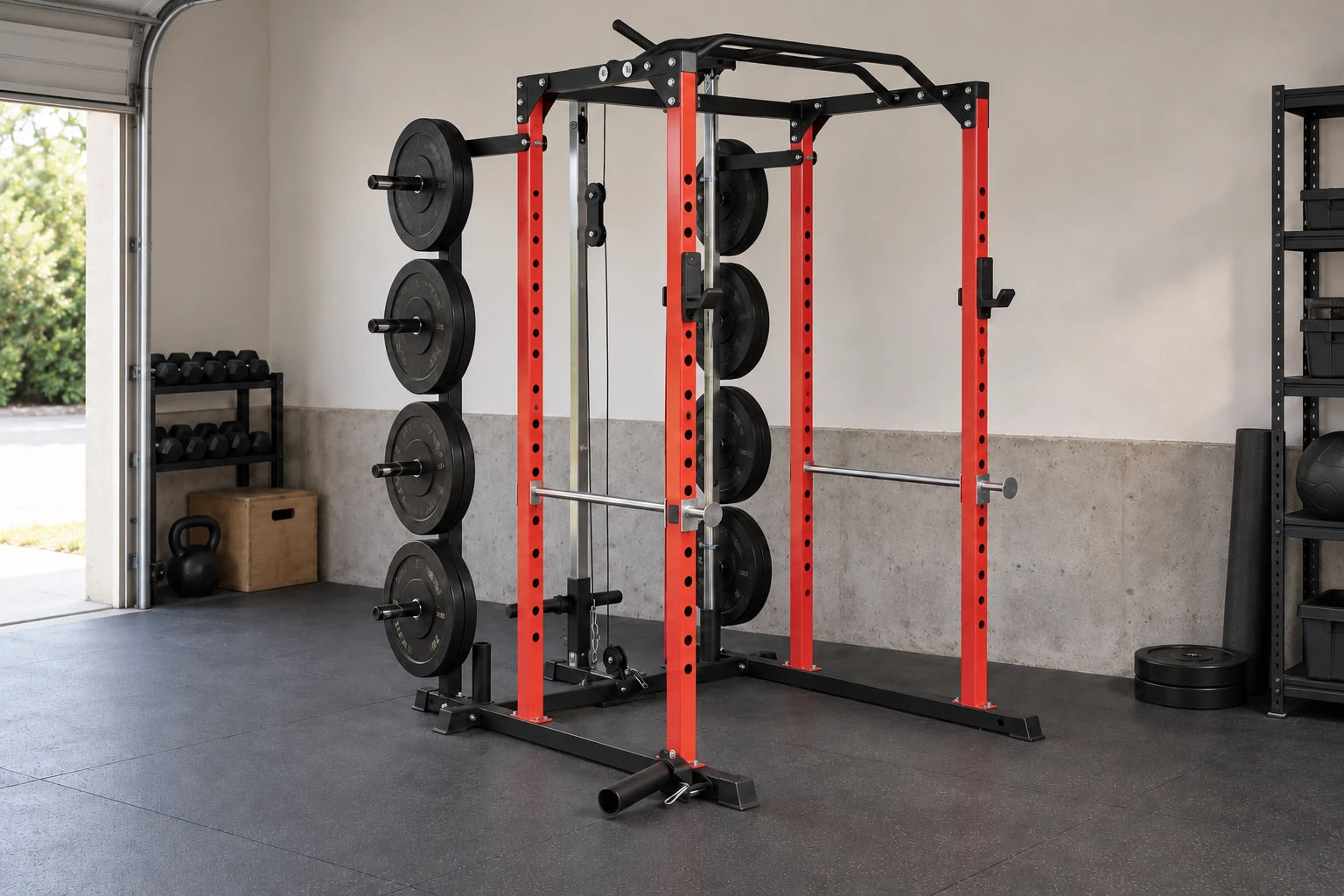
To add weight plates to a power rack, use approved storage horns with the correct sleeve diameter and load limit. Place them where stored plates cannot meet the moving bar, your hands or the bench. Do not assume storage weight makes every freestanding rack suitable for banded work or changes the maker's anchoring requirements.
Compare standard and Olympic barbells to distinguish the plate openings used by those sleeve systems.
Band pegs deserve their own check. The PR-1100 has no band-peg holes, and REP does not recommend band-peg resistance work because of tipping risk. Drilling holes would bypass that design restriction. A heavier-looking frame or a pile of plates at its base does not provide manufacturer approval.
Adding cables to an existing rack requires more than matching a mounting pin. Confirm the rack model, attachment height, rear clearance, plate or stack arrangement, cable travel and included handles. A fixed high-and-low pulley serves a different job from two adjustable cable columns. Choose the system for the movements you want rather than the number of exercises in its advertising. If your rack cannot support the required setup, compare a complete rack-and-pulley system before buying attachments.
Specialty squat rack attachments need the same scrutiny. A belt-squat attachment may add a lever, loading point and platform requirements. Rack-mounted dumbbell holders or a rack-mounted dumbbell spotter must explicitly support the dumbbell type and intended use. A tray for storage is not automatically a starting support for a heavy press. Confirm how you enter, lift out and return the weights before buying.
I would keep specialist purchases behind a clear exercise plan and documented fit. A holder for storing a curl bar, for example, does not establish that the same attachment can support a loaded exercise. Buy the part for its documented job.
What to Check Before Ordering
Compare the cost of the usable upgrade, including the parts needed to operate it. A low-priced cable attachment may still require plates, collars, a compatible hold-down or a separate handle. Storage may need extra fasteners. A foldable rack may lose its folding function when an accessory stays installed.
- Exact item: record both model numbers, generation and size selections.
- Box contents: separate the attachment from plates, handles and mounting hardware shown in photos.
- Operating space: account for the loaded attachment, your body and access to change weights.
- Support: read installation, inspection, warranty and return terms for the exact purchase.
- Unresolved fit: get an answer before ordering a part that holds or catches weight.
When comparing a new power rack against upgrading your current one, price the complete configuration you will use. A rack with the right catches included can be a better starting point than a cheaper frame requiring several separate purchases.
Choose One Useful Upgrade
I would start by checking whether the rack already supports your squat and bench setup properly. Resolve missing or unsuitable catches first. Then buy the attachment that removes the clearest limit in your training: storage that frees a walking route, a pull-up option that fits the ceiling, or a cable station for movements your present setup cannot cover well.
Keep the original safeties and working space usable as the rack grows. Before ordering, write down the exact rack, exact attachment and the source confirming the combination. If that confirmation is missing, keep looking or ask the manufacturer.
FAQs
Are power rack attachments universal?
Power rack attachments are not universal because upright dimensions, pin size, bracket tolerances, hole patterns and rack depth can differ. Use the manufacturer's compatibility list for the exact rack and accessory.
Will every 2x2 attachment fit a 2x2 rack?
Matching 2-by-2-inch uprights does not establish attachment compatibility. The pin, locking system, spacing and bracket must match, and parts spanning the cage need the correct working depth.
What attachment should I buy first?
Buy the J-cups and safeties needed for your barbell setup first, if suitable versions are missing. If the rack already has those parts, choose the next attachment around a specific missing exercise or storage problem.
Can I drill holes to add band pegs?
Do not drill a rack to add band pegs without the manufacturer's approval. Peg fit does not establish suitable force resistance or stability, and some racks explicitly exclude band-peg resistance work.
Can safety straps replace safety bars?
Safety straps can replace safety bars when the manufacturer approves the exact rack, strap set and configuration. Match the working depth and rating, then check the catch position with an empty bar because strap slack changes the supported height.