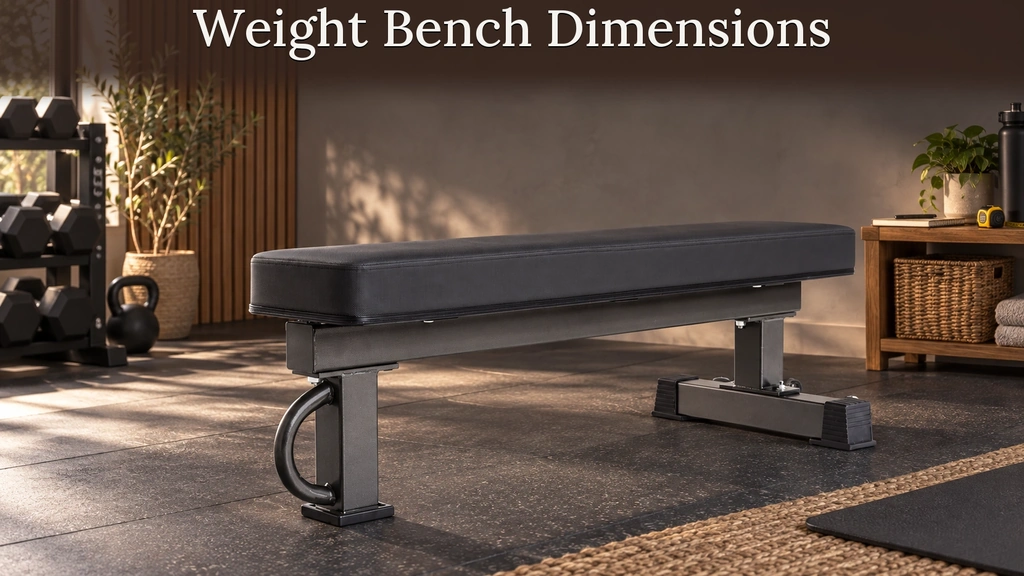
Weight Bench Dimensions: Height, Width, and Room to Train

Founder
I founded HomieGym to help you make informed decisions about training at home. My background includes university-level sports science education, practical coaching, gym training and combat sports.
Weight bench dimensions explained: compare pad height, width, length, real model examples, and the space needed to train and store the bench.
Weight bench dimensions matter when a bench fits your floor plan but leaves your feet struggling to reach the floor or your head without enough support. The size of the steel base tells you where the bench will sit. The height, width and length of the pad help you judge whether it suits your body and exercises.
I would settle the training position before deciding where to store the bench. This guide separates those measurements, compares three real models, and shows how to allow room for weights and movement so you can judge a bench before bringing it home.
Table of Contents
Weight Bench Dimensions: Read the Right Measurements
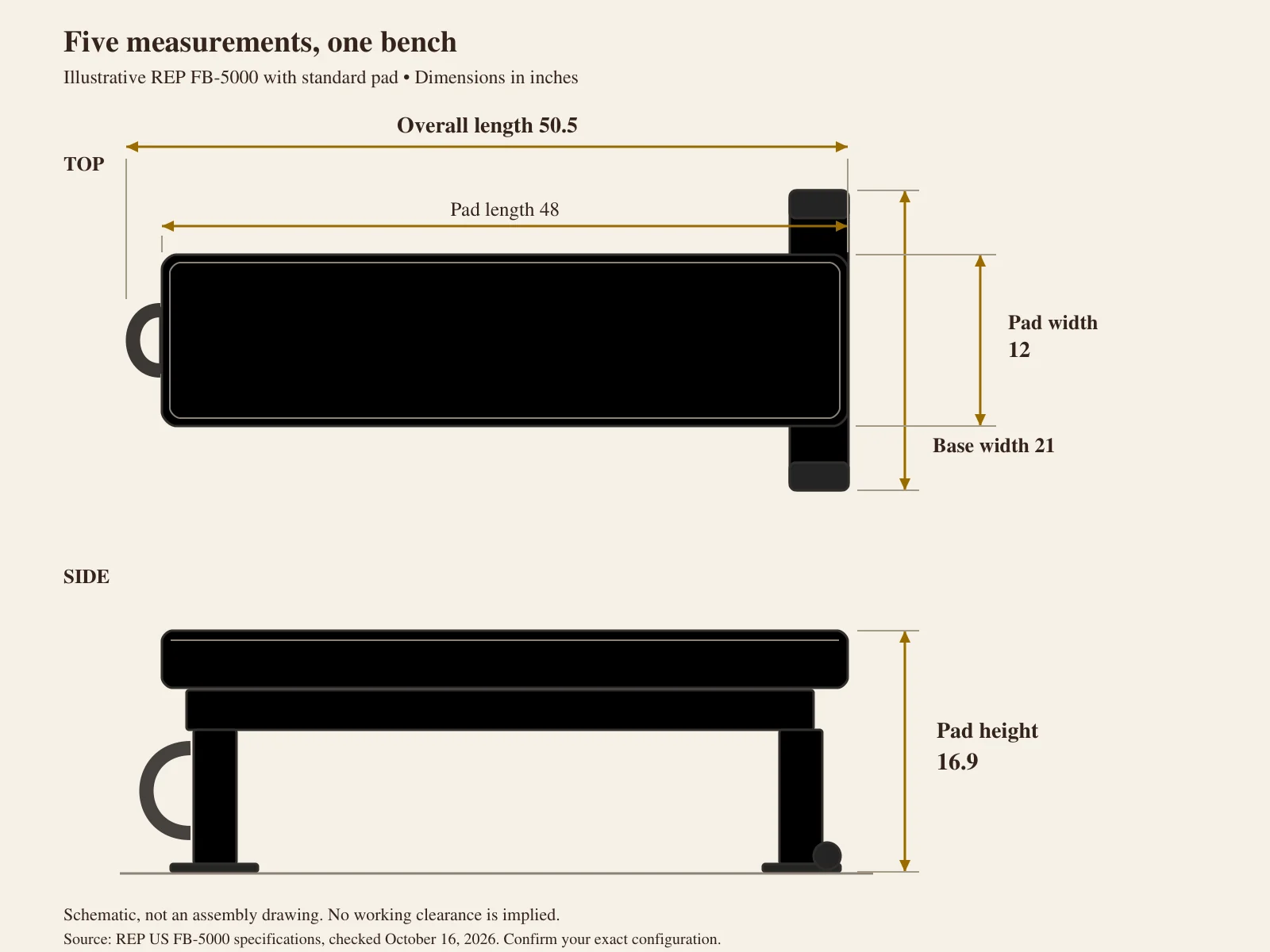
Separate the outside dimensions from the pad dimensions. Overall width usually describes the bench's widest part, often its rear foot. Pad width describes the surface under your body. An adjustable model also has separate backrest and seat lengths, with a junction between them.
| Measurement | Measure between | Reader decision |
|---|---|---|
| Overall length | Farthest points at each end | Floor position and moving route |
| Overall width | Widest points, including feet | Base placement and rack interference |
| Pad height | Floor to top of flat pad | Foot support and pressing setup |
| Pad width | Side to side across support surface | Body support and arm movement |
| Pad length | Usable padded surface | Head, torso, and pelvis support |
| Stored dimensions | Full permitted stored configuration | Closet, wall, and access fit |
Manufacturer labels are not always identical. Confirm whether a published height includes the pad, whether length includes a handle, and whether the dimensions describe the flat or stored configuration. For adjustable weight bench dimensions, request a drawing if a single length or height leaves the raised-backrest position unclear.
Verified Bench Sizes: Three Examples
These weight lifting bench dimensions show variation between actual models, rather than a universal home-gym standard. All measurements are inches, with the bench flat. The examples explain fit; they are not a ranking.
| Model | Length | Base width | Pad height | Pad width |
|---|---|---|---|---|
| Rogue Flat Utility 2.0 | 47 | 14 | 18 | 12 |
| REP FB-5000, standard pad | 50.5 | 21 | 16.9 | 12 |
| REP Nighthawk | 51 | 25.9 | 16.7 | 11.8 |
The Rogue specifications distinguish a 14-inch footprint width from a 12-inch pad. REP likewise lists a 21-inch base width and 12-inch standard pad on the FB-5000, plus a 48-inch pad length. Using base width as if it were pad width would answer the wrong question.
The Nighthawk is listed at 51 inches long and 25.9 inches wide, but its back pad is 36 inches long and its seat is 13 inches long, with a 1.57-inch gap. I would use those separate measurements to assess support. Overall length includes parts that do not support your body.
Pad options and revisions can change the result. REP explicitly says a compatible Thompson pad increases the FB-5000's total height by half an inch. Check the exact configuration you are buying, especially when comparing a used bench with a current product page.
Weight Bench Height: Check Your Feet First
The right weight bench height lets you establish the foot support your exercise requires while keeping the intended body contact with the pad. A familiar gym height is a starting reference, but it cannot settle fit for every person.
The examples above have flat pad heights from 16.7 to 18 inches. Competition rules offer another reference: the International Powerlifting Federation specifies a bench height of 42 to 45 cm, measured to the uncompressed padded surface, with pad width from 29 to 32 cm and length of at least 1.22 m. Those are competition equipment specifications. They do not establish the best home bench height for every lifter.
For a shorter person, a bench can be too high even when its dimensions look conventional. Before buying, try a comparable height with your usual training shoes and normal setup. Do not move onto the pad edge or abandon the intended support position merely to reach the floor. Choose equipment and, where appropriate, a purpose-designed stable foot support arrangement that suits the exercise and its instructions.
For a taller person, a low bench may make getting into position awkward, but total height alone also misses torso length. Check support for the head and torso when flat and when seated against the raised backrest. I would resolve both foot contact and backrest length before choosing by the advertised user-height limit.
An adjustable backrest usually changes angle rather than the bench's entire floor-to-pad height. A listing that says “adjustable height” needs clarification: ask which part moves, how it locks, and the actual pad height in your working configuration.
Pad Width and Length: Support the Body Without Blocking the Lift
Pad width must provide useful support while leaving room for the intended arm movement. A wider pad is not automatically a better fit, and a narrow pad can leave a lifter struggling to find a secure position. Try the actual pressing or supported-row setup before judging the width.
The 11.8- and 12-inch pads in the examples give a useful comparison point, not a mandatory target. Pad shape matters as well as its widest dimension: some seats taper, and the usable support can change along the bench. When a weight bench feels too narrow, check the part of the pad under your upper back rather than the width of the steel base.
Length needs the same care. On a flat bench, compare the continuous support surface with your lying position. On an adjustable bench, check the backrest and seat separately at the angles you need. Adding the seat length and backrest length does not tell you whether the raised backrest supports your head.
Compare flat and adjustable benches if the pad gap or separate seat changes your support.
A pad gap also occupies a particular location under your body. Its width is useful to know, but I would want to know whether it interrupts support during the planned movement. Avoid choosing an awkward body position solely to miss the junction. If the support surface fails the fit check, compare another bench or pad configuration before ordering.
How Much Room Do You Need Around a Weight Bench?
You need room for the whole exercise, weight handling, adjustments, and access around the bench. A product footprint only marks the equipment itself. There is no single clearance number that can cover a dumbbell press, a seated exercise, and a barbell station with different racks and bars.
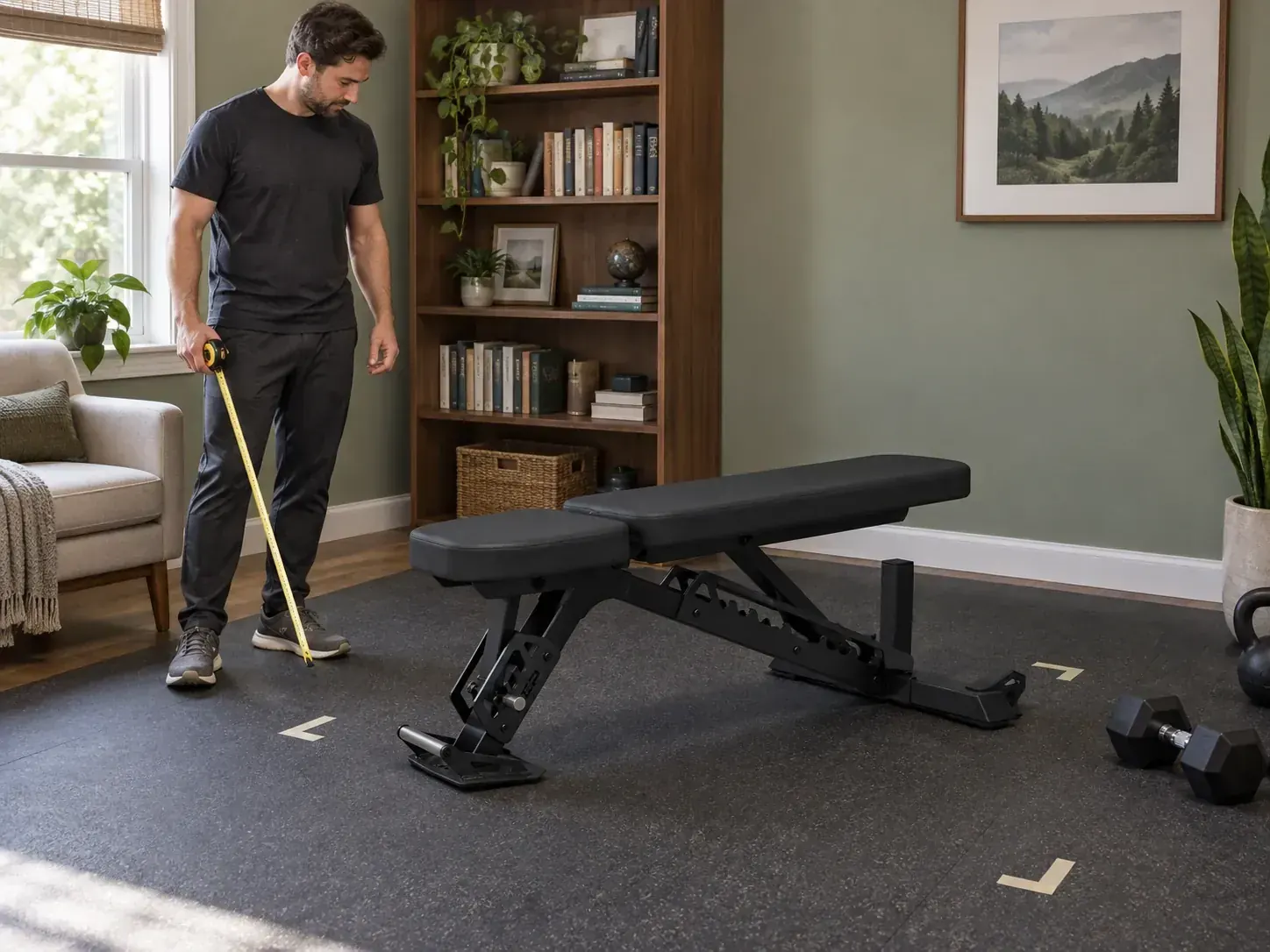
I start with a taped outline of the candidate's full length and width. Then I check the actions around it: approach, sit down, place the feet, reach the adjustments, move through the unloaded exercise, and leave the bench. Include the space occupied by the dumbbells and your arms, rather than ending the plan at the pad edge. Tape is a planning aid and does not replace a manufacturer clearance requirement.
- Mark fixed obstacles: walls, furniture, doors, radiators, and storage.
- Mark the bench: include projecting feet, handle, and permitted moving parts.
- Check the movement: allow the intended body and weight positions.
- Check handling: reach and return weights without an obstacle forcing an awkward turn.
- Check access: preserve an entry and exit route, plus any required spotter position.
For barbell work, add the exact rack and full bar length, plate-loading access, and the usable bench position relative to the bar supports and safeties. A rear foot can meet a rack crossmember before the bench reaches the position you need. The rack dimensions guide handles that larger layout. A bench fitting between the uprights does not settle the whole setup.
“Olympic weight bench dimensions” can describe an integrated bench-and-bar-support unit rather than a loose utility bench. Measure that complete product and its loading area. If the room must also support mat or standing work, the small-room planning approach can help you share the same central floor area.
Check Storage and the Route Back to It
Stored dimensions need their own check. Upright storage rotates a bench into an approved standing position; folding changes its frame configuration. Neither feature is guaranteed by an adjustable backrest. The Nighthawk's manufacturer specifies an upright-storage post, for example.
The folding bench comparison separates flat folding designs from adjustable ones.
Measure the complete stored configuration, including feet and handles, then check the route from the training area. A closet opening, tight turn, or floor transition can make a compact stored size inconvenient. Use only the manufacturer's permitted storage position and moving method, and keep the stored bench from obstructing a door or walking route.
Before ordering, I would write down the candidate's full dimensions, pad dimensions, required use space, and storage method on one page. Compare those with your actual body position and room plan. If one measurement remains unclear, ask for the exact drawing before buying; a shorter product title or a “compact” label cannot fill that gap.
FAQs
What are standard weight bench dimensions?
There is no universal size for every home weight bench; use the exact model's overall dimensions and pad measurements. Competition dimensions belong to a specific rule set and do not guarantee individual fit.
How tall is a weight bench?
The three current models compared here have flat pad heights of 16.7, 16.9, and 18 inches. Check the exact pad configuration and whether the measurement includes the padding.
How wide should a weight bench be?
A weight bench pad should support your body without blocking the arm path for the intended movement. As a reference, the REP Nighthawk has an 11.8-inch pad even though its base is 25.9 inches wide. Use pad width to compare body support, then check your exercise position; neither that example nor the width of the steel base establishes the right fit for every lifter.
Does a taller person need a longer weight bench?
A taller person may need a longer support surface, but total height alone cannot determine the right bench length. Check the head, torso, and pelvis support in the actual flat and inclined positions.
Dimensions are manufacturer specifications checked October 16, 2026. Follow the current instructions for the exact bench, rack, accessories, and planned exercises.