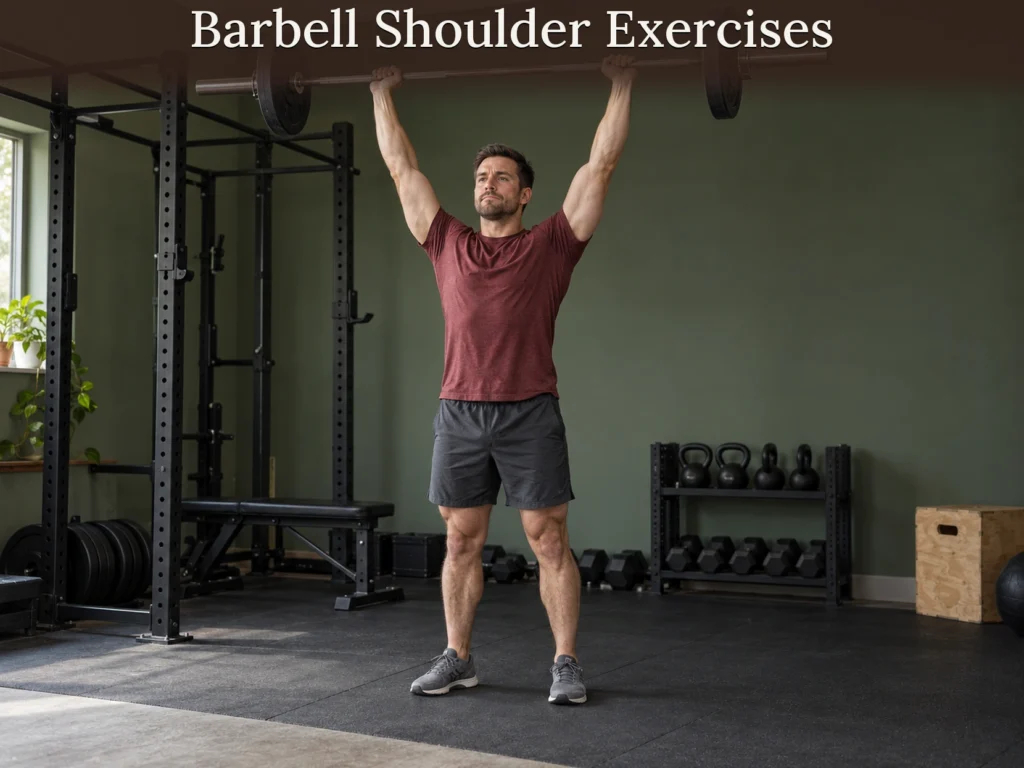
Barbell Shoulder Exercises: Presses, Raises, and a Home Plan

Founder
I founded HomieGym to help you make informed decisions about training at home. My background includes university-level sports science education, practical coaching, gym training and combat sports.
Barbell shoulder exercises work best as a small set of choices built around one main press. I recommend starting with a standing strict press you can lower and rerack under control, then adding side or rear shoulder work only where your wider routine needs it. Performing every press variation in one session adds overlap before it solves a training gap.
The standing press is the default below. An unsupported seated press can replace it when your equipment suits that setup; the push press is a separate skill option. Front raises and upright rows remain optional. If you only own a barbell, expect a press-centered session rather than equal isolation of every part of your shoulders.
Table of Contents
Choose Barbell Shoulder Exercises by Their Role
Choose one strict press first. The remaining barbell shoulder lifts answer different needs, so they belong in your routine only when their role is useful.
| Exercise | Role | Main condition |
|---|---|---|
| Standing strict press | Main overhead press | Controlled standing setup and overhead clearance |
| Unsupported seated press | Alternative main press | Suitable seat and reachable rack supports |
| Push press | Optional leg-drive skill | Deliberate timing and a controlled reset |
| Front raise | Extra front-shoulder work | Useful after counting other presses |
| Upright row | Optional shoulder and upper-trap work | Manageable, comfortable range |
The deltoid is the muscle around the shoulder, commonly described by its front, side, and rear portions. Shoulder exercises using a barbell involve these areas differently. A shrug mainly serves upper-trap training and does not fill the same role as a side raise.
I choose additional exercises by what they add to the week. If pressing already covers your main goal, another press may have less value than direct side or rear shoulder work.
Standing Barbell Press: Setup, Bar Path, and Common Mistakes
The standing barbell overhead press starts at the front of your shoulders and finishes with the bar balanced overhead. Keep your legs still during the press. This is the strict barbell shoulder press used in the workout, rather than a leg-driven repetition.
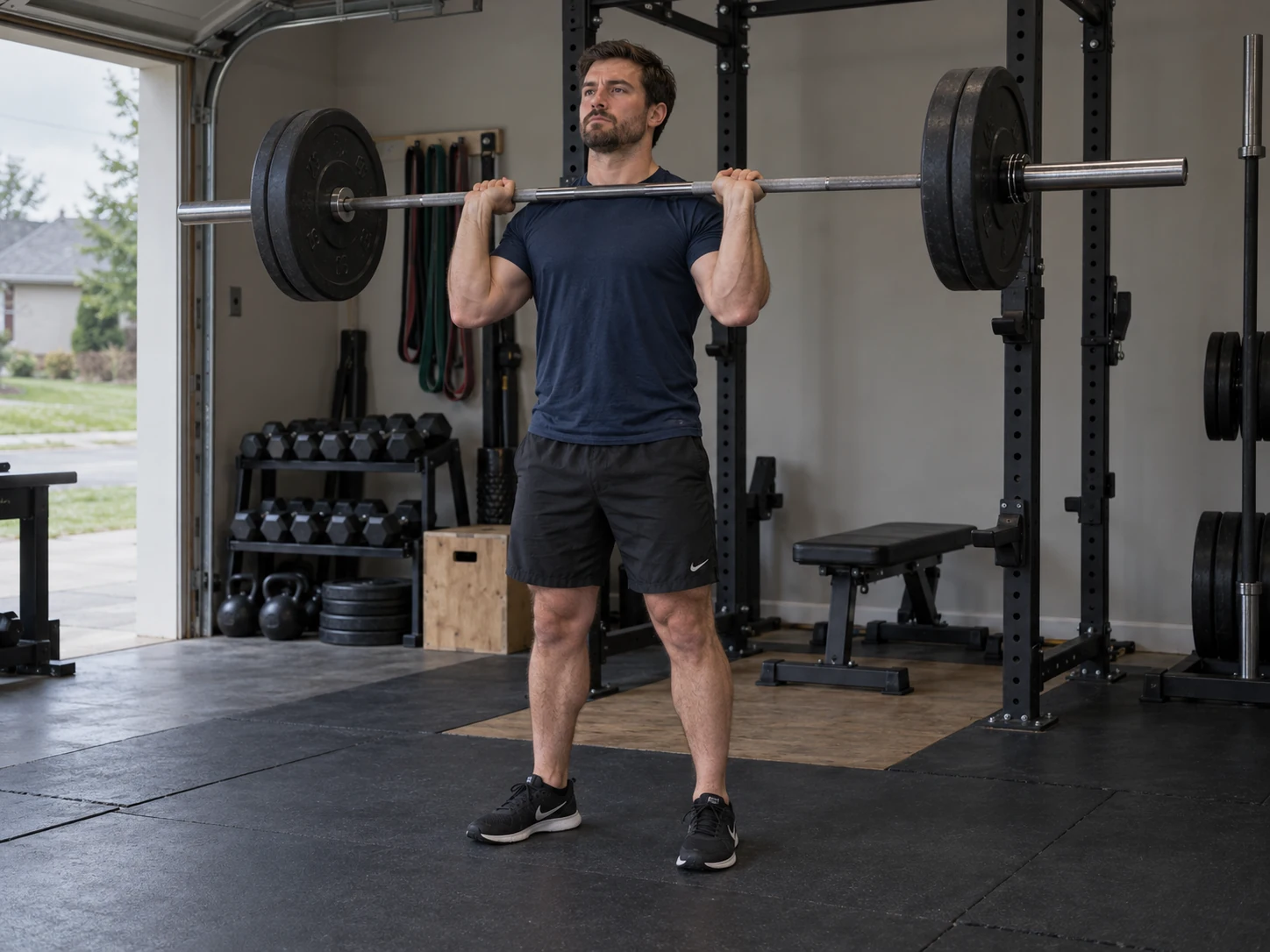
Before loading, check that the bar and plates clear the ceiling, rack, and nearby objects through the full movement. Use compatible equipment, evenly loaded plates, and collars. Rehearse pickup and return with a manageable load; a full-size empty bar is already too heavy for some people.
- Set the bar on appropriate rack hooks where you can lift it clear without stretching up. Use a grip that places your forearms roughly upright beneath the bar at the start.
- Unrack into a balanced stance around hip to shoulder width. Hold the bar close to the front of your shoulders with your hands securely around it.
- Brace your trunk by tightening around your abdomen while keeping your ribs and pelvis controlled. Move your head back enough to clear the bar.
- Press upward close to your face. As the bar clears your head, bring your head back under it and finish with straight arms overhead.
- Lower along the same controlled route to the starting position. Finish the set while you can still return to both hooks deliberately.
For practice, begin with an unloaded movement or lighter training bar, then take a few easy sets with gradually more load if needed. Practice sets do not count as the working sets listed later. Avoid turning the warm-up into a demanding workout.
A standing barbell shoulder press that requires an increasing backward lean, a bar drifting well forward, or an unexpected knee dip needs a lighter load or a technique reset. End the set before these changes become the way you finish every repetition. If overhead movement causes pain, stop that exercise and seek appropriate guidance rather than forcing its range.
The name military press with a barbell often refers to a standing front press. Naming varies, so follow the strict technique described here rather than assuming a different label requires another exercise. Our power rack exercise guide expands on arranging hooks, safeties, and working space.
Seated Barbell Press: Set Up Without a Backrest
This seated barbell press uses a suitable exercise bench or box without a backrest. You still stabilize your own trunk. Sitting down does not automatically make the lift easier to control.
When deciding how to set up a seated barbell shoulder press, check pickup and return before choosing a working weight. You need overhead clearance, firm foot contact, a stable seat rated for the use, and rack supports you can reach while keeping control of the bar. Ordinary furniture is not automatically suitable.
- Position the seat and rack supports according to the equipment instructions. Rehearse taking the light bar from the hooks and returning it without reaching behind yourself or twisting.
- Sit tall with your feet firmly supported. Start with the bar at the front of your shoulders, using a workable press grip.
- Brace, clear your face, and press overhead without leaning back to finish. Lower to the same starting position before the next repetition.
- Return the bar to both supports under control before relaxing your grip or trunk.
There is no universal hook height or bench angle for this arrangement. If your seat and rack cannot provide a repeatable start and finish, keep the standing press or choose another feasible exercise. A supported backrest press needs its own matching equipment setup.
A small study of 15 men compared seated and standing presses with barbells and dumbbells, measuring muscle activity and maximum strength. It shows that these setups create different demands, but it does not establish which grows shoulders best over months or which is safest for everyone (1).
Barbell Push Press: Learn the Dip and Drive
A barbell push press uses an intentional leg drive to accelerate the bar before the arms finish overhead. Choose it when learning that coordination is part of your goal and you can already handle the start, overhead position, and return.
- Begin with the bar supported at the front of the shoulders, elbows slightly forward, and a secure grip. This bar position is called the front rack; it is different from the equipment rack.
- Make a short, controlled knee dip with your torso upright and your feet grounded. Avoid folding forward into a squat.
- Drive upward with the legs, then continue the bar's motion with your arms. Finish overhead without dipping your knees a second time.
- Lower to the front rack, regain balance, and pause before starting another repetition.
For a separate learning option, use 2 sets of 3 to 5 quality repetitions, resting 2 to 3 minutes. Choose a manageable load for this lift and stop when timing or bar control deteriorates. Replace the main strict-press slot if you deliberately choose this option; do not add it to finish failed strict repetitions or automatically copy your strict-press weight.
Front Raises and Upright Rows: When to Include Them
Include either accessory only when it adds useful work beyond your current pressing. Neither is required to complete the default session.
Barbell Front Raise
The barbell front raise adds work for the front of the shoulder, an area already involved in overhead and chest presses. I leave it out of the starting workout because another front-shoulder exercise is often a lower priority than learning the main press or addressing a side-shoulder gap.
If you include it, hold a light bar in front of your thighs with an overhand grip and a small, consistent elbow bend. Raise it in front through a comfortable range, keeping your torso still, then lower without bouncing off your legs. Reduce the load if you have to rock backward to lift it. A lighter implement is a better choice when even the empty bar makes the movement awkward.
Treat this as an optional accessory allocation within your week. Adding it simply because it appears in an exercise list can make your session longer while repeating work you already have.
Barbell Upright Row
The barbell upright row combines an upward pull with shoulder and upper-trap work. Start with a manageable bar held in front of your thighs, hands around shoulder width or slightly wider. Draw the bar close to your body as the elbows move outward, then lower smoothly.
Use a range you can control comfortably. There is no requirement to reach your chin or force your elbows to a fixed height. Omit or replace this exercise if it provokes symptoms; a wider grip or a lower endpoint cannot guarantee an injury-free movement.
I keep the upright row optional because it needs to suit the person and add something useful to the routine. If you own dumbbells and mainly want direct side-shoulder work, a lateral raise is another option without having to include this pull.
When to Add Side and Rear Delt Work
Add direct side or rear delt work when those tasks are a priority and your current week leaves room for them. A barbell press alone does not provide equal isolation of the front, side, and rear shoulder.
A lateral raise moves the arms out to the sides and offers a different task from pressing overhead. A rear-delt raise moves the upper arms outward from in front of the torso. These can use dumbbells rather than trying to turn a straight bar into every kind of shoulder exercise.
Check your pulling sessions as well. Rows can involve the rear shoulder, but the amount and emphasis depend on the exercise and how you perform it. Count that exposure when deciding whether another rear-delt exercise is worthwhile, without treating every row as a fixed number of isolation sets.
Use the dumbbell shoulder exercise guide for the raise options. With a barbell-only setup, keep the honest press-centered version and build the wider program around the equipment you can use well.
Build a Shoulder Session: Sets, Reps, Rest, and Exercise Order
Start your barbell shoulder workout with one standing strict press. The seated strict press can replace it if the unsupported setup above works for you. The table is my practical starting example, not a study-tested optimal shoulder program.
| Order and exercise | Working sets | Reps | Rest | Effort |
|---|---|---|---|---|
| 1. Standing strict press | 2 | 6 to 10 | 2 to 3 min | About 2 to 3 controlled reps remaining |
| 2. Optional dumbbell lateral raise (nonbarbell) | 2 | 12 to 20 | 60 to 90 sec | About 2 to 3 controlled reps remaining |
| 3. Optional dumbbell rear-delt raise (nonbarbell) | 2 | 12 to 20 | 60 to 90 sec | About 2 to 3 controlled reps remaining |
Repetitions in reserve means your estimate of how many more repetitions you could complete with the same range and control. Leave more margin while learning. Two strict-press sets make up the barbell-only starting session; the raises are optional additions when your equipment and wider week justify them.
The 2026 ACSM overview supports progressive resistance training for healthy adults and found that reaching momentary muscle fatigue did not consistently change outcomes across the reviewed evidence. That supports leaving room to practice good repetitions; it does not make training effort irrelevant or validate this exact workout (2).
If you want the optional push-press route, use its separate 3 to 5 repetition prescription and timing-based stop rule. Front raises and upright rows are exercise choices to assess against your needs, rather than extra rows you must add to this table.
Progress Your Press While Counting Chest and Triceps Work
Build repetitions before adding weight. For the strict press, reach 10 controlled repetitions in both working sets with the intended 2 to 3 repetitions remaining before considering the smallest practical load increase. After increasing, work from the lower end of the range again.
Log total bar-plus-plate weight, repetitions in each set, and any change in range or control. If the smallest available increase is too large, repeat the same weight rather than forcing a jump. The same reps-first approach can guide the optional raises; push-press progression depends on repeatable timing and bar control.
One difficult day is a reason to record what happened. If performance repeatedly worsens, review the load, number of sets, spacing of sessions, and recovery before deciding whether to reduce the dose. A single missed target does not automatically require a deload, a planned reduction in training demands.
For an upper/lower example, train upper body Monday and Thursday and legs Tuesday and Friday. Let this chosen press occupy an existing upper-body pushing slot. Count bench pressing and direct triceps work when deciding how much additional pressing you can repeat comfortably.
If you follow the full-body barbell workout for beginners, or the complete power rack routine, adding this entire session changes that program's workload. Keep the base plan and make a deliberate substitution or modest addition.
The barbell triceps exercise guide can help choose an accessory when needed, rather than create another complete pressing day.
Before your next session, choose one press, write down its starting dose, and decide which existing slot it will use. Add an accessory only when you can name the task it supplies and the work it replaces or adds.
FAQs
Can you train every part of your shoulders with a barbell alone?
A barbell can involve different parts of your shoulders, but a press-centered routine does not isolate each part equally. Dumbbell or cable raises offer useful options for direct side and rear shoulder work.
Do you need both a strict press and a push press?
No, you do not need both presses in the same shoulder session. Start with one strict press, and choose the push press separately if deliberate leg-drive training fits your goal.
What can you use if the empty bar is too heavy?
Use a lighter training bar or another implement you can press under control if the empty bar is too heavy. Check that a shorter bar still fits any supports you intend to use.
Do you need front raises if you already bench press?
No, front raises are optional when you already bench press. Count your existing front-shoulder work and decide whether another raise adds more value than side or rear shoulder training.
This content is for informational and educational purposes only. It is not a substitute for professional medical advice, diagnosis, or treatment. If an injury or ongoing symptoms affect your training, seek guidance from an appropriate healthcare professional.
References
- Saeterbakken AH, Fimland MS. Effects of body position and loading modality on muscle activity and strength in shoulder presses. J Strength Cond Res. 2013;27(7):1824-1831. doi:10.1519/JSC.0b013e318276b873
- Currier BS, D'Souza AC, Fiatarone Singh MA, et al. American College of Sports Medicine Position Stand. Resistance Training Prescription for Muscle Function, Hypertrophy, and Physical Performance in Healthy Adults: An Overview of Reviews. Med Sci Sports Exerc. 2026;58(4):851-872. doi:10.1249/MSS.0000000000003897