Elliptical Machine Benefits: Cardio, Practical Uses, and Limits

Founder
I founded HomieGym to help you make informed decisions about training at home. My background includes university-level sports science education, practical coaching, gym training and combat sports.
Elliptical machine benefits include aerobic fitness, adjustable effort, and standing cardio with your feet supported throughout the movement. I favor an elliptical when you want a break from running landings but still want to train on your feet. The guided stride has to suit you, and moving handles do not make it a complete strength program.
The most useful question is what the machine adds to your week. An elliptical can give you an available indoor cardio option, particularly when weather or daylight interrupts outdoor exercise. Its value depends on a comfortable movement and a training demand you can manage.
Table of Contents
Elliptical Machine Benefits at a Glance
The main elliptical benefits concern cardio fitness and a different way to move. Some advantages are physical, while others make a planned session easier to fit into an ordinary day.
| Benefit | Useful for | Practical limit |
|---|---|---|
| Aerobic conditioning | Training sustained effort | Improvement needs repeated training |
| Supported foot movement | A break from running landings | The knees and hips still carry load |
| Moving handles | Adding active arm work | Holding them is not the same as pushing and pulling |
| Adjustable demand | Changing pace or resistance | Levels differ between machines |
| Indoor access | Training around weather and daylight | Comfort and usable space still matter |
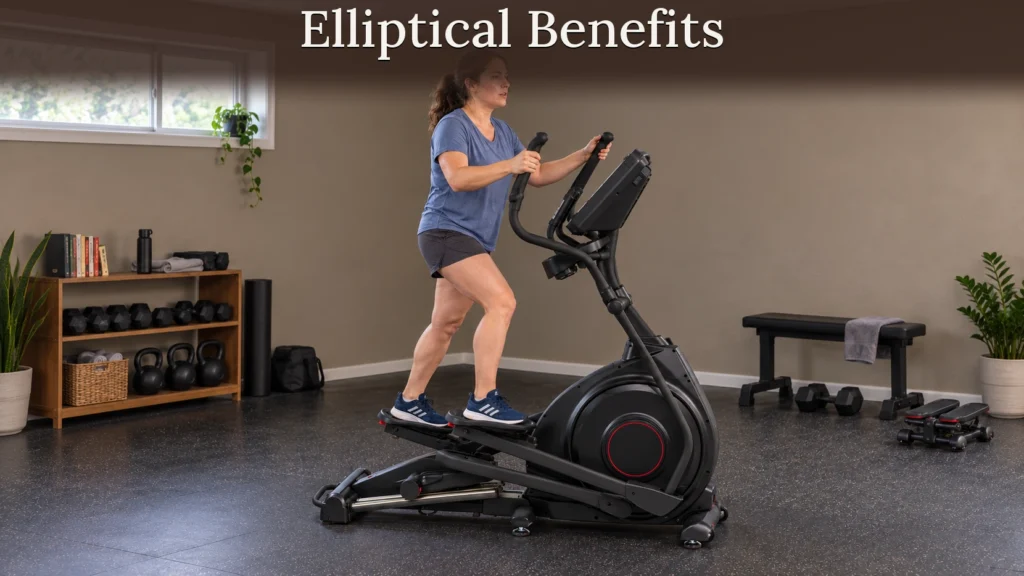
What does an elliptical machine do? It guides your feet through a repeating pedal path while your legs supply the effort. On models with linked moving handles, your arms can help drive that motion. The benefits of an elliptical workout depend on how much work you perform and how often you return to it.
I would choose it for a cardio role first. If your main goal is learning to run, lifting heavier weights, or improving a sport-specific skill, those activities still need their own practice.
Build Aerobic Fitness With Training You Can Repeat
An elliptical can improve aerobic fitness, your ability to sustain exercise using the oxygen your body takes in. That gives it a useful place alongside walking, cycling, and other cardio activities.
In a small 12-week randomized study, 22 moderately active women trained on an elliptical, treadmill, or stair-climber. Aerobic fitness measured on a cycle test improved in all three groups, with no significant difference in improvement between groups. The elliptical group contained eight women, so this supports a training option rather than proving identical results for everyone. 1
You can change the demand by pedaling faster or increasing resistance. I prefer changing one setting at a time when you are learning what an effort feels like. If your thighs are struggling while your breathing has barely changed, a lower resistance and a comfortable rhythm may give you a more useful cardio session.
For a practical check, notice three things:
- Can you keep a smooth rhythm as your breathing rises?
- Can you stay upright without supporting much of your body on the console?
- Does the session leave you able to carry out your next planned activity?
These observations help you choose a manageable demand; they do not measure fitness in a laboratory. The beginner elliptical workout gives you an actual starting session and a progression once you are ready to put the machine to work.
Keep Your Feet Supported While Your Joints Still Move
If running or jumping leaves you wanting a break from repeated landings, an elliptical lets you keep exercising with your feet on the pedals. Low impact describes the contact pattern. It does not tell you that every joint experiences less demand.

A laboratory study of 15 men illustrates the difference. Elliptical exercise produced lower loading rates than level walking, but greater peak knee-extensor and hip-flexor moments. A joint moment describes a turning demand around that joint. A smoother landing pattern therefore did not remove the muscular demand. 2
I would use that distinction to judge the movement, rather than treating the low-impact label as permission to push through discomfort. An awkward pedal path, excessive reach, or resistance you cannot control can still make the session unsuitable. A model that fits another person may feel different under your feet.
Try an easy setting before committing to a longer session. If the movement causes pain or recurring symptoms, stop and get individual advice. Our elliptical and treadmill comparison considers walking and running separately, which is more useful than assuming every treadmill session has the same impact.
Understand What the Moving Handles Add
Moving handles let your arms contribute to the exercise when you actively push and pull. That can make the session more demanding while distributing the work beyond the legs. Simply resting your hands on the grips contributes much less deliberate arm work.
Mier and Feito compared leg-only exercise with combined arm-and-leg exercise on an elliptical. Among the 22 participants who completed both conditions, using the arms increased oxygen consumption and perceived effort at the tested settings. The experiment measured an immediate exercise response, not upper-body strength or muscle growth after weeks of training. 3
I treat the handles as an option for additional cardio work. If they pull you into an uncomfortable reach or disrupt the rhythm, use the fixed grips when your machine's instructions permit it. Add coordinated arm work when you can do it without twisting your torso or hanging your weight on the handles.
The moving arms also have a different job from stable entry supports. Learn which fixed handholds your manual specifies for getting on and off. Linked arms can move with the pedals, so their presence alone does not establish a secure mounting aid.
For muscle-building goals, keep dedicated resistance exercises in the plan. An elliptical does not offer the same range of progressively loaded pushing, pulling, squatting, and hinging tasks that a strength routine can provide.
Make Elliptical Training Practical at Home
An elliptical at home gives you an indoor session without arranging a route, waiting for daylight, or traveling to a gym. That convenience is useful if it removes a real obstacle in your routine. Owning the machine alone does not establish that you will train more often.
I would check the room during use before considering storage. Pedals and handles need their full moving clearance, and your head rises above its normal standing position. Follow the exact model's clearance guidance instead of judging fit from the console height or a photograph.
Before choosing a permanent position, check:
- The entire pedal and handle movement, including nearby furniture and door swings.
- Overhead space for the tallest intended user during the full movement.
- A clear route onto and off the machine, plus access for cleaning and inspection.
Body fit needs its own trial. A short base does not guarantee a comfortable stride, and an adjustable stride does not guarantee that every setting suits every user. Try the movement at the pace you expect to use, with the intended hand position.
If you are still dividing a small room between cardio and weights, the home gym planning guide helps you decide which equipment deserves that space first.
Fit Elliptical Cardio Around Strength Training and Other Activity
An elliptical is useful when it fills a cardio gap without making the rest of your training harder to carry out. If you already walk, play a sport, or cycle, decide which activity it will complement or replace before adding more sessions.
Combining cardio and strength training is a reasonable approach. A review of 43 studies found no overall reduction in maximal-strength or whole-muscle growth gains compared with strength training alone, although explosive-strength gains were smaller, particularly when both modes shared a session. This was broader concurrent-training research, not an elliptical-specific result. 4
For a strength priority, I would protect the quality of the lifting session. If hard elliptical work leaves your legs tired before squats, move that cardio to another time or reduce its demand. An easy warm-up and a demanding cardio session have different roles, even when they use the same machine.
Make the next decision in this order:
- Choose what the elliptical will add: a separate cardio session, an indoor alternative, or a break from running landings.
- Place it where the time and fatigue fit your existing activity.
- Keep or adjust that slot according to whether you can complete the rest of the week.
If weight management is the main reason you are considering it, read the elliptical weight-loss guide for calorie-estimate limits and the wider routine. For now, choose a comfortable opportunity to train, then give that session a clear place beside your strength work.
FAQs
Can an elliptical be your only exercise?
An elliptical can be your main cardio activity if its movement and effort suit you. Keep strength work and any skill-specific practice your goals require, because repeating one guided stride does not cover every training need.
Are ellipticals suitable for beginners?
Yes, an elliptical can suit a beginner who can mount it securely and control its pedal path at an easy effort. Check the machine's instructions and get help if the movement, balance demands, or controls are unfamiliar.
What does the elliptical do to your body?
Elliptical exercise makes your legs work and raises the demand on your breathing and circulation, with additional arm work when you use moving handles actively. Repeated training can improve aerobic fitness, while changes in strength or body weight depend on more than the machine alone.
This content is for information and education, not medical advice or a rehabilitation prescription. Follow your equipment manual. Seek individual guidance for a health condition, injury, or balance concern, and stop exercise for pain or concerning symptoms.
References
- Egaña M, Donne B. Physiological changes following a 12 week gym based stair-climbing, elliptical trainer and treadmill running program in females. J Sports Med Phys Fitness. 2004;44(2):141-146.
- Lu TW, Chien HL, Chen HL. Joint loading in the lower extremities during elliptical exercise. Med Sci Sports Exerc. 2007;39(9):1651-1658. doi:10.1249/mss.0b013e3180dc9970.
- Mier CM, Feito Y. Metabolic cost of stride rate, resistance, and combined use of arms and legs on the elliptical trainer. Res Q Exerc Sport. 2006;77(4):507-513. doi:10.1080/02701367.2006.10599385.
- Schumann M, Feuerbacher JF, Sünkeler M, et al. Compatibility of concurrent aerobic and strength training for skeletal muscle size and function: an updated systematic review and meta-analysis. Sports Med. 2022;52(3):601-612. doi:10.1007/s40279-021-01587-7.