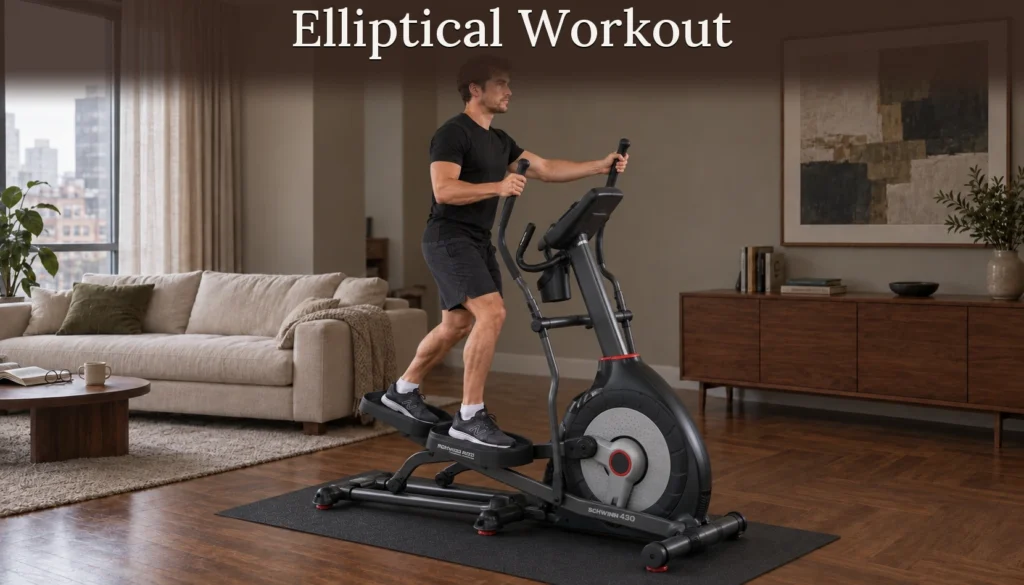
Elliptical Workout: A Beginner Plan for Home

Founder
I founded HomieGym to help you make informed decisions about training at home. My background includes university-level sports science education, practical coaching, gym training and combat sports.
Equipment editor on our team: Milutin Tucakov
An elliptical workout can start with 5 easy minutes, 10 minutes at a manageable steady effort, and 5 minutes easing down. Use the 20-minute plan below as a starting example, and shorten the working block if you need to. My first priority is a smooth stride you can maintain without leaning on the console. Once that feels familiar, you have a useful basis for adding time or a little resistance.
This guide covers a standing elliptical trainer with foot pedals and handles. You will find the starting session first, then help with setup, effort, weekly progress, and the questions beginners ask before their first session.
Table of Contents
A 20-Minute Elliptical Workout for Beginners
Start with a low, comfortable resistance and a steady forward stride. For the middle block, gradually find an effort that makes you breathe harder while you can still talk. There is no resistance number you need to reach. Keep the machine's incline at its familiar starting position, if it has that adjustment.
If this is your first time on the machine, check the setup and mounting instructions below before starting the timer.
Starting session: 20 minutes total
| Phase | Time | What to do |
|---|---|---|
| Warm-up | 5 minutes | Start easy and gradually settle into a smooth forward stride. |
| Steady work | 10 minutes | Use a manageable effort. Keep enough breath to talk; stay easy if needed. |
| Cool-down | 5 minutes | Gradually ease the effort, then bring the pedals to a complete stop. |
The American Heart Association recommends 5 to 10 minutes of gradual warm-up and cool-down. The table starts at the shorter end of that guidance. If you need longer to ease in or settle your breathing afterward, extend those periods and allow more than 20 minutes for the session.
I choose a steady session first because it gives you time to learn the pedal rhythm and notice what changing the resistance does. If you start pulling hard on the handles, rocking from side to side, or struggling to finish a sentence, ease the pace or resistance before continuing. You can keep the whole working block easy while you learn the movement.
If the full session feels too long, try 5 easy minutes, a few comfortable working minutes, and 5 minutes easing down. For example, a 3-minute working block makes a 13-minute session. Shorten the work rather than rushing the start or finish. A break is also an option; if you step off, stop the pedals completely and follow the machine's dismount instructions.
How to Use an Elliptical Correctly
Learn the fixed handholds, pedal movement, and stop procedure before choosing a workout program. Read your model's manual, inspect it for loose or damaged parts, and keep the required clearance around its moving arms and pedals. Check overhead space as well: standing on raised pedals makes you taller than standing on the floor.
On the Schwinn 430 model used as a setup reference, the manual directs you to hold the fixed center handlebars and step onto the lower pedal first. For dismounting, slow to a complete stop, hold those fixed bars, and step from the higher pedal to the floor while your weight stays on the lower foot. The moving handles are linked to the pedals, so they are not stable handholds for getting on or off. Follow your own machine's sequence if it differs.

Once you are standing securely, choose the basic Manual or Quick Start program if your model offers one, following its control instructions. Begin with slow forward pedaling and keep both shoes supported in the pedal trays. Let your knees bend naturally as the pedals move. Stay upright with relaxed shoulders, and look ahead rather than folding over the screen.
I keep the first session simple: forward pedaling, a familiar incline, and small resistance changes. If using the moving handles makes the rhythm awkward, use the fixed grips while you practice, provided your manual permits that. Add the arm movement when you can coordinate it without twisting your torso or gripping harder to keep up.
Do not assume an incline adjustment works like an electronic resistance button. Some machines have a manual ramp that must be adjusted while you are off the machine; the referenced Schwinn model is one example. Check the adjustment instructions before touching the ramp mechanism. If the stride remains uncomfortable at easy settings, choose a different activity rather than forcing the pedal path.
Compare elliptical and treadmill movement if the guided stride does not suit you.
Is the Elliptical a Good Cardio Workout?
Yes, an elliptical can provide a useful cardio workout when your effort gets your breathing and heart rate up. How hard the session feels depends on the resistance, how quickly you pedal, and your current fitness. A slowly moving machine can still feel demanding if the resistance is high.
Use the talk test to check the working block. CDC guidance describes moderate effort as being able to talk while singing would be difficult. At vigorous effort, you can say only a few words before pausing for breath. For this beginner elliptical cardio workout, keep enough control to talk and adjust the settings calmly. You do not need vigorous intervals to begin.

Cadence means how quickly you pedal. A console may show revolutions per minute or another pace measure; check its units. Resistance changes how much force the movement requires. Change one of those at a time so you can tell what made the session harder. Numbered resistance levels are useful for repeating a session on the same machine, but level 5 on one trainer does not establish the effort on another.
My check is whether the setting lets you keep the same smooth movement as your breathing rises. If your legs feel overloaded before you get much cardio work, try a little less resistance and a comfortable rhythm. If the pedals feel difficult to control because you are moving too quickly, slow down. Avoid chasing an RPM target that makes you bounce or pull yourself forward.
Build Your Weekly Routine and Add Intervals
Begin with two manageable sessions spaced through the week. I would start with Monday and Thursday, for example, and consider a third day once those sessions fit your recovery and schedule.
For longer-term health, CDC guidance recommends at least 150 minutes of moderate aerobic activity a week, 75 minutes of vigorous activity, or an equivalent mix, plus muscle-strengthening activity on at least two days. Your initial elliptical sessions are a step toward that weekly total. Easy warm-up and cool-down minutes do not automatically count as moderate work. Brisk walking and other suitable activities can contribute too.

After a session, note the machine, working minutes, resistance, pace or displayed cadence, and whether you could talk. Record the incline too if your machine has that setting. Add working time once several sessions feel controlled and you feel ready for the next planned session. Keep the other settings the same so the change is easy to judge.
If fatigue makes you skip the next planned session, repeat a shorter working block or reduce the effort. If the main problem is finding time, keep two realistic appointments before adding a third. I judge progress by sessions you can complete and repeat; a longer workout that keeps costing you the next one needs adjusting.
Once steady work feels familiar, try replacing one steady session with the following 25-minute interval example. Alternate 1 minute of slightly harder, controlled pedaling with 2 easy minutes, five times. Use a modest change in resistance or cadence, with the other setting held steady. The harder minute can still be moderate effort; this is not an all-out session.
Later interval example: 25 minutes total
| Phase | Time | What to do |
|---|---|---|
| Warm-up | 5 minutes | Start easy and gradually settle into the movement. |
| Intervals | 15 minutes | Repeat 1 minute slightly harder + 2 minutes easy, five times. Include transitions. |
| Cool-down | 5 minutes | Gradually lower the effort before stopping completely. |
Count setting changes inside each interval. Ease into the working minute, then use the start of recovery to slow down or lower resistance. If your breathing has not settled enough to talk comfortably before the next working minute, stay easy longer or skip that effort. Fewer rounds are acceptable, and extending recovery makes the session longer than the table's example.
Keep strength training in your routine as well. If you already have familiar strength days, fit the elliptical around them without immediately making every day harder. You can also use the treadmill workout plans for a different cardio session on days when you prefer walking.
What Muscles Does the Elliptical Work?
The elliptical involves your quadriceps, hamstrings, glutes, and calf muscles as you drive and control the pedals. Those are the muscles at the front and back of your thighs, your buttocks, and the back of your lower legs. A laboratory study of 20 adults measured these lower-body muscle demands on four trainers; it assessed activation during movement, not muscle growth after a training program.1 Moving handles also let your arms contribute when you actively push and pull them.
Muscle involvement and its limits
| Area | Involvement | Practical limit |
|---|---|---|
| Legs | Drive and control the pedals | Working these muscles does not make pedaling a complete leg-strength program. |
| Arms | Push and pull moving handles | Requires active contribution, not only holding on. |
| Trunk | Maintain an upright position | Staying balanced does not make this a complete abdominal workout. |
I treat elliptical training primarily as cardio. If your goal is building muscle, keep suitable strength exercises such as squats, hip hinges, presses, and rows, increasing the challenge as you become able to handle it. A higher resistance number alone does not make the elliptical a complete strength program.
If you want a break from the repeated landings of running or jumping, the elliptical offers a low-impact option: your feet stay on the pedals. Your knees and hips still move and carry load. Mayo Clinic includes elliptical workouts among low-impact options in its arthritis exercise guidance, while advising people to pause for pain and choose activity with their healthcare professional. Comfort with your particular machine matters more than the low-impact label.
FAQs
Is 20 minutes on the elliptical enough?
Twenty minutes on an elliptical can be enough for a useful starting cardio session, with ten minutes of working effort in the example here. Shorten the working block when needed and build it gradually, judging the session alongside your effort and weekly activity.
Is the elliptical good for weight loss?
Elliptical exercise can support weight loss by increasing energy use when the overall pattern of activity and food intake creates a calorie deficit. Choose repeatable sessions rather than a setting advertised as fat-burning, because no universal daily duration guarantees weight loss.
How many calories does an elliptical burn?
As a rough reference, a 154-pound adult might use about 120 total calories during 20 minutes of steady, moderate elliptical work, using the Compendium’s 5-MET category. This includes resting energy and assumes all 20 minutes are moderate, so it is not the calorie total for the mixed-effort beginner plan or an exact food allowance.
Does the elliptical burn belly fat?
Elliptical exercise can contribute to overall fat loss, which may include belly fat, but it does not reliably select where fat is lost. Broader localized-exercise research did not directly test these sessions, and feeling abdominal muscles work does not demonstrate targeted fat loss.2
Is the elliptical good for knees?
An elliptical can suit some people seeking low-impact exercise, but its pedal path still makes the knees bend and bear load. Stop for pain and seek individual guidance for persistent symptoms or an injury rather than forcing the timer.
Choose Your Next Elliptical Session
For your next session, repeat the steady plan if you finished under control and feel ready to train again. If the working block was too demanding or fatigue cost you the next planned session, use the shorter version or lower the effort. Leave enough time for the easy start and finish. I would add time or replace one steady day with intervals only once the basic session is manageable.
This guide is for general information and education, not medical advice or a rehabilitation prescription. Follow your equipment manual. Consult your healthcare provider before a new program if you have a health condition, an injury, or concerns about exercise or balance. Stop for concerning symptoms such as chest pain, dizziness, or unusual breathlessness and seek appropriate medical help.
References
- Burnfield JM, Shu Y, Buster T, Taylor A. Similarity of joint kinematics and muscle demands between elliptical training and walking: implications for practice. Phys Ther. 2010;90(2):289-305. doi:10.2522/ptj.20090033. Read source
- Ramirez-Campillo R, Andrade DC, Clemente FM, Afonso J, Pérez-Castilla A, Gentil P. A proposed model to test the hypothesis of exercise-induced localized fat reduction (spot reduction), including a systematic review with meta-analysis. Hum Mov. 2022;23(3):1-14. doi:10.5114/hm.2022.110373. Read source