
Elliptical Machine vs Stair Stepper: Movement, Effort, and Home Fit

Founder
I founded HomieGym to help you make informed decisions about training at home. My background includes university-level sports science education, practical coaching, gym training and combat sports.
The elliptical machine vs stair stepper choice starts with the movement: choose a standing elliptical for a continuous guided stride, or a stepper if you prefer repeated downward steps. I would decide which kind of stepper you mean before comparing the effort. A compact hydraulic mini stepper, a full-size pedal stepper, and rotating gym stairs ask different things of you.
For home use, a mini stepper can be easier to put away, while an elliptical provides a longer guided pedal path and often moving arm handles. Neither description establishes a better workout for everyone. Match the equipment to the session, support, and space you need.
Table of Contents
Elliptical Machine vs Stair Stepper at a Glance
An elliptical favors a continuous gliding rhythm. A stepper favors a more vertical stepping action. The stepper's mechanism changes the comparison, so use the categories below rather than treating every machine with stepper in its name as interchangeable.
| Equipment | What your feet do | Main choice to check |
|---|---|---|
| Standing elliptical | Follow a repeating curved pedal path | Stride fit and handle reach |
| Hydraulic mini stepper | Press small pedals down against cylinders | Balance, pedal travel, and permitted use time |
| Full-size pedal stepper | Press supported pedals through downward strokes | Step depth, controls, and fixed supports |
| Rotating stair machine | Lift and place each foot on the next stair | Step placement, moving stairs, and overhead space |
I favor the elliptical when you want to stay in one continuous pedal rhythm and deliberately involve your arms. A mini stepper deserves consideration when a full-size machine would take over the room, provided you can use its short stepping motion and arrange any support you need.
A gym stair machine is a separate choice again. It may give you the climbing action you enjoy, but its size and entry method can make it a poor substitute for a compact home stepper.
Mini Stepper, Pedal Stepper, or Rotating Stairs?
A mini stepper and a stairmill have different moving surfaces. On a pedal stepper, your feet normally remain on the pedals. On rotating stairs, you repeatedly pick up and place your feet while the staircase moves.
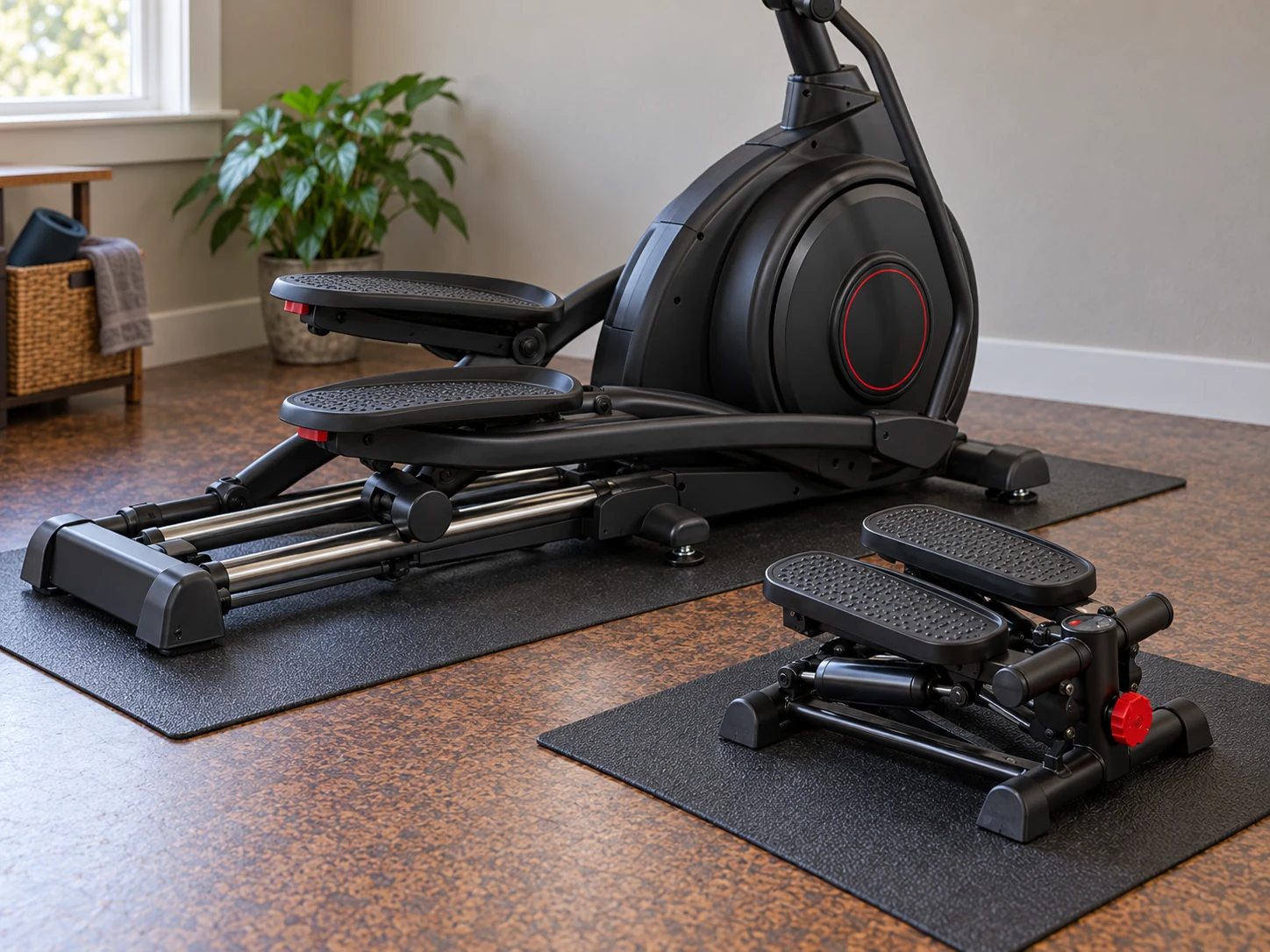
That affects the job you are learning. An elliptical asks you to follow a guided pedal path, often while coordinating moving handles. A hydraulic mini stepper asks you to alternate pressure within its available pedal travel. A rotating stair machine adds repeated foot placement and a moving surface that has its own start and stop procedure.
Check these details in the actual machine's instructions:
- Whether its pedals are linked, move independently, or form a revolving staircase.
- Whether the adjustment changes step height, selectable resistance, speed, or another feature.
- Which handholds or other support are permitted for entry, exercise, and exit.
A step-height knob is not automatically a resistance selector. Likewise, a tall machine with handles is not automatically a rotating stairmill. Our stepper technique guide explains those operating differences without transferring one machine's mounting sequence to another.
What the Direct Cardio Research Compares
Both elliptical training and stair-climbing can develop aerobic fitness. The useful research question is which machines, people, and training conditions were compared, rather than which machine name wins.
A 12-week study assigned 22 moderately active women to elliptical, treadmill, or stair-climber training. All groups improved aerobic fitness on a cycle test, without a significant difference in improvement between groups. With only seven or eight people per group, that finding supports both options but does not prove they are equivalent. 1
The study was not a test of a small home hydraulic stepper. I would not use it to promise that a mini stepper reproduces a gym machine's training demand. Pedal travel, available resistance, support, and the effort you can sustain all need separate attention.
A practical comparison starts at an effort you can control. Notice whether your breathing increases while you maintain the movement, or whether balance and local leg fatigue end the attempt first. If one machine makes you struggle to stay in position, increasing the setting will not help you compare its cardio potential.
You also do not need to settle the choice with a maximal test. For an ordinary home session, I would give more weight to controlled movement at the effort you plan to use than to how exhausted you can become in a brief trial.
Compare Leg Effort, Handle Support, and Comfortable Motion
The elliptical combines a guided leg movement with optional active arm work. A stepper emphasizes repeated downward leg effort, with the exact range and support depending on its design. Neither category automatically supplies a complete strength workout.
Moving elliptical handles let you push and pull; fixed stepper rails mainly provide support and access to controls. Some mini steppers add resistance bands, but those are a separate arm task. If a band occupies the hand you need for balance, it is a drawback for that session rather than a reason to give up support.
I would compare the following before choosing a harder setting:
- Foot position: Can your shoes stay securely supported through the intended movement?
- Reach: Can you use the controls and permitted grips without folding over or stretching?
- Movement: Can you pedal or step without forcing an awkward stride, dropping into the base, or pulling yourself along with your arms?
Supported feet also do not guarantee comfortable knees. An elliptical still bends and loads the legs, while a short stepper movement can feel very different from taking full stairs. Pain or a known condition calls for an individual assessment, not a category-wide promise that either machine is joint-friendly.
If muscle development is your priority, compare suitable strength exercises as well. The stepper muscle guide separates the muscles involved during a step from the training needed to build them.
Which Burns More Calories, an Elliptical or a Stair Stepper?
A full-size stair-climber had higher estimated energy expenditure than an elliptical in one demanding laboratory comparison. That result cannot rank every home stepper against every elliptical, especially when the sessions differ in duration and effort.
In the 2024 experiment, 30 recreationally active men aged 35 to 49 completed 12-minute bouts at very hard and maximal effort. The tested Life Fitness gym stair-climber exceeded the SportsArt elliptical in energy expenditure. The men were experienced with cardio equipment, and the study measured individual exercise bouts rather than weight loss over time. 2
I would keep that result in perspective when choosing a normal session. A demanding stair-climber bout can use more energy per minute, but it gives you little advantage if you stop much sooner than planned or cannot repeat the activity. A comfortable elliptical session and a short, difficult climb are different amounts of work.
Compare duration and effort alongside the machine. A console's step count, distance, level, and calorie total are not matching units across these devices. Avoid converting steps on a mini stepper into an imaginary distance or treating two level-five settings as equal exercise.
If weight loss drives the decision, use the elliptical weight-loss guide to consider the wider activity and food pattern. A higher reading on one console does not establish a better long-term result.
Compare the Space You Will Use, Not Just the Base
A hydraulic mini stepper usually has a much smaller base than a standing elliptical, but both need space for your body and a clear way off. A full-size stair-climber belongs in a different room-planning comparison from the compact stepper.
For an elliptical, account for the complete pedal and handle travel, plus the user standing on raised pedals. For a mini stepper, include any permitted support and the room needed for bands if you intend to use them. For rotating stairs, check the manufacturer's overhead and access requirements with the user on the machine.
I would rule out an unsuitable operating area before comparing displays. The relevant measurement is the space the exact machine and its user require while moving. A folded or stored dimension cannot establish that a session will fit between a sofa and a wall.
Then consider what happens between sessions. A mini stepper may be small enough to put away, but you still have to lift it and return it to a suitable surface. A full-size elliptical that stays ready can remove that setup task while permanently occupying more floor space.
Maintenance differs too. Follow the exact manual for inspection, cleaning, lubrication, and any use or cooling limits. A hydraulic stepper's restrictions should shape the session you plan; they should not be borrowed from a gym stair-climber with a different mechanism.
Choose by the Session You Want to Repeat
Choose an elliptical if a comfortable continuous stride and moving-handle option are the reasons you want the machine. Choose a mini stepper if its compact format solves a real space problem and you can use its stepping movement securely. Choose a gym stair-climber or rotating stairs when you specifically prefer that climbing task and have access to the right equipment.
Use a short trial to make the choice concrete:
- Learn the actual start, stop, and entry procedures before comparing effort.
- Try a manageable rhythm with the support you will normally use.
- Check whether the full planned session and the home setup still make sense.
Once the movement is settled, use the elliptical starting session for guided pedaling. Keep your chosen machine's controls and use limits in view rather than copying a gym stair-climber setting.
For a compact stepper, use the stepper workout guide to begin with a shorter introduction and gradual changes of pace. Check the planned session against your machine's permitted use time before starting.
FAQs
Is a stepper the same as an elliptical?
No, a stepper and an elliptical guide the feet through different movements. A stepper uses downward stepping, while an elliptical follows a curved pedal path; rotating stairs add repeated foot placement.
Can a mini stepper replace a gym stair-climber?
A mini stepper can provide another home activity, but it does not reproduce every gym stair-climber's movement or training range. Compare its pedal action and documented use limits before treating it as a substitute.
Which is easier for a beginner?
The easier choice is the machine on which you can mount, move, and stop securely at a manageable effort. An elliptical's guided stride, a mini stepper's balance demands, and rotating stairs' foot placement can each be the limiting task for a different person.
This content is for information and education, not medical advice or a rehabilitation prescription. Follow your equipment manual and seek individual guidance for a health condition, injury, or balance concern. Stop for pain or concerning symptoms.
References
- Egaña M, Donne B. Physiological changes following a 12 week gym based stair-climbing, elliptical trainer and treadmill running program in females. J Sports Med Phys Fitness. 2004;44(2):141-146.
- Prieto-González P, Yagin FH. Energy expenditure, oxygen consumption, and heart rate while exercising on seven different indoor cardio machines at maximum and self-selected submaximal intensity. Front Sports Act Living. 2024;6:1313886. doi:10.3389/fspor.2024.1313886.