
Barbell Leg Workout: Squats, Hinges, and Single-Leg Work

Founder
I founded HomieGym to help you make informed decisions about training at home. My background includes university-level sports science education, practical coaching, gym training and combat sports.
A barbell leg workout can start with a back squat, a Romanian deadlift, and one single-leg exercise. I favor that combination because it gives you a main squat, a hip hinge, and practice loading each leg separately without making every session a long list of similar lifts.
The routine below includes working sets, effort, rest, a lighter starting dose, and ways to train without a rack. The main session needs no bench. Choose it as a lower-body part of your week, then account for the squats and hinges you already perform elsewhere.
Table of Contents
Your Barbell Leg Workout: Order, Sets, Reps, and Rest
Perform the squat first, the Romanian deadlift second, and one single-leg exercise third. These leg exercises with a barbell cover different movement tasks; you do not need both lunges and split squats in the starting session.
| Order and exercise | Working sets | Reps | Rest | Effort |
|---|---|---|---|---|
| 1. Back squat from a suitable rack | 3 | 6 to 8 | 2 to 3 min | About 2 to 3 controlled reps remaining |
| 2. Romanian deadlift | 2 | 8 to 10 | 2 to 3 min | About 2 to 3 controlled reps remaining |
| 3. Floor-based split squat or suitable lunge | 2 per leg | 8 to 10 per leg | 90 to 120 sec after both sides | About 2 to 3 controlled reps remaining |
| 4. Optional supported bodyweight calf raise (nonbarbell) | 2 | 12 to 20 | 60 to 90 sec | About 2 to 3 controlled reps remaining |
This is an editorial starting example for healthy adults, not a claim that one routine fits every goal. The 2026 ACSM overview supports progressive resistance training and adjusting its prescription to the desired outcomes. It did not test this particular barbell leg session (1).
Before the working sets, move easily to warm up and rehearse each pattern with bodyweight, a lighter bar, or a manageable load. Add load gradually through practice sets when needed. These sets prepare the movement and do not count toward the table.
If you are new to these lifts, begin with 1 to 2 squat sets and 1 set each of the Romanian deadlift and split squat. Leave more effort in reserve while learning. Add the remaining sets only when you can repeat the movements and recover for your next planned session.
Repetitions in reserve means your estimate of the additional repetitions you could complete with the same range and control. A set of eight with two repetitions remaining should not require a ninth repetition just to test the estimate.
For calf raises, stand on a level floor beside a stable support, rise through the balls of your feet, and lower under control. Keep this optional addition bodyweight-based initially rather than introducing a bar-on-back balance task after your main lifts.
Back Squat: Set Up and Perform Your Main Lift
Begin and end the back squat at a suitable rack with compatible hooks and safeties. Check the equipment instructions and rehearse the arrangement with a light bar before adding a demanding load.
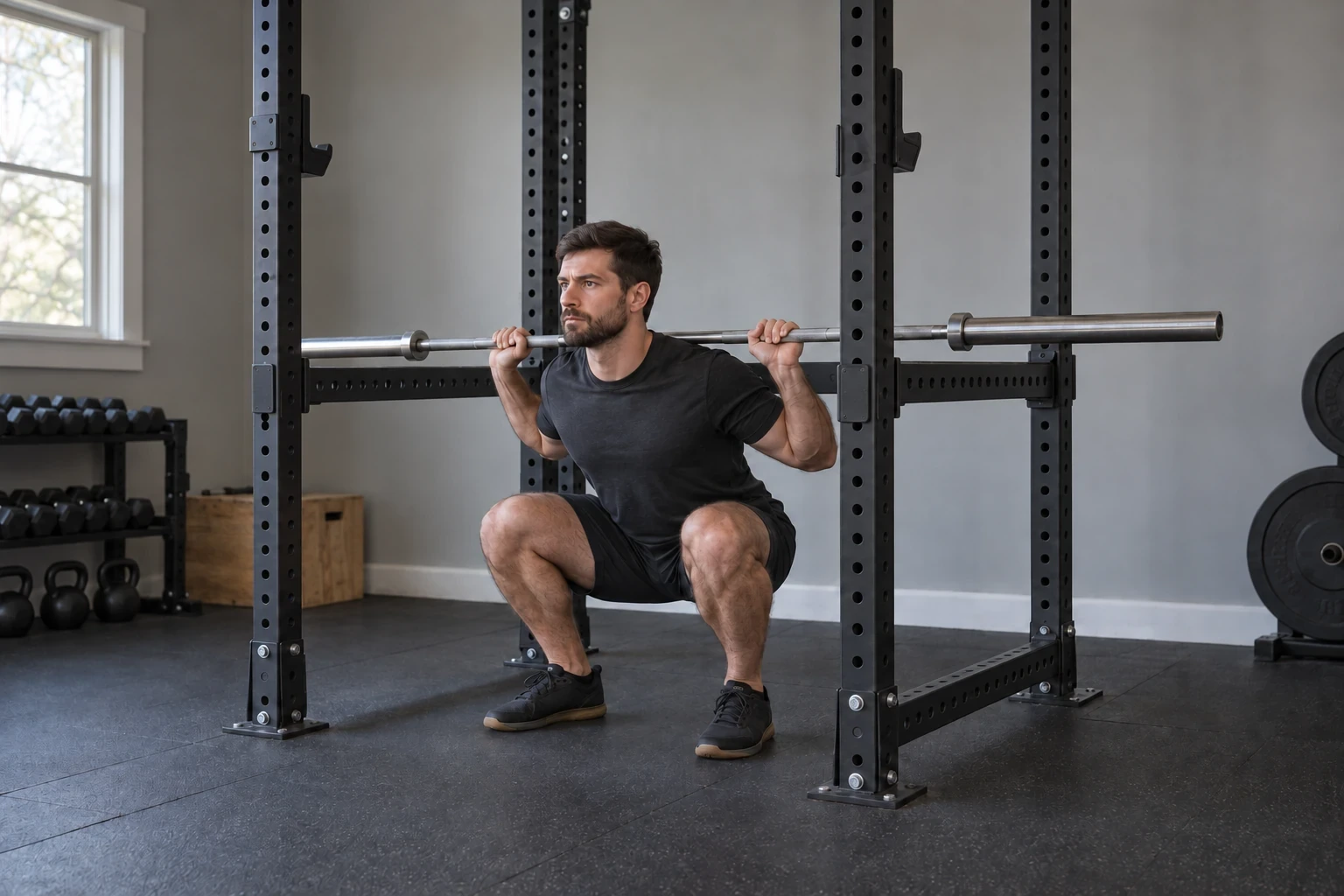
- Set both hooks so you can lift the bar clear by straightening your legs from a small knee bend. You should not need to rise onto your toes.
- Position the bar securely across your upper back, rather than on your neck. Take a grip you can maintain and lift clear of both hooks.
- Take only the steps needed to establish a balanced stance. Brace by tightening around your abdomen so your trunk stays controlled.
- Bend at your hips and knees, keeping your feet supported and knees moving in line with your feet. Descend only through a range you can control, then stand back up.
- After the final repetition, move deliberately toward the rack. Confirm both sides are over the hooks before lowering the bar into them. Check that both hooks support the bar before releasing your grip and stepping away.
Check the safeties with your intended range, not a guessed rack-hole number. They should allow your normal repetitions while providing a suitable catch arrangement. With a manageable practice bar, rehearse lowering it onto both safeties and moving clear once the bar is supported and still. If the arrangement cannot provide both your planned depth and a clear exit, change the setup before loading. Have competent help establish the setup if you are unsure. The power rack exercise guide gives the rack checks more space.
I keep the squat choice stable at first so changes in repetitions or control are easier to interpret. A barbell front squat can replace this main-squat slot when you have learned its setup and it suits your goal. It does not need to become a second main squat on the same day.
Romanian Deadlift: Keep a Hip Hinge in the Program
The Romanian deadlift gives the session a hip hinge: your hips move backward while the bar stays close and the knees bend only slightly. This trains a different task from another squat and provides work for the hamstrings, glutes, and the muscles that hold your back position.

Plan the initial pickup and final return separately from the repetitions. Suitable low rack hooks can provide a standing start. Without a rack, use the barbell only if you can already lift that manageable load from the floor into position and return it competently. You do not need to learn a heavy floor deadlift just to follow this workout.
- Start standing with the bar near your thighs, a secure overhand grip, and your feet firmly planted.
- Brace, soften your knees slightly, and move your hips backward as you lower the bar close to your legs.
- Stop before you lose your controlled back position or need substantially more knee bend to keep descending.
- Reverse the hinge and stand tall without leaning back at the top. Repeat from standing, then use your planned return after the final repetition.
The floor is not the target of every RDL repetition. If a manageable pickup or return is unavailable, use a suitable dumbbell hinge or bodyweight hinge practice. Avoid improvised bar supports.
A barbell hip thrust is another glute-focused choice, but it has a different setup and emphasis. I keep it separate from the RDL because it does not provide an identical hamstring task. Keep a feasible hinge in the program unless you deliberately redesign that part of the session.
Barbell Lunges and Split Squats: Choose One Single-Leg Exercise
Start with a floor-based barbell split squat if you can control the stance and the bar setup. The feet stay in place during its repetitions, so you can practice the lowering and rising before adding repeated steps. Both feet remain on the floor; a rear-foot bench is unnecessary.
Learn the pattern without a bar first. Set a split stance with enough side-to-side width to balance, bend both knees to lower under control, then return to standing in that stance. Adjust the distance between your feet to your proportions and control rather than copying one fixed measurement.
For back-loaded repetitions, use a suitable rack and rehearse the light bar's unrack, step into stance, side change, and rerack. Keep the bar secure on your upper back and your trunk controlled. If maintaining balance becomes the main struggle, use bodyweight or suitable dumbbells instead.
Barbell lunges add a step and return on each repetition. Choose a lunge only when you can repeat that step, place your foot consistently, and keep a clear route to the rack. Walking lunges are not necessary in a small home training area. A controlled stationary split squat can fill the single-leg slot.
Use the same per-side dose for your chosen lunge or split squat in this example. Two sets of 8 to 10 per leg means two rounds, each containing 8 to 10 repetitions on each side. It does not mean four rounds per leg.
Allow a brief pause and safe repositioning between sides, reracking if needed. After completing both sides, rest 90 to 120 seconds, or longer if that is needed to restore control. Match the planned repetitions on both sides with a manageable load rather than forcing the less controlled side to catch up under fatigue.
Fit One or Two Leg Sessions Around Your Other Training
Choose leg-session frequency by the lower-body work already in your week. Two dedicated leg days are an option, not something to add automatically to two full-body workouts.
| Day | Example upper/lower week | Placement note |
|---|---|---|
| Monday | Upper body | Keep lower-body fatigue in mind |
| Tuesday | This leg session | Use the starting dose you can manage |
| Thursday | Upper body | Retain the wider program's pushing and pulling |
| Friday | This leg session | Adjust to recovery from Tuesday |
You can also pair one leg day with an existing full-body day for a week that emphasizes the lower body. If you replace one day of our twice-weekly beginner barbell workout, however, you also remove that day's upper-body work. One full-body day plus one leg day is not equivalent to the original balanced plan.
Keep the original full-body routine if two balanced sessions are your priority. If you want lower-body emphasis, decide how much upper-body training to preserve elsewhere before replacing a day. A leg day does not supply the pressing and pulling that disappeared.
I count the actual squat, hinge, and single-leg sets already scheduled before adding another session. That includes leg work from a power rack plan. Combining several complete article routines without adjusting their overlaps can create more work than the weekly plan intended.
Progress Your Leg Training With Reps, Load, and Recovery
Reach the top of the repetition range in every working set with repeatable technique and the intended effort before considering a load increase. Use the smallest practical increase, then return toward the lower end of the range.
For example, completing 8, 8, and 6 squat repetitions means there is still room to build repetitions at the same load. Completing 8, 8, and 8 with your usual depth, control, and effort makes a modest increase worth considering. The log should show the total weight, including the bar, rather than just the plates on one side.
- Record the exercise, total load, repetitions in each set, and any meaningful change in range or control.
- For unilateral work, record repetitions on each side so a combined total does not hide a difference.
- Keep the load when the next available plate increase is too large to preserve the movement.
- Review your schedule and dose when performance or recovery repeatedly worsens.
A single difficult session does not automatically require a deload. Repeat the load, allow more rest, or reduce that day's work if needed. When the same problem continues, reassess load, set count, other demanding training, and recovery before adding more.
You do not need a one-repetition maximum test or a compulsory weekly increase to use this plan. End a set when technique or control breaks down. Stop a movement that causes pain rather than using the rep target as a reason to continue.
Replace Back-Loaded Lifts When You Have No Rack
Without a suitable rack, replace the back-loaded squat and single-leg lifts. Keep the movement task and make the setup feasible, even when that means using bodyweight or dumbbells instead of a bar.
| Planned exercise | Available route | Dose in this example |
|---|---|---|
| Back squat | Bodyweight squat or manageable goblet squat | 2 sets of 8 to 12 |
| RDL with no workable bar pickup/return | Suitable dumbbell RDL or bodyweight hinge practice | 2 sets of 8 to 10 |
| Back-loaded split squat or lunge | Bodyweight or manageable dumbbell split squat | 2 sets of 8 to 10 per leg |
| Optional calf work | Bodyweight calf raise beside a stable support | 2 sets of 12 to 20 |
For the squat and hinge replacements, rest 2 to 3 minutes. For split squats, allow safe repositioning between sides and rest 90 to 120 seconds after both sides. Rest 60 to 90 seconds for calf raises. Use about 2 to 3 controlled repetitions remaining for loaded movements, with more margin while learning; bodyweight practice can stay easier.
If bodyweight repetitions are easy, treat them as movement practice rather than pretending the listed count guarantees a demanding strength set. When you have suitable dumbbells, our dumbbell leg workout gives you a complete alternative built around that equipment.
A barbell RDL can remain if you have a competent, manageable floor pickup and return. The absence of a rack alone does not remove it. Conversely, owning a bar is not a reason to improvise supports or clean it onto your back for the other lifts.
The main workout needs no bench. An optional hip thrust introduces a separate support and entry setup, so leave it out unless that arrangement is suitable. Choose your feasible squat, hinge, and single-leg movements before the first session, then log the dose you can repeat.
FAQs
Can you do this leg workout with only a barbell?
The main back-loaded workout requires a suitable rack as well as a barbell, plates, and collars. Without those supports, use the bodyweight or dumbbell replacements and retain the barbell RDL only if pickup and return are manageable.
Do you need a bench for this barbell leg workout?
No, the main barbell leg workout uses a floor-based split squat and does not need a bench. A hip thrust or rear-foot-elevated split squat would introduce a separate support requirement.
Should you do this workout twice a week?
Two separated leg sessions can fit an upper/lower routine if the dose suits your skill and recovery. Count leg work in any full-body sessions before adding another day.
Should you do lunges and split squats in the same session?
No, you do not need both lunges and split squats in this starting session. Choose one you can load, perform on each side, and finish under control.
This content is for informational and educational purposes only. It is not a substitute for professional medical advice, diagnosis, or treatment. If an injury or ongoing symptoms affect your training, seek guidance from an appropriate healthcare professional.
References
- Currier BS, D'Souza AC, Fiatarone Singh MA, et al. American College of Sports Medicine Position Stand. Resistance Training Prescription for Muscle Function, Hypertrophy, and Physical Performance in Healthy Adults: An Overview of Reviews. Med Sci Sports Exerc. 2026;58(4):851-872. doi:10.1249/MSS.0000000000003897