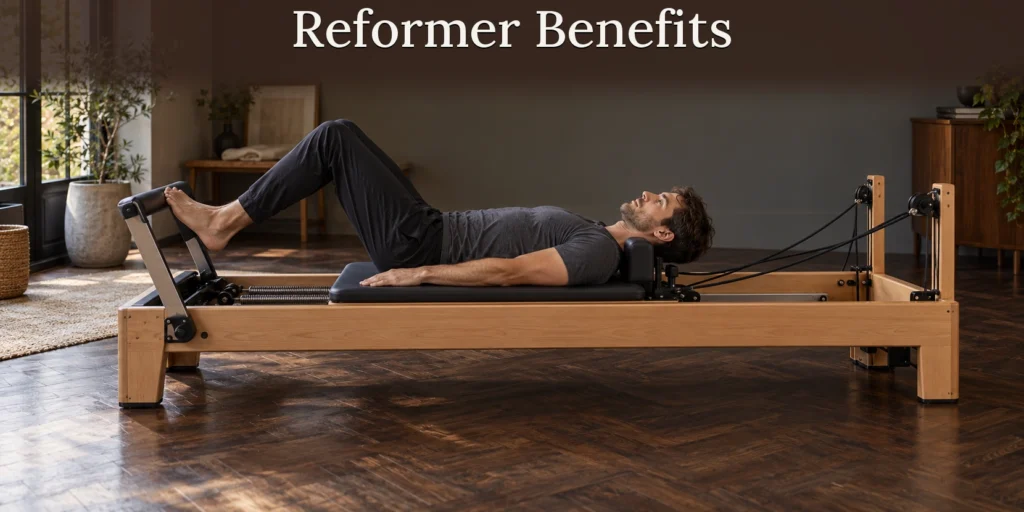
Benefits of Pilates Reformer Training: Strength, Control, and Limits

Founder
I founded HomieGym to help you make informed decisions about training at home. My background includes university-level sports science education, practical coaching, gym training and combat sports.
The benefits of Pilates reformer training can include better muscular endurance, movement control, and flexibility. The exercises and progression matter more than the machine alone. I recommend a reformer when its adjustable support helps you learn movements and keep practicing them, with other training alongside it when your strength or aerobic goals need more. If weight loss is the reason you are starting, I cover what the research shows in my guide to whether reformer Pilates is good for weight loss.
Table of Contents
What Is Reformer Pilates Good For?
Reformer Pilates is useful for practicing controlled movement against resistance, with exercises that can challenge muscular endurance and flexibility. The table separates those training benefits from the practical advantage of having a machine at home.
| Potential benefit | What to look for | Practical limit |
|---|---|---|
| Muscular endurance | Repeat controlled efforts | Different from maximum strength |
| Movement control | Manage carriage and body position | Needs appropriate instruction |
| Flexibility | Work through suitable ranges | Keep control through the range |
| Adaptable exercise options | Adjust support and resistance | Settings depend on the movement |
| Convenient home practice | Practice without traveling | Requires space and equipment care |
Use that list to choose a purpose for the session. If your goal is better control during arm work, rushing through unfamiliar exercises makes it harder to judge progress. A smaller set of exercises you have learned gives you something you can compare from one session to the next.
Improving Muscular Endurance and Control
Muscular endurance is the ability to sustain or repeat effort, and it is one of the fitness outcomes studied in Pilates training. On a reformer, you can practice moving your limbs while maintaining the trunk position required by an exercise.

In a 2025 trial, 47 women ages 30 to 60 with overweight or obesity were assigned to reformer training or an inactive control group. Training involved supervised sessions of 50 to 60 minutes, three days a week for eight weeks. The exercise group improved more on trunk-endurance and handgrip tests. These measured tasks give a narrower picture than a claim about strength throughout the body.(1)
For your own training, keep a record of the movement, setup, and progression your instructor uses. Completing an exercise with less unwanted carriage movement gives you something specific to discuss at the next session. A spring-color change needs the same context: what changed in the movement, and could you still control it?
Flexibility and More Ways to Adjust a Movement
Pilates can help improve flexibility. A systematic review of healthy participants found support for flexibility, dynamic balance, and muscular endurance, though study methods and follow-up were limited. It covered Pilates more broadly, so the findings cannot predict your response to a particular reformer program.(2)

The reformer also gives an instructor ways to adjust support. You might practice a supported position before trying a variation with less support. If an injury or health condition affects the movement, the choice still needs individual guidance.
I favor a range you can control over reaching farther by losing the position you were meant to maintain. Tell the instructor where you feel restricted or uncomfortable so the exercise can be reviewed. A photograph of a deeper variation gives you no reason to force that position in your own session.
Is Reformer Pilates Strength Training?
Yes, reformer exercises can provide resistance training, but that does not make every session an equivalent replacement for a progressive weight-training program. Resistance, effort, exercise selection, and progression all influence what you train.
A 2022 systematic review found no clear advantage of Pilates over other exercise for the strength, balance, and flexibility outcomes it assessed. Confidence in the evidence was low to very low. The review covered Pilates broadly, so it does not settle a direct comparison between mat and reformer training.(3)
If increasing a particular barbell lift is your main goal, I recommend keeping practice and progression for that lift in the plan. Reformer work can sit alongside it for control or endurance practice. Improvement in those tasks tells you little about how much muscle you have gained.
When muscle size is the priority, ask how the program will track and progress the relevant work. A hard-feeling session and a visible change in body composition are different pieces of information. Avoid using soreness or a post-workout photograph as a substitute for judging the program over time.
Making Home Practice Useful
A home reformer can remove travel from a taught practice, provided you have the space, equipment skills, and instruction to use it. The practical advantage is getting the session into your week; owning the machine does not create the habit by itself.
Before buying, walk through the whole routine. Where will the reformer be stored? Can you move it as instructed, open it safely if needed, and leave the required operating area clear? Would a class or mat practice be easier to arrange at this stage?
Keep an aerobic activity you can fit into the week when reformer practice mainly focuses on controlled resistance work. Pilates sessions vary in cardiovascular effort, so consider what the class actually asks you to do when planning the rest of your activity.
Our beginner reformer exercises and sample routine can help you review movements you have been taught. Keep the setup and progression tied to your machine and instruction, especially when switching between classes and home practice.
Choose What Progress Will Mean
Decide what you want to improve before adding sessions or buying accessories. For a first block, that might mean learning a small exercise set, repeating it with appropriate control, and following a taught progression. Record that task, the setup, and what changed.
At your next session, ask your instructor what should improve in the movements you are learning and how you will recognize it. Use that answer to decide whether to continue the current program, change the progression, or make room for another type of training.
This guide is for general education and is not medical advice or an individualized Pilates program. If you have an injury, ongoing pain, pregnancy-related exercise needs, or a health condition that affects training, get advice from a qualified clinician and an appropriately trained Pilates instructor.
FAQs
Can reformer Pilates build muscle?
Reformer training can challenge muscles, but the amount of muscle growth depends on the program and individual response. Better control or endurance alone is not a measure of increased muscle size.
Can a reformer replace weight training?
A reformer can meet some resistance-training needs, but replacing weight training depends on the exercises and strength goals involved. Keep task-specific practice when improving a particular lift is the priority.
How many classes does it take to see results?
There is no established class count that guarantees reformer Pilates results. Track the particular skill or fitness outcome you want to improve and review the progression with your instructor.
Is reformer Pilates a good workout?
Yes, reformer Pilates can be a useful workout when its exercises, effort, and progression suit your goals. Check which training needs the session serves and which still need another activity.
References
- Gökalp Ö, Kirmizigil B. Effects of reformer Pilates on body composition, strength, and psychosomatic factors in overweight and obese women A randomized controlled trial. Sci Rep. 2025;15(1):23602. doi:10.1038/s41598-025-09683-8.
- Cruz-Ferreira A, Fernandes J, Laranjo L, Bernardo LM, Silva A. A systematic review of the effects of Pilates method of exercise in healthy people. Arch Phys Med Rehabil. 2011;92(12):2071-2081. doi:10.1016/j.apmr.2011.06.018.
- Pinto JR, Santos CS, Souza Soares WJ, et al. Is Pilates better than other exercises at increasing muscle strength? A systematic review. Heliyon. 2022;8(11):e11564. doi:10.1016/j.heliyon.2022.e11564.