Does a Rowing Machine Build Muscle? Evidence and Limits

Founder
I founded HomieGym to help you make informed decisions about training at home. My background includes university-level sports science education, practical coaching, gym training and combat sports.
Rowing may contribute to muscle growth, but the evidence needs a careful reading. Compare actual rowing studies and choose where strength work belongs.
A rowing machine may help build some muscle, but progressive resistance training is the more dependable choice when muscle growth is your main goal. Rowing studies report mixed results, and several measure overall lean mass rather than the size of individual muscles.
I recommend giving strength exercises their own place in the week and using rowing for conditioning. That gives you a way to challenge different muscles separately while keeping the cardio you enjoy.
Table of Contents
Does a Rowing Machine Build Muscle or Mostly Endurance?
Rowing mainly develops cardio fitness and the ability to repeat the stroke. It can challenge your muscles, but a longer session or faster pace is evidence of better rowing performance, not a measurement of muscle growth.
Three training outcomes help separate the question:
- Muscular endurance is the ability to keep producing effort through repeated contractions.
- Strength concerns how much force you can produce in a particular task.
- Hypertrophy means an increase in muscle size.
These outcomes can improve together, but they need different measurements. The 2026 American College of Sports Medicine position stand supports high-effort resistance training for muscle function and size, with progression helping support continued gains.1 Progression means adjusting the challenge as your capacity improves, such as adding repetitions or load.
Early improvements can include learning to coordinate the stroke. If your goal is bigger muscles, I would track that goal separately instead of using a better rowing split as the verdict.
What Rowing Studies Say About Muscle Growth
Some rowing studies report gains in lean mass or muscle size; others do not. What was measured and what else participants trained explain why those findings need different interpretations.
DXA, a type of X-ray body-composition scan, measures lean mass without isolating skeletal muscle. An MRI or ultrasound measurement of a particular muscle comes closer to the size question.
| Study | Finding | Main limitation |
|---|---|---|
| Young women, 12 weeks | Average DXA lean mass rose2 | Shared resistance warm-ups; six rowing scans |
| Visually impaired adults, 6 weeks | No significant lean-mass gain3 | 20 adults; no control group |
| Older male rowers | Rowers had larger muscle areas4 | One-time comparison |
| Older men, 6 months | Larger trunk and thigh areas reported5 | Review cites unpublished intervention data |
| Elite female rowers | Muscle changes varied6 | Heavy lifting included |
| Men with obesity, 12 weeks | Muscle-mass gains reported7 | Abstract available; full methods unverified |
Some Studies Report Gains
Brown and colleagues compared rowing intervals with mixed exercise intervals over 12 weeks in young women. Average DXA lean mass rose in the rowing group, and the analysis across both groups found an increase over time, with no significant difference between their responses.2
Both groups did the same warm-ups: bodyweight and kettlebell exercises, followed by progressively loaded resistance exercises. The rowing group also trained with weights, so the study cannot isolate rowing's contribution. Only six rowing participants had usable body-composition scans, and there was no inactive comparison group.2
An SH's 2026 randomized study reports increases in fat-free and skeletal muscle mass among 11 middle-aged men with obesity assigned to rowing, compared with 11 assigned to treadmill exercise. Only the published abstract was available for this review; the measurement methods and dietary controls could not be verified. It supports the possibility of a benefit without establishing how much a home user should expect.7
Older male rowers had larger trunk and thigh muscle areas than untrained men of similar ages in Asaka and colleagues' 2010 study. That one-time comparison cannot show whether rowing caused the difference.4 A 2012 review also describes muscle-area increases after six months of training, but labels the underlying intervention data unpublished; the tested trunk-flexion force and leg-extension power did not improve.5
Growth Is Not Consistent or Easy to Attribute
Shin and colleagues followed 20 visually impaired adults through six weeks of rowing, five days per week. Back strength improved, but lean mass did not change significantly. The study had no control group, so it is a useful example of strength and body-composition results differing within a small study.3
The elite women in a 2021 study did high-load resistance training as well as rowing. Muscle responses varied, and a later follow-up included only seven athletes; its muscle-volume change was not statistically significant. This describes adaptations to a combined program, not evidence that rowing alone produced larger muscles.6
I would leave room for rowing to contribute to muscle growth, while building a muscle-focused plan around exercises whose loads you can progress separately. The research does not justify a promised number of pounds or a rowing-only growth schedule.
Why More Rowing Resistance Does Not Settle the Question
A harder stroke asks more of your muscles, but a higher machine setting does not establish a muscle-building dose. The muscles challenged, the effort involved, and how the work changes over time still matter.
On a Concept2, the damper changes airflow and drag; how forcefully you accelerate the flywheel also affects intensity. Its highest lever number is not a universal muscle-growth setting, and its numbers do not transfer to a magnetic rower.8
A cardio rower repeats one movement sequence, so it does not let you choose separate loads for a chest press, leg exercise, and back exercise. The rowing-machine technique guide explains how the stroke fits together.
Increase rowing difficulty when it serves your rowing goal and you can keep the stroke controlled. If the heavier feel makes you shorten the drive or rush the return, reduce the demand before adding more.
How to Combine Rowing With Muscle-Building Work
Give muscle-building exercises priority in your week, then fit rowing around them. The useful amount of rowing is the amount you can recover from while keeping your strength work productive.
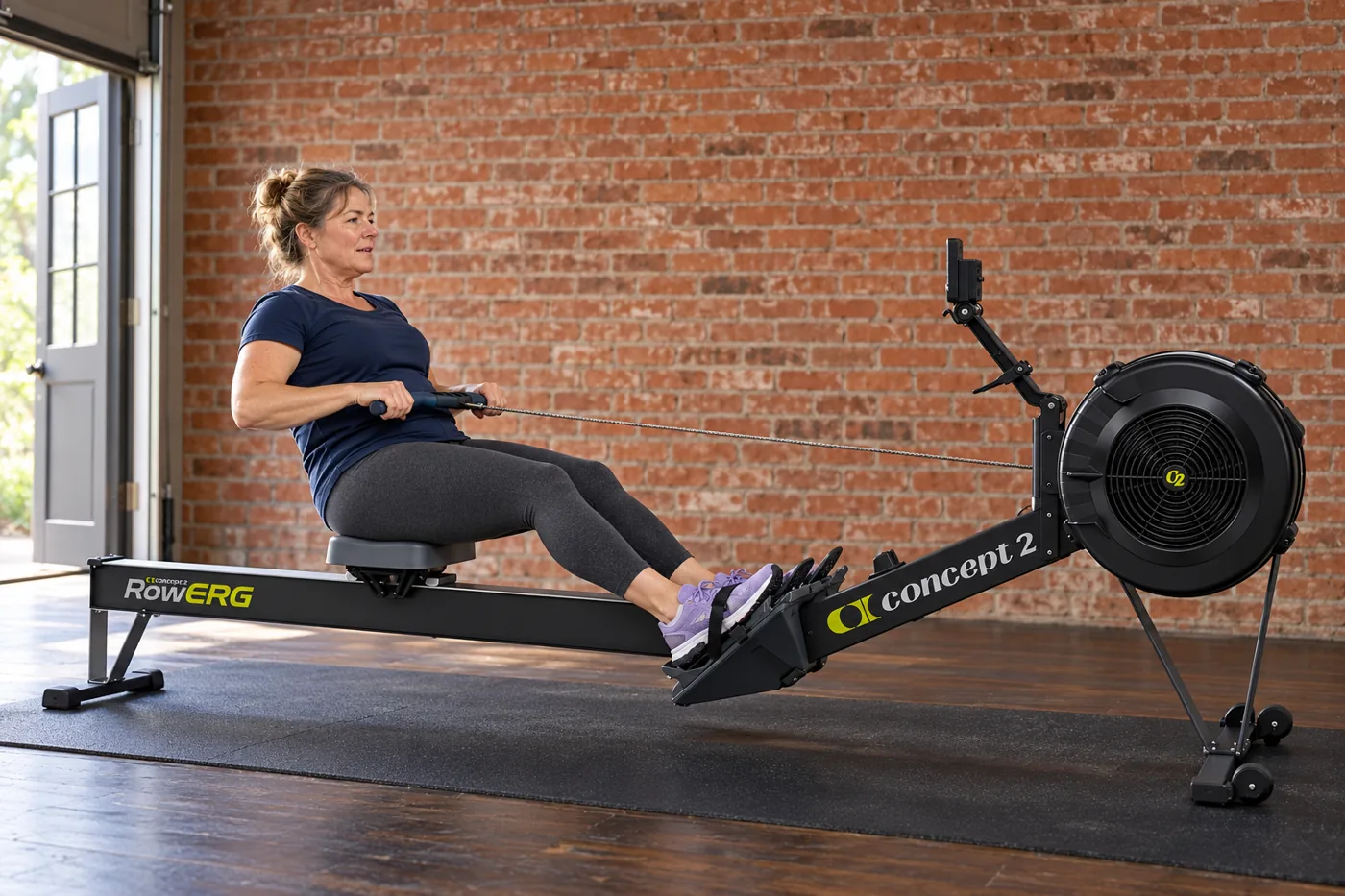
The ACSM position stand supports high-effort resistance training for the major muscle groups at least twice weekly. Higher weekly resistance-training volume can further enhance hypertrophy, but rowing strokes are not interchangeable with resistance-exercise sets.1
For a basic home routine, I would cover a squat or split squat, a hip hinge, a press, and a dedicated pulling exercise, with trunk work as needed. These give you separate ways to challenge and progress different movements. The home-gym essentials guide explains how a small dumbbell setup can cover several of those jobs.
| Your priority | What I would prioritize | Role for rowing |
|---|---|---|
| Visible muscle growth | Progressive resistance exercises | Conditioning that leaves you ready to lift |
| General fitness | A repeatable mix of cardio and strength | Main cardio option if comfortable |
| Faster rowing | Technique and appropriate rowing progression | Sport-specific practice and conditioning |
A 2022 meta-analysis found that adding aerobic training to strength work did not, on average, reduce muscle-size or maximal-strength gains compared with strength work alone. Gains in explosive strength, the ability to produce force quickly, were more vulnerable, especially in the same session. The evidence mainly involved running and cycling, so it supports combining goals without guaranteeing a particular rowing schedule.9
One starting example is to lift on two nonconsecutive days and row on two other days. Keep the rowing manageable while you learn how you recover. When sessions share a day, I would put the work for your main goal first; repeated losses in lifting performance are a reason to reduce or move demanding rowing sessions.
Choose Progress That Matches Your Goal
If larger muscles are the reason you are choosing equipment, reserve time and equipment for resistance training first. Keep a simple log of exercises, loads, and repetitions, using consistent technique so comparisons mean something. Use rowing pace and distance to judge your conditioning alongside that work.
Soreness or a temporary feeling of fullness is a poor reason to overhaul the plan. Look for progress over several weeks, and adjust the workload when you repeatedly struggle to recover or complete your planned sessions.
Choose a rower if it gives you cardio you enjoy and can repeat without crowding out those strength sessions. The wider rowing benefits and limitations can help you decide whether it deserves that place in your home gym.
This article provides general educational information, not an assessment of an injury or a personalized training prescription.
FAQs
Can rowing replace lifting weights?
No, conventional cardio rowing does not replace a complete muscle-building program. Dedicated resistance exercises let you progress loads for different muscles and movements separately.
Will rowing make your legs bigger?
Rowing may contribute to leg muscle growth, but it cannot promise visibly bigger legs. Your starting point, training challenge, and other activity affect the result, and the available rowing evidence does not provide a dependable forecast.
Should you row every day to build muscle?
No, daily rowing is not necessary for a muscle-building plan. Give progressive resistance training and recovery enough room, then choose a rowing frequency you can sustain without repeatedly undermining those sessions.
How long does rowing take to build muscle?
There is no well-established rowing-only timeline for noticeable muscle growth. Studies lasting six to twelve weeks have produced different lean-mass findings, so a calendar deadline is a poor basis for expecting a result.
References
- Currier BS, D'Souza AC, Fiatarone Singh MA, et al. Resistance training prescription for muscle function, hypertrophy, and physical performance in healthy adults: an overview of reviews. Med Sci Sports Exerc. 2026;58(4):851-872. doi:10.1249/MSS.0000000000003897
- Brown EC, Hew-Butler T, Marks CRC, Butcher SJ, Choi MD. The impact of different high-intensity interval training protocols on body composition and physical fitness in healthy young adult females. Biores Open Access. 2018;7(1):177-185. doi:10.1089/biores.2018.0032
- Shin KY, Choi EH, Lim JY, Cho AR, Lim YH. Effects of indoor rowing exercise on the body composition and the scoliosis of visually impaired people: a preliminary study. Ann Rehabil Med. 2015;39(4):592-598. doi:10.5535/arm.2015.39.4.592
- Asaka M, Usui C, Ohta M, Takai Y, Fukunaga T, Higuchi M. Elderly oarsmen have larger trunk and thigh muscles and greater strength than age-matched untrained men. Eur J Appl Physiol. 2010;108(6):1239-1245. doi:10.1007/s00421-009-1337-6
- Asaka M, Kawano H, Higuchi M. Rowing as an aerobic and resistance exercise for elderly people. J Phys Fitness Sports Med. 2012;1(2):227-234. doi:10.7600/jpfsm.1.227
- van der Zwaard S, Koppens TFP, Weide G, et al. Training-induced muscle adaptations during competitive preparation in elite female rowers. Front Sports Act Living. 2021;3:781942. doi:10.3389/fspor.2021.781942
- An SH. The effects of a 12-week rowing machine exercise program on body composition, insulin resistance, and blood lipid profiles in middle-aged obese men. Journal of the Korean Society of Physical Education. 2026;24(1):77-90. doi:10.22997/jcses.2026.24.1.77
- Concept2. Damper setting 101. Accessed October 23, 2026.
- Schumann M, Feuerbacher JF, Sünkeler M, et al. Compatibility of concurrent aerobic and strength training for skeletal muscle size and function: an updated systematic review and meta-analysis. Sports Med. 2022;52(3):601-612. doi:10.1007/s40279-021-01587-7