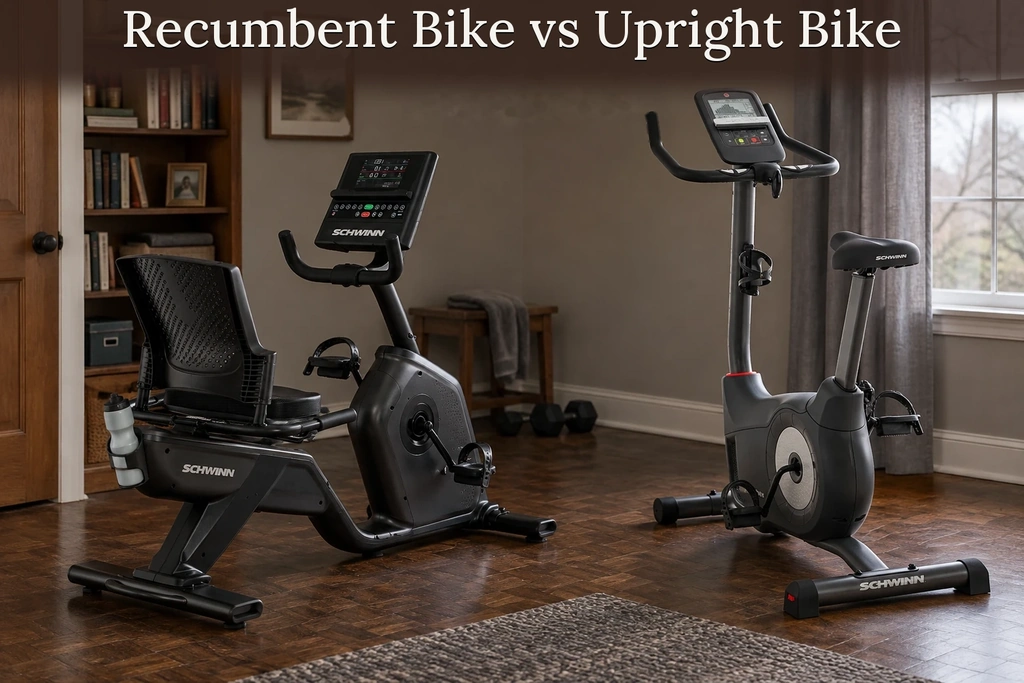
Recumbent Bike vs Upright Bike: Which Fits You?

Founder
I founded HomieGym to help you make informed decisions about training at home. My background includes university-level sports science education, practical coaching, gym training and combat sports.
Equipment editor on our team: Milutin Tucakov
Choose between a recumbent and upright exercise bike by seat comfort, cardio goals, access, usable space, and the full cost of your home setup.
Choosing between a recumbent bike and an upright bike starts with the seated position you can use comfortably and the space you have. A recumbent bike gives you a broad seat, a backrest, and pedals in front of you. An upright exercise bike puts the pedals below you and uses a smaller saddle.
My starting choice is a recumbent when back support matters most, and an upright when a shorter frame and a familiar cycling position suit you better. Check getting on and off either bike before deciding. Both can give you useful cardio, including harder seated sessions.
Table of Contents
Recumbent Bike vs Upright Bike at a Glance
Choose the position first, then compare individual models. These differences help narrow the choice before you look at resistance levels, screens, or apps.
Compare the Riding Positions
| Check | Recumbent | Upright |
|---|---|---|
| Seat | Broad seat and backrest | Smaller saddle; no backrest |
| Pedals | In front of your body | Below your body |
| Access | Check sitting down and standing up | Check mounting and bar reach |
| Training | Steady rides or seated intervals | Steady rides or seated intervals |
| Room fit | Often a longer frame | Often a shorter frame |
| Main fit test | Seat-to-pedal reach | Saddle and handlebar reach |
If you already enjoy an upright stationary bike, a recumbent is not automatically an upgrade. If saddle pressure or an awkward reach interrupts your rides, compare the fit and contact points before paying for extra features.
Compare Seat Comfort and Back Support
A recumbent gives you a backrest and a broader seat; an upright leaves your torso unsupported. The practical question is whether those contact points let you pedal without repeatedly shifting or straining to reach the bars.
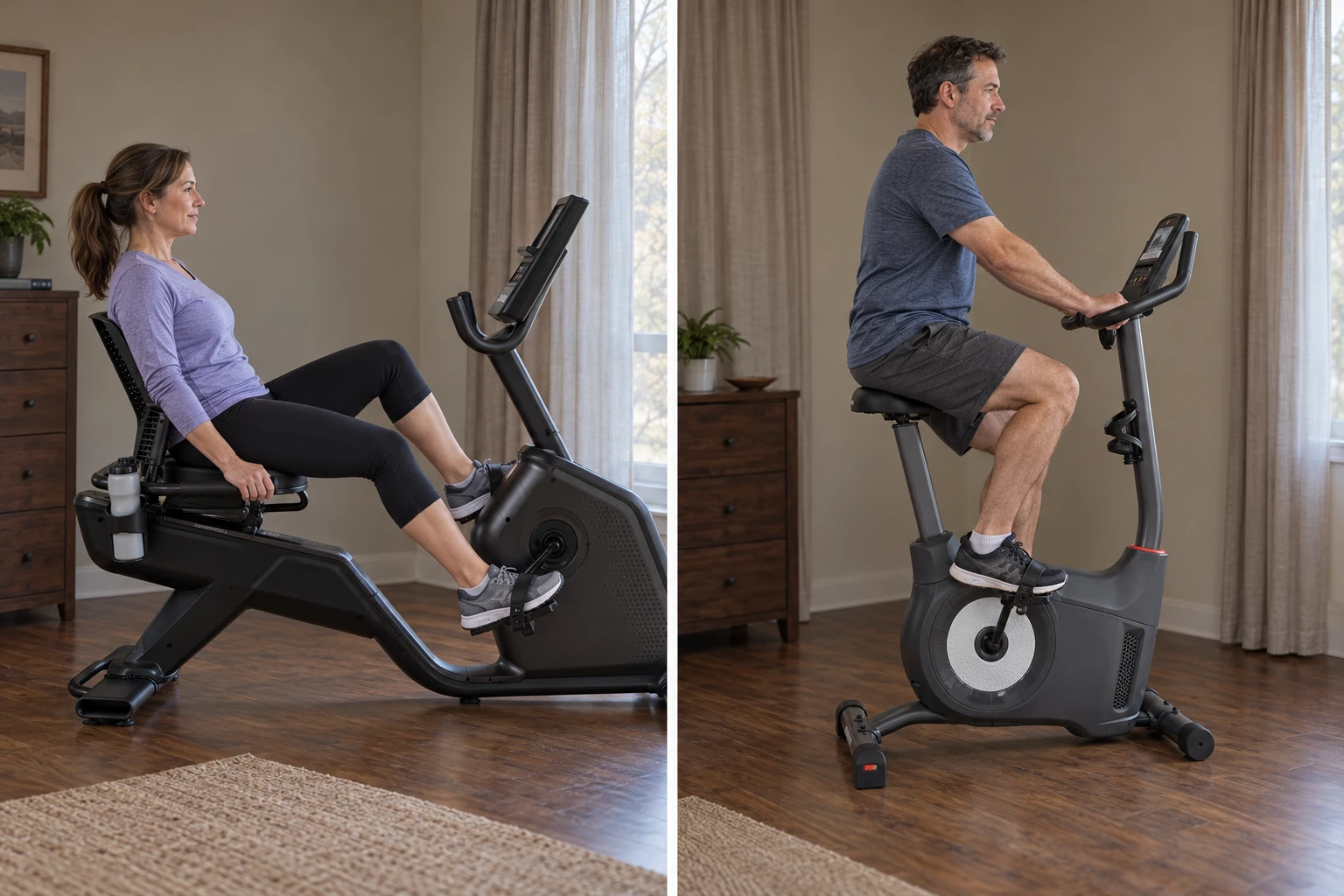
On a recumbent, check whether you can stay against the backrest while reaching the pedals. On an upright, check whether you can reach the handlebars with relaxed shoulders. The Arthritis Foundation notes that the forward position on an upright can be uncomfortable for people with back, shoulder, or wrist issues.
Compare seat shape, padding, and reach together. A wide seat can still press into the back of your legs, while a narrower saddle may suit you well when its shape and position fit. More padding alone will not correct an awkward reach.
Use the exercise bike seat comfort guide to review fit, clothing and compatible saddle changes.
Which Is Better for Knees and Back Pain?
A recumbent is worth comparing when back support is a priority. For knee pain, neither type is an automatic winner. Your condition, seat position, and comfortable range of motion matter more than the bike label.
The Arthritis Foundation recommends considering recumbents for balance or mobility difficulties and keeping a slight knee bend while pedaling. The backrest supports your torso, but your knees and hips still move through each pedal turn.
If arthritis or recurring knee or back pain is driving the purchase, ask your healthcare provider or physical therapist about a suitable position before a trial. Stop cycling for sharp or shooting pain. If the movement remains uncomfortable, another cardio option may suit you better.
Our recumbent bike benefits guide explains the broader health and training considerations. A supported seat is a selection feature, not a promise of pain relief.
Which Bike Is Better for Cardio and Weight Loss?
Both can give you useful cardio and help you use more calories. Neither guarantees better weight loss. The useful comparison is how much activity you can repeat comfortably on each bike.
A “level 5” setting on one bike may feel different from the same number on another. Compare your effort instead: the CDC’s talk test says you can talk but not sing at moderate effort, while vigorous effort makes speaking more than a few words difficult. Adjust resistance and pedaling pace while keeping the movement comfortable.
In a 2024 study of 30 experienced male exercisers, estimated calorie burn was higher on the upright bike during 12-minute tests at a self-selected very hard effort. The bikes were compared at the same perceived effort, not the same measured power output.1 That short test gives a useful comparison, but it cannot predict long-term weight loss or the result for every rider.
If saddle discomfort cuts an upright ride short, a recumbent session you can finish and repeat may contribute more to your week. If both positions suit you, compare the resistance range and sessions you want to do.
Either bike can add to the calories you use, but weight loss still depends on a calorie deficit, which means using more energy than you take in. Food intake is part of that calculation. Once you have chosen a suitable position, our stationary bike exercise for weight loss guide helps you plan the sessions.
What Muscles Do the Two Bikes Work?
Both involve the front and back of your thighs and the lower legs. That includes the quadriceps at the front of the thigh, hamstrings at the back, and calf muscles. A recumbent supports your torso while your legs still turn the pedals.2
A 2014 study of ten male non-cyclists measured four leg muscles during both riding positions. Its published abstract found no clear difference in their measured peak activity at a moderate workload.2 This compares activity during pedaling, rather than long-term muscle growth.
That finding gives you little reason to choose a seat style for a promised leg-muscle advantage. An upright has less back support, but this comparison does not tell you which bike gives a better abdominal workout.
Think of either bike primarily as cardio, and keep dedicated strength training alongside it. The CDC recommends muscle-strengthening work on at least two days per week as well as aerobic activity.
Check Fit, Access, and Shared Use
Check the full pedal movement and every step of getting on and off. A listed height range cannot tell you whether a particular seat, handlebar, or control position works for you.
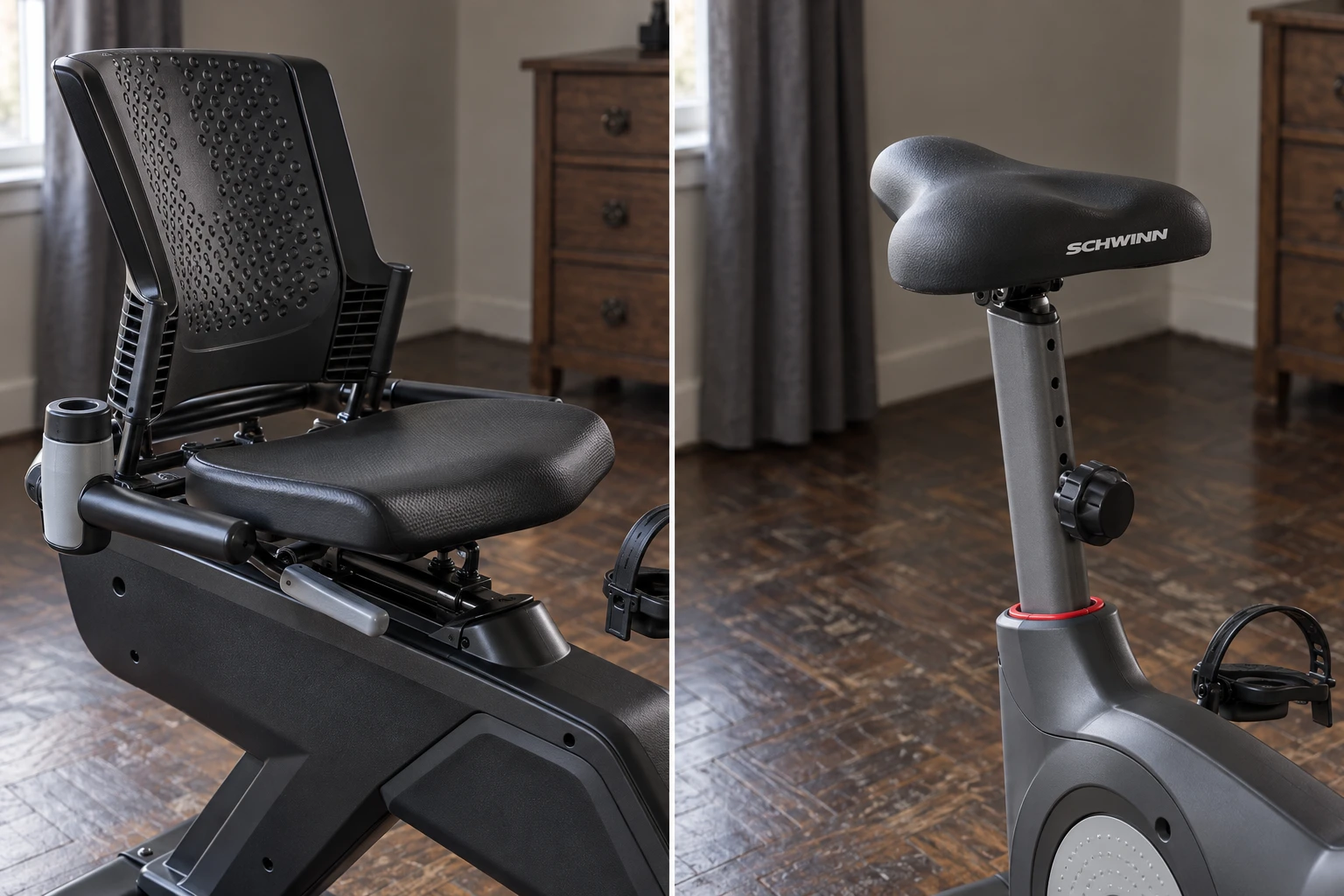
For example, the Schwinn 290 manual calls for a slight knee bend with the pedal forward. Its seat moves toward the pedals when you cannot reach comfortably and away when the knee is too bent. It also says to step off before adjusting and engage the seat lock fully. Follow your own model’s adjustment instructions. On the YOSUDA recumbent exercise bike, for instance, the seat is held by a pin and a tightening knob, so check both after every change.
Before choosing a bike, check these five practical tasks:
- Sit and stand up. Check seat height, the frame you step over, and the support you can actually reach.
- Turn the pedals slowly. Look for comfortable reach through the whole circle, without stretching to keep a foot on the pedal.
- Reach the controls and pedal straps. Check that you can use them without an awkward twist or forward reach.
- Try the starting resistance. The easiest setting needs to be usable, as well as the harder settings challenging enough.
- Reset the bike for another user. Check whether the shortest and tallest people in the household can adjust it and lock it securely.
When comparing an exercise bike for seniors, give entry, exit, and control access more weight than the age label on a listing. A low seat can be difficult to rise from even when it feels supportive during the ride. Check that part of the trial as carefully as pedaling.
The exercise bikes for seniors shortlist applies those access checks to three specific recumbent models.
Compare Space and the Full Cost
An upright is usually the better starting point when you need a compact exercise bike. Recumbents often have a longer frame because the seat sits behind the pedals. Compare the actual dimensions and required operating space before ruling either type out.
Our foldable exercise bike guide checks open space, stored dimensions and the route between them.
The Schwinn 130 and 290 give a concrete example from models already in our catalog. These figures come from the manufacturer’s US listings, checked October 14, 2026.
Two Home Bike Examples
| Check | Schwinn 130 upright | Schwinn 290 recumbent |
|---|---|---|
| Frame, L × W | 41.3 × 21.4 in | 66.4 × 28 in |
| Machine weight | 58.4 lb | 107.6 lb |
| User limit | 300 lb | 330 lb |
| Listed price | $399 | $799 |
In this pair, the 290 is longer, heavier, and more expensive. That shows why the exact model matters; it is not a price rule for all recumbents and uprights. Add space for getting on, seat adjustment, and the clearance specified by the manual.
Mark the frame on your floor plan, then add the clearance required by its manual. Check door swings, the path to the seat, and the delivery route. Transport wheels do not solve stairs or narrow doorways. Our home gym essentials guide helps plan equipment around the space you use for training.
Compare delivered cost, power, and repair access before paying for a screen. Both example models use wall power and offer built-in workout programs, while connected apps require separate subscriptions. Plan the cable route and check which features need a membership.
Add taxes, assembly or delivery help, floor protection, and any membership you will use. Ask about replacement parts, labor, and return freight. If you cannot try the bike locally, find out whether the seller accepts returns after assembly and use, and what you would pay to send it back. Follow that model’s maintenance instructions.
FAQs
Is a Recumbent Bike a Stationary Bike?
Yes, an indoor recumbent bike is a type of stationary exercise bike. Upright indoor bikes are stationary bikes too; the word “stationary” does not mean the bike has an upright saddle.
Is a Recumbent Bike Good for Seniors?
A recumbent bike can suit an older rider when its fit and access work for that person. Check pedal and control reach and the ability to stand from the seat, since a backrest and wider seat do not establish suitable seat height or access.
Can I Stand on an Upright Exercise Bike?
Stand on an upright exercise bike only if that exact model's instructions permit it. For standing intervals, compare indoor cycling models designed for that use instead of assuming an ordinary upright supports the same riding style.
What Is the Main Disadvantage of a Recumbent Bike?
A recumbent bike's longer frame can be harder to fit into a small room, although the actual model determines the space needed. Its seated, supported position may also rule it out when you want standing cycling intervals.
Can I Make an Upright Bike Seat More Comfortable?
Better fit or a compatible replacement saddle may make an upright bike more comfortable. Check seat position and handlebar reach before adding padding, follow the manufacturer's replacement-part rules, and seek assessment for persistent pain.
Is a Recumbent Bike as Good as a Spin Bike?
A recumbent bike can be a useful alternative to a spin bike for seated cardio. Choose the position and sessions that suit you, allowing for the spin bike's different posture and standing work only when its manual permits it.
Try the Position Before Choosing the Bike
Before ordering, try both types if you can. Set the seat for your reach, begin at an easy resistance, and check whether you can pedal comfortably while using the controls. Include getting on and off in the trial, especially if that is one reason you want a supported seat.
Rule out a bike that fails fit, access or required room clearance. If both pass, choose recumbent when usable back support is the priority; choose upright when its riding position suits you and the exact model's shorter frame solves the room constraint. A smaller bike earns no saving if its reach or saddle ends your rides.
Compare our exercise bike shortlist once you have chosen a riding position.
If you already have an upright you enjoy using, identify the problem a recumbent would solve before buying another bike. For a new purchase, bring your room measurements and test the adjustments for anyone sharing it. Confirm the user limit, required clearance, and return conditions. If neither position works comfortably, pause the purchase and try another cardio option.
This guide is for education and equipment selection, not individual medical advice. If you have an existing condition or are recovering from an injury, ask your healthcare provider or physical therapist about suitable exercise and setup.
References
- Prieto-González P, Yagin FH. Energy expenditure, oxygen consumption, and heart rate while exercising on seven different indoor cardio machines at maximum and self-selected submaximal intensity. Front Sports Act Living. 2024;6:1313886. doi:10.3389/fspor.2024.1313886.
- Lopes AD, Alouche SR, Hakansson N, Cohen M. Electromyography during pedaling on upright and recumbent ergometer. Int J Sports Phys Ther. 2014;9(1):76-81.