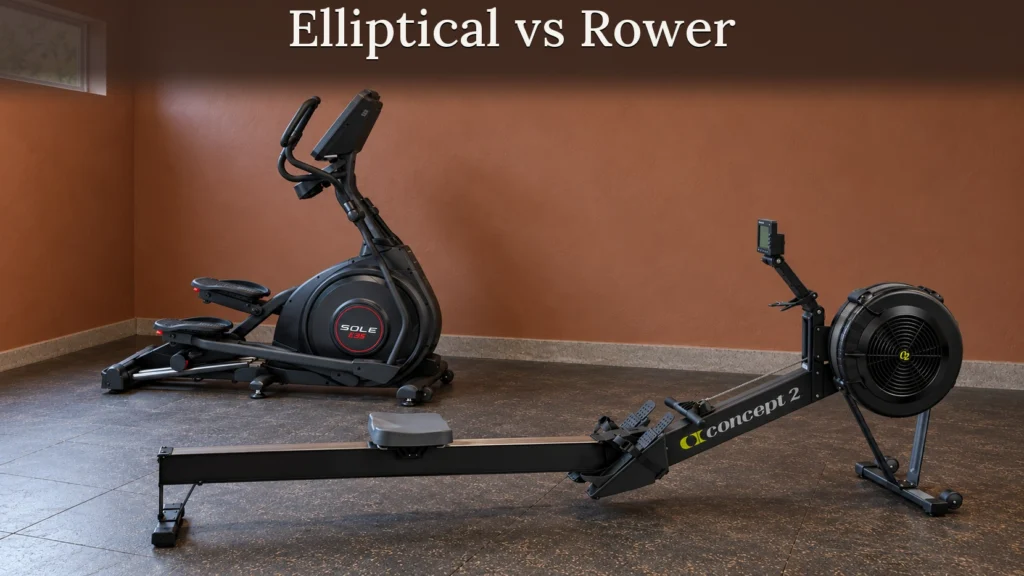
Elliptical vs Rowing Machine: Movement, Effort, and Home Fit

Founder
I founded HomieGym to help you make informed decisions about training at home. My background includes university-level sports science education, practical coaching, gym training and combat sports.
The elliptical vs rowing machine choice starts with the movement you want to repeat: continuous standing strides or seated strokes with a drive and recovery. I favor the elliptical when you want to settle into a steady rhythm with fewer sequencing demands. A rower earns its place when you enjoy coordinating a stroke and want that skill to be part of your cardio.
Choose the movement before comparing calorie displays. The better match lets you train at an appropriate effort, move comfortably, and use the room without rearranging your home before every session.
Table of Contents
Elliptical vs Rowing Machine at a Glance
An elliptical guides your feet around a continuous pedal path; a rowing machine combines a sliding seat with a repeated handle pull. This comparison concerns a full-size standing elliptical and a seated rowing ergometer, the indoor machine that simulates rowing. Seated pedal devices and strength-training row machines serve different purposes.
| Decision | Standing elliptical | Rowing machine |
|---|---|---|
| Movement | Continuous guided strides | Drive followed by recovery |
| Body position | Standing on raised pedals | Seated, with repeated knee and hip bending |
| Arm task | Push and pull if moving handles are fitted | Control the handle through each stroke |
| Early learning | Find a comfortable stride and rhythm | Learn timing between legs, trunk, and arms |
| Room check | Pedal travel, handle travel, and headroom | Full slide, body travel, and access beside the seat |
| Storage | Check the exact model's permitted configuration | Folding or separation varies by model |
The elliptical is a reasonable first trial if continuous movement appeals to you. The rower is worth trying if a repeated push, pull, and return sounds more engaging. Being seated does not make rowing effortless or remove the need for balance and trunk control. Getting down to the seat and back up also needs to work for you.
Both can involve the lower and upper body, but they distribute that work differently. For the broader training value of the standing machine, the elliptical benefits guide explains what it can add alongside other exercise.
Continuous Strides or a Stroke to Learn?
The elliptical usually asks you to learn a repeating rhythm; rowing asks you to coordinate distinct parts of each stroke. On the elliptical, the linked pedals keep the movement cycling. On a rower, you produce the drive and then control your return before the next effort. The recovery is part of the movement, rather than a reason to let the seat rush forward.
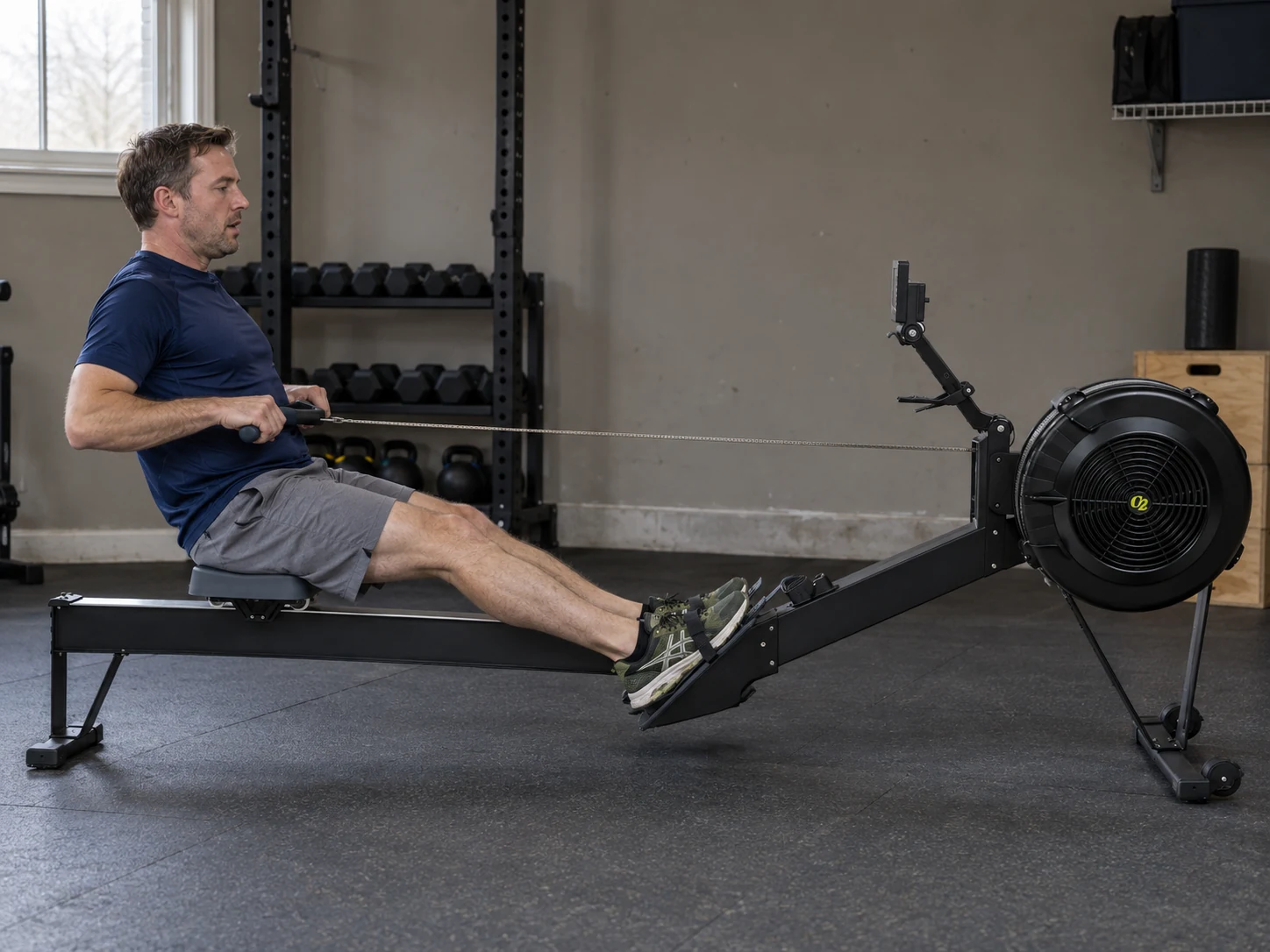
Learning the rowing sequence can be enjoyable, especially if you like having a skill to improve. It can also occupy most of your attention at first. I give the elliptical the edge for someone who wants a simpler movement to settle into after work, provided its stride and standing position fit. Someone who enjoys practicing coordination may prefer the rower even while keeping the effort easy.
Check how each handles a small increase in effort. An elliptical stride should stay controlled when you pedal a little faster or raise resistance. With rowing, watch whether you can increase the work without turning every stroke into an early arm pull or a hurried slide. A setting you can move does not necessarily give you a movement you can repeat well.
If rowing appeals but the order feels confusing, use the rowing setup and form guide for the complete lesson. A short comparison cannot replace that practice, and a confusing first attempt alone does not establish that you cannot learn the stroke.
Which Gives You Better Cardio and Burns More Calories?
Either machine can provide demanding cardio; neither burns more calories in every real session. Effort and duration change the comparison. A rower used hard and an elliptical used gently are different workouts, even if both consoles label the session as cardio.
A 2024 study compared seven machines in 30 recreationally active men aged 35 to 49 who had extensive indoor cardio experience. They completed 12-minute bouts at very hard perceived effort and maximum effort. The elliptical produced higher reported average energy expenditure than the rower in these tests. Researchers calculated expenditure from respiratory measurements. (1)
That finding describes a demanding laboratory comparison, not your expected calorie total. One model represented each activity, the participants were experienced men, and the study did not measure long-term weight loss. I would not make a beginner choose an uncomfortable elliptical stride to reproduce that ranking.
For a useful personal comparison, start easily on both and gradually reach an effort you can sustain while keeping the movement controlled. Notice whether breathing or a local limitation stops you first. If your grip tires while your breathing remains easy, that rowing session may be limited by the handle task before it becomes the cardio session you intended. An awkward elliptical stride can create a similar mismatch.
When comparing an elliptical vs rowing machine for weight loss, prioritize the activity you can include regularly and consider food intake alongside exercise. Neither machine guarantees a calorie deficit. The elliptical weight loss guide covers activity, calorie estimates, and progress without turning this choice into a promised rate of weight change.
Which Movement Fits Your Joints and Back?
Neither machine is automatically better for every knee, hip, or back. Both avoid the repeated running landings, but your joints still move under load. An elliptical keeps you standing through a fixed or adjustable stride. Rowing repeatedly bends and extends the knees and hips while your trunk moves with the stroke.
A systematic review of rowing biomechanics included 22 studies with 429 participants. It found that fatigue was associated with greater lower-back bending at the catch, the forward position before the drive. This research concerned rowers and rowing mechanics, not a trial showing that an elliptical is safer for home exercisers. It supports taking deteriorating stroke control seriously rather than extending a session at any cost. (2)
Compare the demands you would live with. On an elliptical, can you stay upright without reaching for the moving handles or feeling forced into an awkward stride? On a rower, can you reach the handle and move through a comfortable stroke without chasing extra length? A seated position only helps if the seat, reach, and movement suit you.
I treat pain as a reason to stop the trial, not as a cue to find a harder setting. Persistent discomfort, an injury, or a condition that changes how you move calls for individual guidance. The more comfortable activity is a useful choice, but comfort alone cannot certify that a machine treats a joint problem.
Fit the Movement Into Your Home
Measure each machine in use before comparing its storage size. A narrow rowing rail still needs length for the full stroke and room beside the seat. A standing elliptical needs space for the pedals and handles throughout their travel, plus clearance above your head while you move.
A rower may fold or separate for storage, but that feature varies by model. Some ellipticals also have storage features. Follow the exact instructions for moving and storing the machine, including whether it may stand upright. A tidy upright product photograph does not establish an approved storage position.
- Mark the operating area. Use the exact model's dimensions and required clearances, then include your moving body and a route for getting on and off.
- Check access. Rehearse stepping onto raised elliptical pedals or sitting down and standing up from the rowing seat, using the intended supports.
- Rehearse storage. Confirm that you can perform the permitted fold, separation, or move and reopen the machine without blocking a doorway.
Sound also depends on the mechanism. Air resistance, magnetic resistance, rollers, pedals, and the floor can all affect what you hear. Compare the actual models at your intended effort if noise would limit when you train. Neither category has a universal quietness advantage.
For a room that also holds weights, the home gym space checklist helps you preserve access and usable training space. Leave that space clear during exercise, including when other people or pets are nearby.
Choose With a Short Movement Trial
Try each movement before committing to the machine. Begin easily, learn the controls, and give yourself enough time to distinguish an unfamiliar motion from one that remains uncomfortable. Rowing deserves a basic technique explanation before you judge it against an elliptical you already know.
My recommendation is an elliptical for someone who enjoys standing cardio and wants a continuous rhythm. Choose the rower when the stroke feels satisfying, the seated access works, and you are willing to practice it. If both fit, let enjoyment and the demands of your other training settle the choice rather than buying the machine with the more impressive console calorie number.
Once you decide, start with the matching guide. The rowing workout options separate steady sessions from intervals so that your next step follows the activity you chose.
If standing strides suited you better, the beginner elliptical workout gives that choice its own starting session. Keep the first sessions manageable while you learn the controls and judge how the activity fits your week.
FAQs
Is an elliptical or rowing machine better for beginners?
An elliptical is often the simpler first trial for a beginner who is comfortable standing. Rowing can also suit beginners, but allow time to learn the stroke before increasing effort.
Does a rower work more muscles than an elliptical?
Both involve several muscle groups, and the contribution changes with your technique and the equipment. Rowing combines leg drive, trunk movement, and pulling; moving elliptical handles add pushing and pulling to the stride. Neither replaces a complete strength program.
Is a rowing machine better for your back because you sit down?
No, sitting on a rower does not automatically make it better for your back. Your trunk still moves through repeated strokes, and your comfort, control, and individual condition affect suitability.
Can I alternate rowing and elliptical sessions?
Yes, you can alternate the two when both movements suit you and the total training load is manageable. Learn each activity at an easy effort and adjust the combined schedule around your other exercise and recovery.
This content is for informational and educational purposes only. It is not a substitute for professional medical advice, diagnosis, or treatment. Consult an appropriate healthcare professional for guidance about an injury or condition that affects your exercise.
References
- Prieto-Gonzalez P, Yagin FH. Energy expenditure, oxygen consumption, and heart rate while exercising on seven different indoor cardio machines at maximum and self-selected submaximal intensity. Front Sports Act Living. 2024;6:1313886. doi:10.3389/fspor.2024.1313886
- Nugent FJ, Vinther A, McGregor A, Thornton JS, Wilkie K, Wilson F. The relationship between rowing-related low back pain and rowing biomechanics: a systematic review. Br J Sports Med. Published online January 4, 2021. doi:10.1136/bjsports-2020-102533