
Elliptical vs Treadmill: Which Is Better for You?

Founder
I founded HomieGym to help you make informed decisions about training at home. My background includes university-level sports science education, practical coaching, gym training and combat sports.
Equipment editor on our team: Milutin Tucakov
The choice between an elliptical and a treadmill comes down to the movement you want to practice, how comfortably you can train, and what fits your home. I favor a treadmill for a walking or running goal and an elliptical when you want standing cardio without repeated running landings. Weight loss alone does not give either machine an automatic advantage.
An easy treadmill walk, a hard run, and a demanding elliptical session ask different things of your body. I compare the workout I would use regularly before comparing calorie estimates or extra features.
Table of Contents
Elliptical vs Treadmill at a Glance
The main difference is the movement: a treadmill lets you walk or run; an elliptical guides your feet through a pedal path. For general cardio, both give you ways to adjust the effort.
Which Machine Fits Your Goal?
| Priority | Treadmill | Elliptical |
|---|---|---|
| Walk or run | Practice actual walking or running steps. | Guided pedaling offers a different movement. |
| General cardio | Adjust speed and available incline. | Adjust pedaling pace and resistance. |
| Impact | Walking and running have different demands. | Feet stay on supported pedals. |
| Arm movement | Arms swing naturally unless you hold supports. | Moving handles allow active pushing and pulling. |
| Home fit | Check operating area, belt fit, and storage. | Check pedal travel, stride fit, and headroom. |
A treadmill's belt moves beneath you while you take steps. On a standing elliptical, your feet stay on two platforms throughout the stride. Moving handles, when fitted, let you add an active push and pull with your arms.
A seated under-desk pedal device does not provide the same workout as a full-size standing elliptical. A walking-only pad cannot meet a running goal; our walking pad buying guide compares belt fit, controls, and storage for that use. Compare the actual equipment you are considering, including its intended use.
Which Machine Fits Your Cardio Goal?
Both machines can provide aerobic exercise, which is sustained activity that raises your breathing and heart rate. A treadmill lets you practice walking and running; an elliptical offers a different movement pattern, sometimes with active arm work. Mayo Clinic's comparison favors a treadmill for preparing for a running event.
If a 5K is your goal, I would choose the treadmill because you need to practice running steps and pacing. An elliptical can add cardio on days when you want a break from running, but you still need running practice for the race.
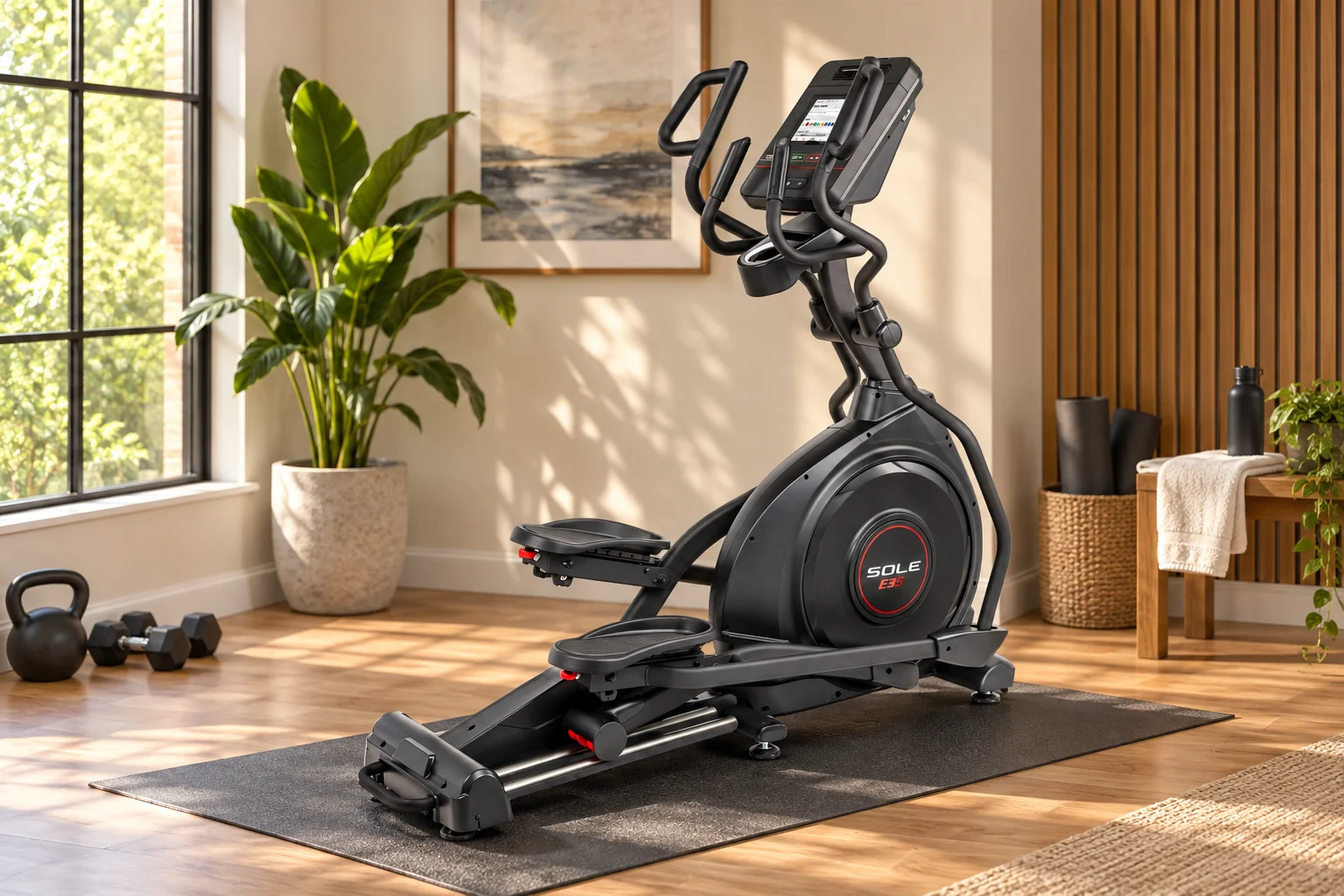
For general fitness, the effort you can sustain matters more than copying someone else's console settings. Use the talk test: at moderate effort you can talk but not sing; at vigorous effort you can manage only a few words before pausing for breath. Those are CDC guidelines for judging relative intensity.
On a treadmill, you adjust speed and, if available, incline. On an elliptical, you change resistance and cadence, meaning how quickly you pedal; some models also have an adjustable ramp. I would use breathing and movement control to judge the effort, since resistance level 5 can feel different on two machines.
Once you choose the movement, use a plan that suits it. The treadmill workout guide separates walking, incline, and running options. The beginner elliptical workout gives you a starting session and ways to adjust the effort.
What Burns More Calories, a Treadmill or an Elliptical?
Neither machine burns more calories in every comparison. Effort, duration, and the person exercising affect the result. A hard treadmill run can demand more energy than easy elliptical pedaling, while a demanding elliptical session can exceed an easy treadmill walk.
What the Direct Comparisons Found
In a 2010 study, 18 untrained college-aged adults completed separate 15-minute treadmill and elliptical sessions at a similar moderate perceived effort. Energy expenditure was similar, although heart rate was higher on the elliptical. That higher heart rate did not mean more calories were burned in this experiment (1).
A 2024 study found higher energy expenditure on the treadmill than the elliptical during very hard and maximal exercise. It involved 30 recreationally active men aged 35 to 49 who were familiar with indoor cardio equipment. Those results describe demanding laboratory bouts in that group, rather than a typical beginner workout (2).
For me, these results rule out choosing by the machine name alone. Similar moderate sessions produced similar energy use in one study; the treadmill came out ahead during much harder work in another. Neither study tested weight loss over months.
A 30-Minute Calorie Estimate
The 2024 Adult Compendium lists reference energy costs for treadmill walking, running, and elliptical exercise. These estimates assume a person weighing 154 pounds, or 70 kilograms. A 0% grade means a level belt. The running row is a general running category, not a treadmill-specific measurement; none of the rows represents a matched-effort comparison.
Reference Calories in 30 Minutes at 154 Pounds
| Activity | MET | Calories |
|---|---|---|
| Treadmill walk 2.5 to 2.9 mph, 0% grade |
3.5 | 125 |
| Treadmill walk 3.5 to 3.9 mph, 0% grade |
4.8 | 170 |
| Running 5.0 to 5.2 mph, general reference |
8.5 | 300 |
| Elliptical Moderate effort |
5.0 | 175 |
| Elliptical Vigorous effort |
9.0 | 315 |
A MET, or metabolic equivalent, describes energy use relative to resting. I calculated these estimates as MET × 70 kilograms × half an hour, using the Compendium's definition of one MET as one calorie per kilogram per hour, then rounded to the nearest five calories. They include resting energy use during that time.
These references put moderate elliptical work near brisk treadmill walking and below running at the listed pace. Your own expenditure can differ from these estimates and the console display.
Elliptical or Treadmill for Weight Loss
Either machine can support weight loss by adding activity and helping you use more energy. Weight loss still requires an overall calorie deficit, where you use more energy than you take in. CDC guidance connects physical activity and food intake with that balance.
I would choose the machine that lets you complete regular sessions without dreading the movement or having to stop because it hurts. Enjoyable walking may be a better choice for you than elliptical training you avoid, even if a reference table gives the latter a higher calorie estimate.
For overall adult health, CDC recommends at least 150 minutes of moderate aerobic activity or 75 minutes of vigorous activity per week, or an equivalent combination. That is a health guideline, not a guaranteed weight-loss dose; the amount needed for weight management varies.
If you can usually fit in only a short session, plan around that time instead of waiting for a full half-hour to become available. A shorter walk or elliptical session gives you activity you would otherwise miss.
Can Either Machine Target Belly Fat?
No. I would not choose either machine as a way to target belly fat. A 2022 meta-analysis of 13 localized limb-training studies found no preferential fat reduction in the trained limb (3). That is broader evidence about spot reduction, not a direct test of abdominal fat loss on these two machines.
Both can contribute to activity that supports overall fat loss. There is no basis in these comparisons for promising that a particular incline or resistance setting will take fat specifically from your waist. Choose the session for its effort and comfort, and assess weight management across your whole routine.
Which Is Better for Your Knees?
An elliptical can reduce repeated impact compared with treadmill running, but it is not automatically better than treadmill walking for your knees. Mayo Clinic describes walking as producing about the same force as elliptical exercise. Pain or a known knee condition needs an individual answer.
Low impact here describes the absence of repeated running landings: your feet stay on the pedals. Your knees still bend and your legs still apply force. It does not mean that a particular stride, resistance setting, or range of motion will feel good for you.
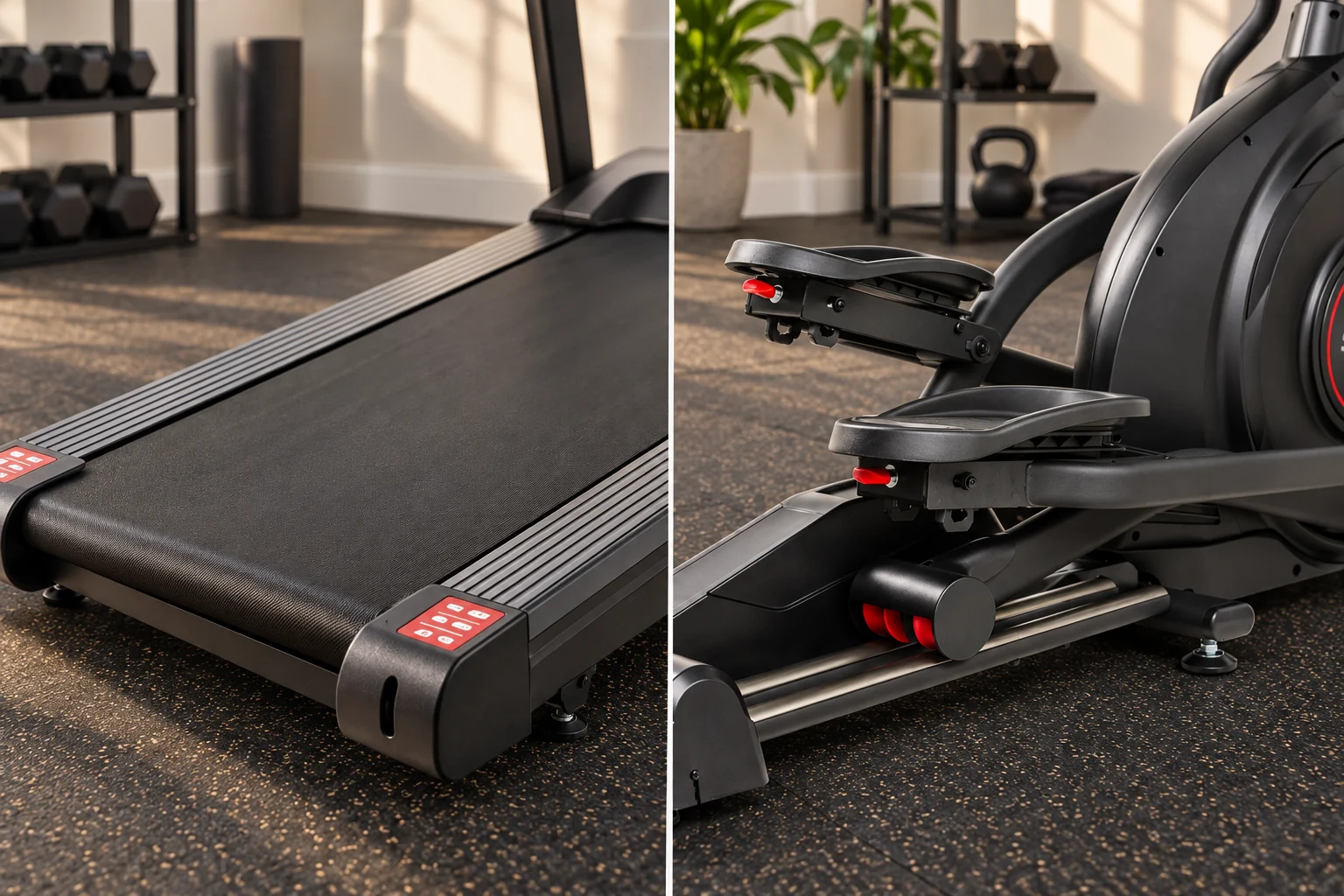
I would compare an easy treadmill walk with easy elliptical movement before assuming that the elliptical wins. A stride that feels too long or forces an awkward position is a reason to try a different model or activity. Increasing resistance or incline is not a remedy for discomfort.
If exercise makes knee pain worse, causes a limp, or changes how you move, stop that activity and seek medical guidance. For a known injury or recurring pain, a clinician or physical therapist can help you choose an appropriate movement and amount of work based on the cause.
What Muscles Do the Two Machines Work?
Both machines involve the quadriceps at the front of the thighs, hamstrings at the back, glutes around the hips, and lower-leg muscles. An elliptical with moving handles also lets you push and pull with your arms. I treat that as additional muscle involvement, not a complete strength program.
A laboratory study of 20 adults compared four elliptical designs with walking (4). It measured EMG, electrical activity in muscles. The findings below describe muscle activity during those sessions, not long-term muscle growth or a comparison with running.
Leg Muscle Activity in the Walking Comparison
| Muscles | Elliptical vs Walking |
|---|---|
| Main glute and outer-thigh quadriceps | Higher activity. |
| Inner hamstrings, calves, and front of lower leg | Lower activity. |
| Side glutes and outer hamstrings | Similar activity. |
I would not read the higher thigh and glute activity as proof that an elliptical builds more muscle. Other muscles showed lower activity, and the study did not quantify the arms' contribution. For a strength goal, I would choose exercises whose resistance I can increase as I get stronger.
Keep muscle-strengthening work in your week as well. CDC recommends at least two days alongside aerobic activity. Choose strength exercises based on the muscles and movements your cardio sessions do not adequately train.
For strength sessions alongside either cardio machine, follow the full-body dumbbell routine.
If you want to use a cable station for some of that work, the cable machine exercise guide covers rows, presses, and other options. Choose movements you can control and progress, rather than counting moving elliptical handles as a substitute for every upper-body exercise.
Space, Stride Fit, and Cost at Home
For home use, compare operating space, comfortable fit, and total cost for the exact models you are considering. I would rule out a machine that blocks the room or forces an awkward stride before comparing its screen or workout programs.
Floor Space and Ceiling Height
Mark the proposed position on the floor, then add the operating clearance required by the model's manual. Include a route for getting on and off, the space behind a treadmill, and the full travel of elliptical pedals and handles. Keep that area free of furniture, pets, and children while exercising.
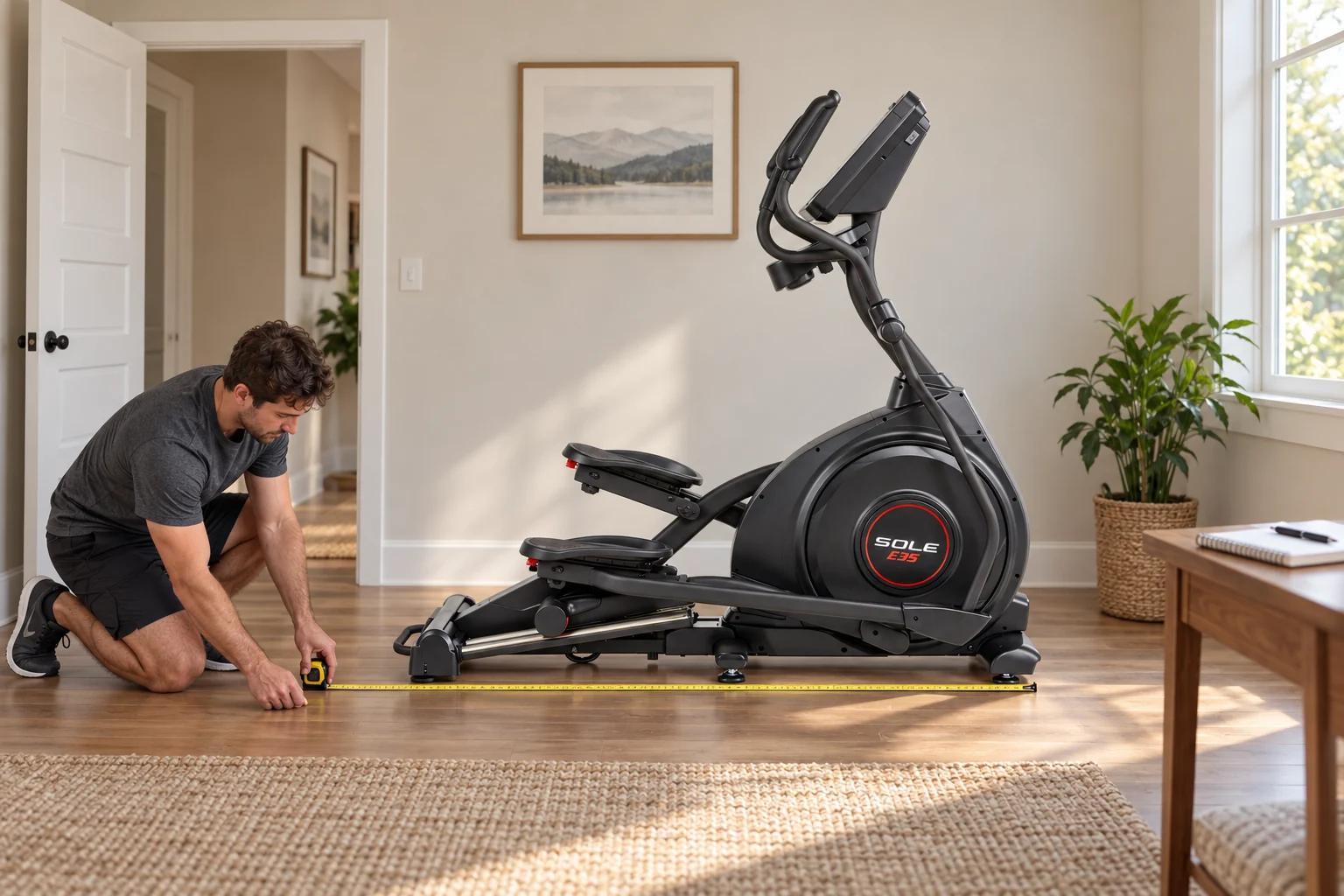
A folding treadmill may reduce its storage footprint, but it still needs its full operating area when unfolded. A full-size elliptical can have a long base even when its console looks narrow. I would also check the delivery route, stairs, doorways, and whether the floor can accommodate the machine.
For ceiling height, account for where your head will be while standing on the equipment. Check your standing height plus the highest pedal position on an elliptical, or the belt height at the incline you plan to use. Then allow the headroom required by the manufacturer's guidance. The console's height does not tell you whether your head will clear the ceiling.
Stride and Control Fit
An elliptical's guided path needs to feel comfortable at an easy pace. Check that you can keep a steady stance without reaching excessively for the moving handles or feeling forced into an awkward stride. Compare elliptical models for stride adjustments; do not assume every machine has them.
For a treadmill, look at the usable belt and the intended walking or running use. Test whether you can reach the controls without disrupting your steps. Learn the stop procedure and use the safety key as the manual directs before trying a workout.
Total Cost, Noise, and Maintenance
Compare the purchase price together with delivery, assembly, any optional subscription, and servicing. Check the warranty's labor and parts terms. I would pay for a comfortable movement and appropriate operating limits before paying for a screen that leaves the underlying machine unsuitable.
Illustrative prices, not current quotes: for two machines that fit you and cover the same general-cardio sessions, a $1,200 treadmill plus $200 delivery and $100 assembly totals $1,500. A $1,350 elliptical with delivery included and $100 assembly totals $1,450. The treadmill's $150 sticker advantage becomes a $50 higher setup cost. With neither paid app selected, these are the known purchase subtotals over the same three years; electricity and servicing still need estimates. If both movements suit you equally, the elliptical saves $50. Running practice would still favor a suitable treadmill.
Noise also depends on the model, the workout, and the building. Treadmill footfalls and elliptical moving parts can transmit sound or vibration, so a quiet showroom does not tell you what a downstairs room will hear. If noise matters, test the machine at your intended pace and consider the floor beneath it.
Check each manual for cleaning, belt care, lubrication, and inspection requirements; do not assume one routine applies to both categories. The home gym essentials guide can help you weigh a cardio machine against the room and other equipment your training needs.
Choose the Machine You Can Train On Consistently
If both machines suit your goal, try the kind of session you expect to repeat at home. A brief sprint or a few easy pedal strokes will tell you less than a trial at your intended steady effort.
If you can try both machines, use this short comparison:
- Start at an easy effort. Learn each machine's controls and stop procedure, then check your stance and movement.
- Try a manageable steady pace. Compare breathing, comfort, and whether you can keep going without leaning heavily on the handles.
- Check the home setup. Confirm the operating space, headroom, delivery route, and cost for the model you would actually use.
Choose the treadmill if running practice is the reason you are buying. For general cardio, choose the machine that passes the movement and home checks, then start with its workout guide. If neither feels comfortable, try another cardio option before buying.
FAQs
Is an elliptical better than a treadmill?
No, an elliptical is not better for every goal. It can suit guided cardio without running landings, while a treadmill is the more direct choice for practicing walking or running. If you would rather compare it with seated cardio, see my elliptical vs exercise bike guide.
Is walking better than using an elliptical?
Walking is better if walking itself is your training goal or the more comfortable activity. Elliptical exercise can also provide aerobic work; neither is automatically superior for everyone.
Is an elliptical or a treadmill better for weight loss?
Neither an elliptical nor a treadmill has a universal weight-loss advantage. Choose the activity you can perform regularly at a manageable effort, and consider food intake alongside your exercise routine.
Does an elliptical build muscle?
Elliptical exercise makes muscles work, but it does not guarantee muscle growth. Growth depends on the training stimulus and your starting point, so include progressive strength training if gaining muscle is a main goal.
References
- Brown GA, Cook CM, Krueger RD, Heelan KA. Comparison of energy expenditure on a treadmill vs. an elliptical device at a self-selected exercise intensity. J Strength Cond Res. 2010;24(6):1643-1649. doi:10.1519/JSC.0b013e3181cb2854. Accessed October 11, 2026. Read source
- Prieto-González P, Yagin FH. Energy expenditure, oxygen consumption, and heart rate while exercising on seven different indoor cardio machines at maximum and self-selected submaximal intensity. Front Sports Act Living. 2024;6:1313886. doi:10.3389/fspor.2024.1313886. Accessed October 11, 2026. Read source
- Ramirez-Campillo R, Andrade DC, Clemente FM, Afonso J, Pérez-Castilla A, Gentil P. A proposed model to test the hypothesis of exercise-induced localized fat reduction (spot reduction), including a systematic review with meta-analysis. Hum Mov. 2022;23(3):1-14. doi:10.5114/hm.2022.110373. Accessed October 11, 2026. Read source
- Burnfield JM, Shu Y, Buster T, Taylor A. Similarity of joint kinematics and muscle demands between elliptical training and walking: implications for practice. Phys Ther. 2010;90(2):289-305. doi:10.2522/ptj.20090033. Accessed October 11, 2026. Read source