
Power Rack vs Squat Rack: Which Fits Your Home Gym?

Founder
I founded HomieGym to help you make informed decisions about training at home. My background includes university-level sports science education, practical coaching, gym training and combat sports.
Equipment editor on our team: Milutin Tucakov
Compare full power cages, open squat stands and half racks by catch setup, usable space, mounting requirements and the complete purchase.
Power rack vs squat rack is a choice about how you want to lift in the room you have. A full cage gives you a place to squat and bench between its posts, while an open stand puts the lift in front. That difference can matter more than how compact either frame looks in a product photo.
For solo squats and bench presses, I would start with a full cage whose safeties suit your lifting position. This comparison explains when an open stand or half rack makes more sense, and how to compare the space and complete purchase each requires.
Table of Contents
Power Rack vs Squat Rack at a Glance
A full power rack gives you an enclosed working area; an open stand places the main lifting area in front of its uprights. A half rack sits between those layouts, usually adding rear supports or storage while keeping the main lifting position in front. None of those names establishes which safeties are included or whether the rack needs anchoring.
| Decision | Full power rack | Open squat stand | Half rack |
|---|---|---|---|
| Where you lift | Usually between front and rear posts | In front of two uprights | Usually in front of the main uprights |
| Catch system to check | Compatible internal bars, pins or straps | Compatible front spotter arms, if approved | Approved arms or another model-specific arrangement |
| Space question | Can the bench and your movement fit inside? | Can the bar and arms fit in front? | Will rear storage or supports obstruct the room? |
| Best reason to choose it | You want a dedicated area for barbell work inside the cage | You need an open lifting layout and the complete stand suits your lifts | You want an open front plus integrated support or storage |
| Common buying mistake | Assuming safeties are included | Assuming an open frame uses less floor space | Assuming short rear catches protect a lift performed in front |
I would settle the catch position first. If the bar could miss the end of the arms or land outside the internal safeties during your planned lift, a smaller footprint or attractive accessory package does not fix that mismatch. The rest of the comparison follows from where you will actually stand or lie.
What the Different Rack Frames Mean
Look at the posts and crossmembers to identify the layout. A full power cage has front and rear uprights connected around the working area. Its J-cups hold the bar at the start and finish of a set; a separate catch system spans the space where you lift. Check the parts list, because a frame-only package may leave that system to a separate purchase.
Review the parts of a power rack if the package leaves the support and catch components unclear.

An open squat stand uses two main uprights, often joined by a base and a pull-up bar. Separate independent squat stands are another design again: their installation and permitted use depend on their own instructions. An open top can make standing presses easier to arrange, but the room still needs enough ceiling clearance for you, the bar and its plates.
A half rack may have four posts in the photograph while still placing the working bar in front. Rogue's HR-2, for example, adds rear uprights and short connecting members to an open-front design. Its optional short pin-and-pipe safeties and its front spotter-arm options serve different positions. Count the working space, not just the posts.
Folding describes a storage mechanism rather than a catch system. A folding wall rack may open into a two-upright lifting station, while a freestanding full cage may remain assembled permanently. If you are browsing HomieGym's power racks or squat racks, use those categories to find candidates, then inspect each configuration.
Which Layout Makes More Sense for Solo Lifting?
I favor a full cage for solo barbell squats and bench presses when the lifter and bench fit properly between its safeties. The internal catch system provides a defined place to set the bar if a repetition cannot be completed. It still has to be compatible, installed correctly and positioned for that particular exercise.
J-cups do a different job. They support the bar before and after a lift; they do not replace the catches below its movement. Rogue's SML-2 stand illustrates why the package matters: the manufacturer includes J-cups, while the SAML-24 front spotter arms are a separate option. Its RML-390F full cage includes pin-and-pipe safeties.

With an open stand, check that the approved spotter arms extend beneath the relevant bar path. With a full cage, check the internal depth and the available height settings. For bench pressing, the bench must reach a position that allows an unrack without placing the bar beyond the catches. Test the arrangement with an unloaded bar before adding training weight; a difficult unrack or an unusable safety height calls for a different setup.
For the bench press, confirm that a normal repetition clears the catches and that the bar can rest on them clear of your chest, head and neck when you relax your pressing position. If the available settings cannot achieve both, change the bench or catch arrangement before lifting.
A frame's advertised capacity also does not automatically rate every hook, arm or strap attached to it. Read each component's instructions and limits. I would not rank two racks for solo lifting by comparing the largest number on their sales pages while leaving the catch system out of the decision.
Does a Squat Stand Really Save Space?
An open stand can save space, but its frame shape alone does not prove it. The Rogue SML-2 squat stand has a 49-by-48-inch footprint. The RML-390F full cage and HR-2 half rack list the same two floor dimensions in the opposite order. These specific models occupy the same rectangular base area even though their working layouts differ.
The more useful measurement is the working area. Add the bar's total length, room to load its sleeves, the bench's full position and your route in and out. An open-front lift moves work into the space ahead of the stand. Rear plate storage moves part of the installation behind the working uprights. Neither extension disappears from the room because it lies outside the advertised base.
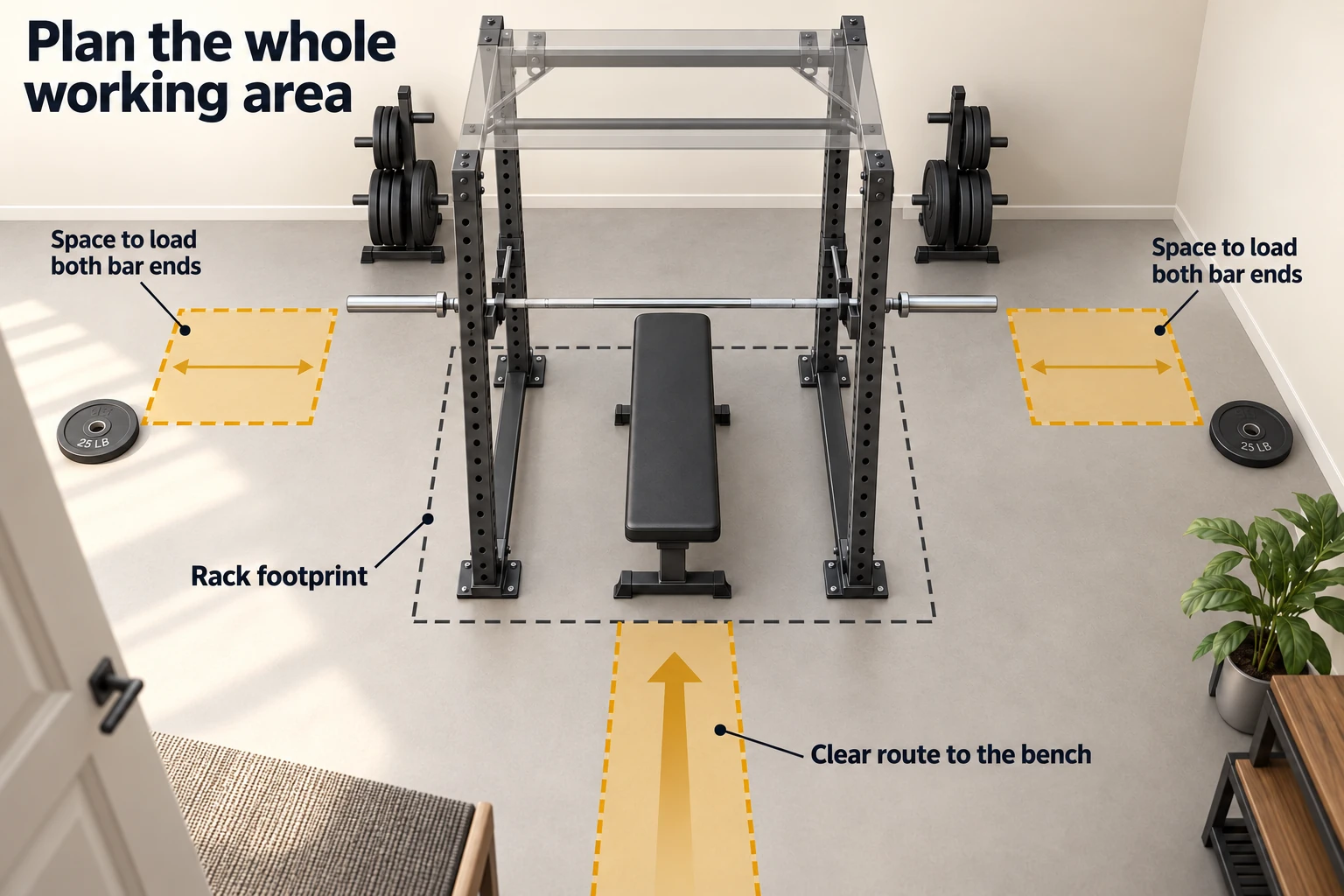
Mark the proposed base on the floor with tape, then lay out the bar and bench positions around it. Open nearby doors and check storage access. For height, measure under beams, garage-door tracks, lights or fans, then check the highest part of the planned movement. A rack fitting below the ceiling does not establish that your head will clear it during a pull-up.
Decide whether the equipment must move after each session. A folding rack may reclaim useful space, but you still need somewhere to put the bench, bar and plates. I would map that storage before choosing a folding design for a room that also serves as an office or parking space.
Compare folding bench options if storing the bench is part of reclaiming that room.
Check Anchoring Before Choosing the Frame
Anchoring depends on the exact model, its configuration and the attachments you plan to use. A full cage does not always need floor bolts, and an open stand is not automatically suitable for every freestanding exercise. Start with the current assembly manual and any separate accessory instructions.
Rogue describes the RML-390F's flat-foot base as self-stabilizing without floor anchoring. The same page expressly prohibits Band Pegs and Safety Spotter Arms on that rack. That restriction matters if you imagined using it like an open stand with front catches or adding band resistance later.
REP's current US PR-4000 instructions show how configuration changes the answer. The 41-inch-depth setup with its Rear Base Stabilizer has an anchoring exception, but REP still requires bolting down and Front Foot Extensions when using specified accessories, including Iso Arms and Spotter Arms. An exception for one configuration does not carry across the whole product family.
| Configuration | Condition to retain |
|---|---|
| Rogue RML-390F | No floor bolts; no Band Pegs or Safety Spotter Arms |
| PR-4000, 41-inch depth with Rear Base Stabilizer | Freestanding exception; check attachment rules |
| PR-4000 with Iso Arms, Spotter Arms or Globe Pull-Up Bar | Floor bolts plus Front Foot Extensions required |
If you cannot drill, shortlist models explicitly intended for your freestanding configuration. If the rack requires anchoring, establish whether the floor or wall construction permits the manufacturer's installation before ordering. A rubber mat protects a surface differently from a structural fixing; choose your home gym flooring after resolving the mounting requirements.
Compare the Exercises and Attachments You Will Use
Both layouts can support a barbell-focused home gym when the complete setup suits the lifts. The decision becomes more specific when you add standing presses, pull-ups, plate storage or cable work. Write down those movements before paying for extra posts or an attachment ecosystem.
For a standing overhead press, check the bar's path against crossmembers and the ceiling. For bench pressing, check bench placement, the unrack and the catch settings. For pull-ups, check that a bar is supplied, its installed height and the room above it. A model's exercise list cannot establish whether those movements fit your body and room.

Most rack shopping involves steel uprights, but the nominal tube size is only the beginning of an accessory check. Match the exact model, hole diameter, hole pattern, bracket fit and required span. REP's rack guide separates multiple frame families and attachment options; a part being sold by the same brand does not make it interchangeable across them.
A cage also does not provide cable exercises simply by having space for an attachment. Confirm the pulley unit, usable travel, plate or stack loading, seating position and additional footprint as one system. If independent cable work is the main reason for buying, compare the whole rack package with the options in our home cable machine guide before committing to an expansion.
My Verdict and What to Price Before Buying
Choose a full cage for a dedicated barbell area, an open stand for a suitable open lifting layout, or a half rack when its front working area and rear support or storage solve a real need. I would compare those three uses before comparing finishes, maximum attachment counts or a headline capacity.
Request a complete quote: frame, compatible J-cups and catches, required mounting components, barbell, plates, bench if needed, delivery and assembly. Include the storage needed to keep the working area clear. A bare stand can look less expensive than a cage until its separate arms and other required parts enter the basket.
Illustrative prices, not current quotes: compare two approved squat-and-bench layouts after checking their catches and installation.
| Required purchase | Open stand | Full cage |
|---|---|---|
| Frame and J-cups | $600 | $800 |
| Approved catches | $200 front arms | Included internal safeties |
| Delivery | $100 | $100 |
| Rack subtotal | $900 | $900 |
Add the same $250 bar, $300 matching plates, $30 collars, $200 bench, $20 storage and $100 specified floor protection to either. That shared $900 basket makes both complete stations $1,800 before tax. This assumes no paid assembly or extra mounting work; add either if required. The stand's cheaper frame buys no saving here. At equal totals, I would choose the cage for solo squat-and-bench work when its internal safety positions fit.
For a beginner building the rest of the room too, our home gym essentials guide helps keep the rack purchase in proportion. A suitable cage without the bar, plates or bench your sessions require is still an unfinished gym.
Mark the complete station on the floor and confirm the exact catch and mounting instructions. If both pass, choose the frame that makes your regular sessions easiest to set up. If either fails, move to another configuration before adding accessories.
FAQs
Are a power rack and squat rack the same thing?
Sometimes the names refer to the same full cage, because sellers use “squat rack” broadly. An open squat stand and a full power rack have different working layouts, so check the frame and catch system in the actual listing.
Is a power rack or squat stand better for a beginner?
A full power rack is my starting choice for a beginner planning solo squats and bench presses, provided the bench and lifter fit its compatible safeties. An open stand can also work when its approved catch system, installation and working area suit those lifts.
Can you bench press with a squat stand?
Yes, a squat stand can support bench pressing when its manufacturer permits that setup and the bench, J-cups and approved catches position correctly together. Check the unrack and bar path with an unloaded bar before adding training weight.
What is the difference between a half rack and a full power rack?
A half rack usually places the main lift in front of its uprights, while a full power rack provides an enclosed working area between front and rear posts. Rear supports on a half rack may provide storage or additional connections without creating a full cage-depth lifting area.
Does a squat stand need less room than a power rack?
A squat stand needs less room only when its complete installed layout is smaller for your planned use. Some stands and full cages have identical base footprints; bar loading, front catches, bench placement and access can determine the real difference.
Can you use a power rack without bolting it down?
Yes, some power racks permit freestanding use in specified configurations. Follow the exact model and accessory instructions, because adding an attachment or changing depth can change the anchoring requirement.